
Micro-Climates and Smart Spaces: The Next Frontier in Luxury Home Automation
The traditional definition of a smart home has long been anchored to macro-level convenience. Property owners have grown accustomed to smart security systems that monitor the perimeter, lighting that shifts to match circadian rhythms, and central smart thermostats that regulate entire floors. However, a major architectural shift is currently underway. Luxury residential engineering is moving away from generic ambient regulation toward ultra-precise micro-climate management designed to preserve high-value, organic assets within the home.
As homes become more integrated, high-net-worth property owners are demanding localized climate control systems that treat specialized collections with the same precision as industrial laboratories. By understanding how smart sensors drive digital transformation across modern spaces, innovators are deploying independent, sensor-driven ecosystems optimized for the hyper-specific preservation of fine wines, premium tobacco, and historical artwork. No longer satisfied with basic climate control, these networks utilize real-time data to protect investments from the smallest environmental fluctuations.
The evolution of active asset preservation
For years, the preservation of premium consumables relied entirely on passive insulation. Traditional wine racks and wooden desktop boxes depended heavily on the ambient stability of the room around them. When regional humidity fluctuated or summer heat waves spiked central HVAC systems, these passive barriers frequently failed, causing accelerated aging, structural degradation, or organic spoilage.
The modern response has been a heavy integration of localized appliance networking. In contemporary luxury kitchens and dedicated tasting rooms, high-performance, multi-zone wine coolers have become standard. These units do far more than chill bottles. They utilize advanced vibration-dampening compressors and dynamic carbon filtration networks to eliminate ambient odors and sediment disruption while maintaining strict relative humidity boundaries.
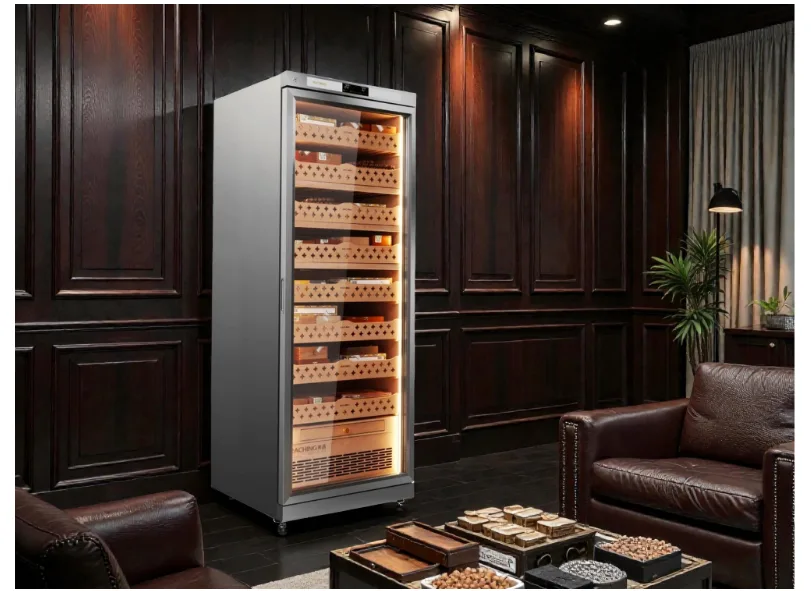
This exact methodology is revolutionizing specialized hobbies. Serious collectors are systematically replacing legacy storage setups with an electric humidor with humidity control linked directly to their primary automation hubs. By utilizing continuous-run inverter compressors rather than standard start-stop cooling elements, these systems prevent the aggressive temperature drops and rapid moisture depletion that ruin delicate wrappers. Managed via low-energy mesh networks like Thread or the Matter protocol, these appliances allow users to receive real-time, push-notification alerts regarding internal water reservoir levels and fan diagnostics, turning a high-maintenance hobby into a set-and-forget automated system.
The mechanics of dual-stage environmental stability
To understand why these micro-enclosures are surging in popularity, it is necessary to examine the core mechanics of thermodynamic stability. Standard residential air conditioning functions on a binary system, meaning it turns on at full capacity until a temperature target is reached and then shuts off completely. This creates a wave-like pattern of temperature peaks and valleys that can be highly destructive to volatile materials.
In contrast, specialized micro-appliances utilize dual-stage thermoelectric modules or variable-speed scroll compressors. According to climate control standards maintained by the American Society of Heating, Refrigerating and Air-Conditioning Engineers (ASHRAE), these systems run almost continuously at ultra-low power levels to maintain a perfectly flat baseline. This engineering approach prevents the sudden drop in relative humidity that naturally occurs when a standard refrigeration coil gets freezing cold. By pairing these precise cooling mechanics with ultrasonic mist transducers, the internal environment remains perfectly balanced, protecting delicate items from the drying effects of traditional refrigeration.
Engineering protective barriers for fine art
This standard for localized micro-climates extends well past consumables and directly onto the walls of modern smart spaces. High-end art collections are uniquely vulnerable to invisible environmental hazards, specifically ultraviolet light waves, chemical off-gassing from architectural materials, and micro-fluctuations in localized moisture.
To mitigate these risks, interior designers and automation integrators are treating art curation like an extension of museum engineering. Galleries are increasingly featuring custom-built enclosures equipped with specialized UV-protected glass and museum-grade archival framing materials designed to filter out up to 99 percent of destructive light wavelengths. Behind these frames, hidden presence-sensing occupancy trackers communicate directly with localized lighting loops. Rather than subjecting delicate oil paintings or rare paper prints to continuous illumination, accent spot fixtures activate exclusively when a viewer enters the room, dimming instantly upon their departure to dramatically extend the lifespan of the pigment.
Decentralized sensor arrays and data logging
The intelligence of these modern preservation systems relies heavily on decentralized sensor arrays. Rather than trusting a single internal thermostat, advanced storage systems deploy multiple digital hygrometers and thermal sensors throughout the entire enclosure to map internal air currents.
These sensors feed data back to a localized microprocessor that constantly calculates the dew point. If a door is left open or an external seal begins to degrade, the system does not just work harder to fix the issue. It cross-references historical data, logs the anomaly, and alerts the homeowner via their primary smart home interface. For alternative asset investors who view their collections as financial portfolios, this continuous data logging provides an unassailable digital ledger proving that their assets have been kept in pristine conditions since the day they were acquired.
Scaling technology into functional architecture
The final step in this micro-climate evolution is the seamless integration of functional hardware with bespoke interior architecture. While standalone electronic appliances work exceptionally well in dedicated utility or kitchen spaces, primary living areas, private offices, and home libraries require solutions that blend into high-end design aesthetics.
This design necessity has fueled a significant increase in custom, integrated architectural fixtures. Industrial designers are now collaborating with smart home integrators to construct full-scale, climate-controlled furniture humidors and built-in gallery alcoves that function as structural statement pieces. These heavy timber cabinets house industrial-grade, commercial HVAC micro-compressors hidden entirely within custom plinths or false backings.
By utilizing multimodal sensing arrays, where touch-capacitive glass doors, hidden humidity sensors, and localized water-line feeds interact autonomously, these structural fixtures maintain flawless internal stasis completely independent of the room’s overarching temperature. The result is a highly functional, secure, and fully automated storage vault that protects valuable physical assets while matching the refined craftsmanship of a luxury home.