
Why Ranking #1 Is No Longer Enough: The Rise of AI Answer Engines
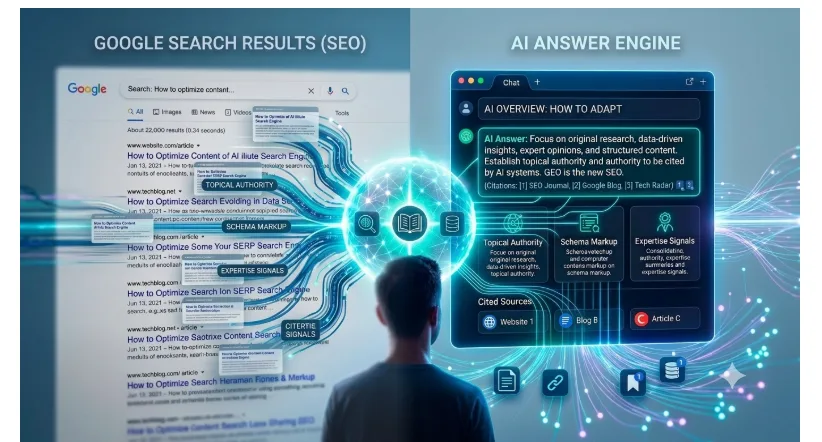
For years, businesses invested heavily in search engine optimization (SEO) with a simple, straightforward goal: rank #1 on Google. Higher rankings guaranteed visibility, traffic, and customers, forming the backbone of digital marketing strategies.
Today, however, the rules of online discovery are shifting. Artificial intelligence is transforming traditional search engines into “answer engines,” where platforms like Google AI Overviews provide direct, synthesized responses.
As a result, users frequently get what they need without clicking a single link accelerating the rise of the “zero-click search.” To remain competitive, businesses must adapt to a reality where being cited by AI matters just as much as traditional rankings.
The Shift From Traffic Distribution to Information Synthesis
Traditional search engines functioned as directories, acting as traffic distributors that sent visitors to relevant web pages. Generative AI fundamentally changes this model by consolidating data from multiple sources directly within the search interface.
For users, this offers unprecedented speed, driven by advanced platforms like OpenAI and Perplexity AI. For publishers, however, it poses a significant challenge. When AI-generated summaries appear above organic results, even the top-ranked websites can experience declining click-through rates.
Conversely, a website that isn’t sitting at position #1 can still gain massive exposure if its insights are trusted and referenced by the AI system itself.
The New Currency: Authority, Trust, and Citations
As answer engines become more sophisticated, they prioritize credibility. AI systems evaluate content quality, accuracy, and depth before presenting it to users. To earn visibility in this environment, brands must pivot toward creating high-value content ecosystems.
According to a recent Search Engine Journal analysis on AI search evolution, traditional keyword matching is being replaced by semantic understanding. To build this authority, brands should focus on publishing original research, data-driven industry insights, expert opinions, and structured educational guides that address specific user intents.
The ultimate objective is no longer just to rank it is to become an authoritative source that AI engines trust enough to reference.
Generative Engine Optimization (GEO) Is the New SEO
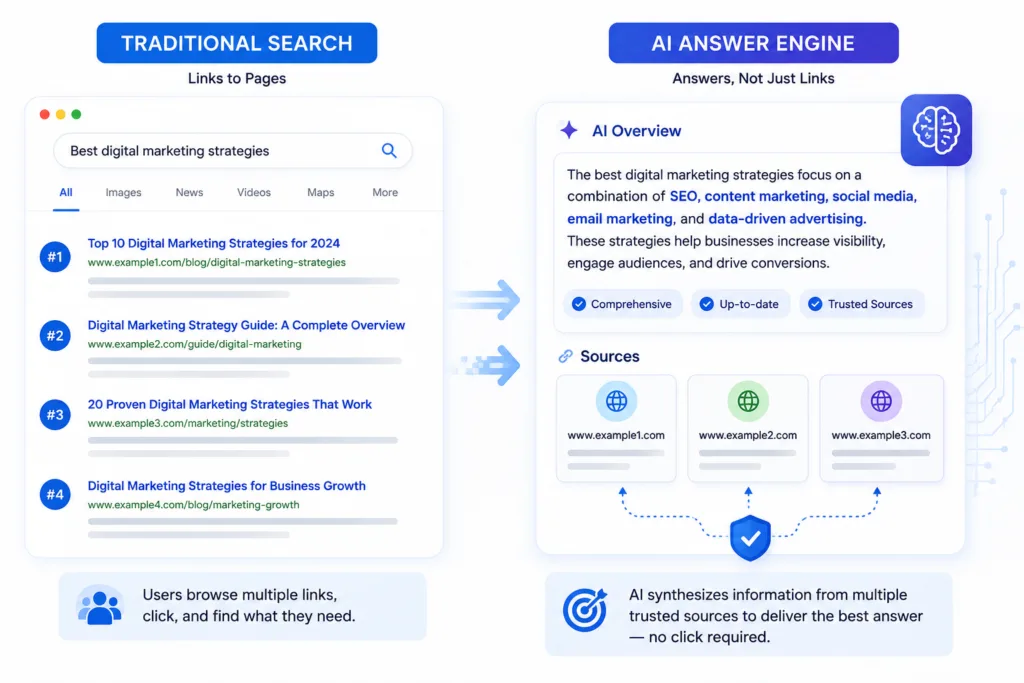
SEO isn’t dying; it is evolving into Generative Engine Optimization (GEO). While foundational SEO mechanics remain critical, adopting proactive future of SEO strategies requires an advanced layer of planning:
- Topical Authority: Building interconnected content hubs rather than writing isolated, keyword-stuffed articles.
- Structured Information: Utilizing logical formatting, clear headings, and schema markup to help AI algorithms parse content efficiently.
- Expertise Signals: Leveraging author credentials, case studies, and first-hand experience to build digital trust.
- Brand Recognition: AI models inherently favor recognized authorities. If you want to future-proof your visibility, hiring an expert digital marketing agency to audit your footprint is essential. Specialized SEO services that focus on semantic optimization can ensure your brand stays integrated into AI-generated response maps.
Measuring Success Beyond the Click
For decades, website traffic was the ultimate KPI. In the AI era, discovery extends far beyond immediate site visits. A user might discover a brand via an AI response, internalize the recommendation, and conduct a branded search days later.
Consequently, forward-thinking businesses must broaden their metrics to include brand mentions, AI citations, direct traffic growth, and lead quality over simple traffic quantity. The future of digital visibility belongs to those who focus on becoming genuinely helpful, authoritative resources.
To win in this new landscape, brands must create content worthy of being chosen, not just found.