
What Makes a Wedding Guest Dress Photo-Ready?
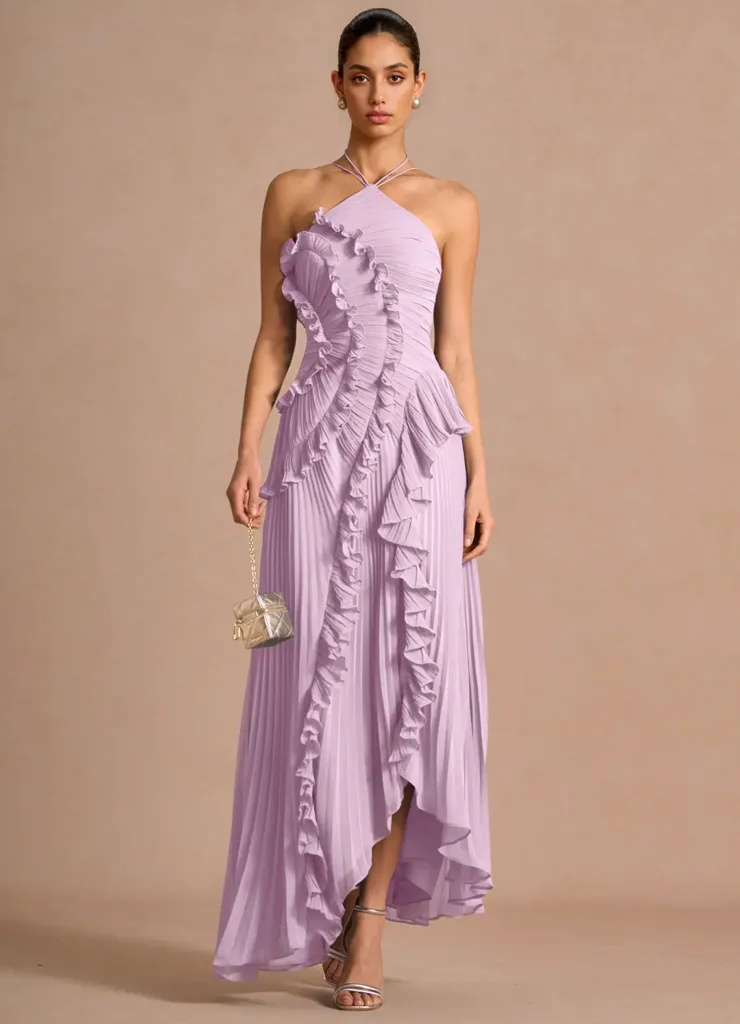
You know the photos. The wedding album goes up on Instagram a week later and there you are. You look… fine? Maybe? But somehow the dress you loved in the mirror that morning is just kind of there in the pictures. Flat. Washed out. Or weirdly shiny. Or somehow a completely different color than you remember.
This happens to almost everyone at least once.
The reason is mostly photography, not fashion. Wedding photographers move through a wild range of light all day. Full sun. Deep hedge shadow. Mixed indoor-outdoor through open doors. Candle-lit dinner. Dance-floor flash. Sometimes all of that within an hour. The dress has to perform in every single one of those conditions.
Some dresses can. Most can’t. Here is what separates the two.
Light Is Doing More Than You Think
Wedding photos happen across a wider range of lighting than almost any other event in your life. Outdoor ceremony in midday sun. Group portraits in deep shade by a hedge. Cocktail hour with the golden hour pouring sideways through the trees. Reception in warm dim tones with the occasional flash burst.
The same dress reads completely differently in each one.
Quick reads on what tends to work in each:
- Bright daylight rewards matte and mid-tone fabrics. Anything close to white tends to blow out and lose detail. Very dark heavy fabrics can flatten and look like a hole in the frame.
- Cloudy or overcast light favors saturated colors. Pale washed-out shades disappear into the gray.
- Mixed indoor-outdoor moments (think tent receptions, doors propped open) need fabric that handles both. Stretch satin and crepe usually win here.
- Warm dim evening light is when jewel tones finally come alive. Satin reads luxurious. Velvet glows in a way it never does by day.
- Flash photography is unforgiving. Anything mirror-shiny or heavily sequined catches every bit of it and reads as costume. Soft sheen and tonal embellishment hold up much better.
First question to ask yourself is when the ceremony actually happens. A 2pm outdoor ceremony is a different lighting brief than a 6pm rooftop one, even if the dress codes are the same.
Fabric Has Its Own Photo Personality
This is the part nobody really talks about. Every fabric has a way it shows up on camera, and it’s not always the same as how it looks in your bathroom mirror.
Quick reference table:
| Fabric | How It Photographs | Best For |
|---|---|---|
| Matte crepe | Clean, refined, ageless on camera | Daytime ceremonies, group portraits |
| Stretch satin | Soft sheen, drapes nicely, forgiving | All-day weddings, mixed lighting |
| Chiffon | Light and airy, can read wispy in wide shots | Outdoor weddings, warm weather |
| Heavy satin | Luxe at night, can read overly shiny by day | Evening receptions, ballrooms |
| Lace | Adds texture, sometimes flattens under flash | Close-ups, formal venues |
| Sequins or heavy beading | Catches every bit of light, can read as costume in daylight | Evening only |
| Velvet | Absorbs light, photographs richer than it looks in person | Winter evening, candle-lit settings |
The single most useful thing to know: high shine and high formality are not the same thing. A heavy satin gown might be totally black-tie appropriate, but at a bright outdoor ceremony it can photograph shiny in a way that fights the moment. Crepe and stretch satin sidestep this for most situations.
Color Looks Different on Camera Than in the Mirror
Some colors do not photograph the way they look when you’re trying them on at home.
A few that shift the most on camera:
- Pale pinks and peaches sometimes read flesh-toned in certain lighting (which means you almost look undressed from a distance in the wide shots)
- Pure pastels often wash out completely under flash
- Very dark navy can read as black in evening light, which is fine, just worth knowing
- Bright red blows out in close-ups and loses its detail
- Ivories, creams, and very pale champagnes read as bridal in almost any light, just skip them
Colors that hold up well across most lighting conditions:
- Mid-saturation tones like dusty blue, sage, dusty rose, burgundy
- Deep navy with some tonal variation in the fabric
- Forest green, hunter, emerald
- Black with some sheen or texture (flat dead black can read as a void in low light)
- Jewel tones for evening (sapphire, ruby, amethyst)
Not sure how a color will photograph? Do the wall test. Stand in front of a flat-painted wall in the dress and have someone take a phone photo in regular daylight. That is roughly what the wide group shot will look like, give or take.
Group Photos Are Their Own Whole Thing
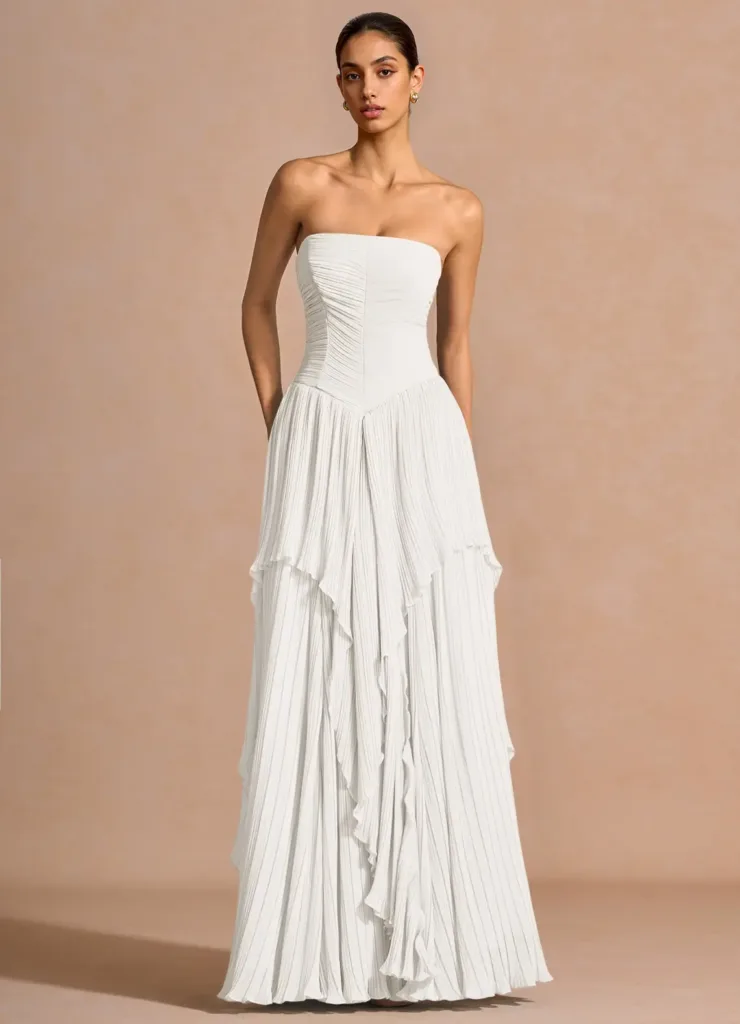
Most wedding photos are not solo shots. You’ll end up in dozens of group lineups: the friends-from-college row, the family table photos, the candid clusters at the bar.
Things that matter more in group photos than they do in solo:
- Color contrast against the people next to you. If three friends are in pastels and you’re also in a pastel, the photos blend into one soft beige blob.
- Solid colors hold up better than busy prints in group lineups. Prints fight each other when six people stand together.
- Silhouette matters. A dress with a defined waist reads cleaner than something boxy or unstructured in a wide shot.
- The bridesmaid palette is the one to avoid completely. Even if it would suit you, wearing close to that color confuses the formal portraits.
A small trick photographers actually use. When you stand at the edge of a group lineup, the dress is way more visible than when you’re tucked in the middle. If you love your dress, gravitate to the ends of the row.
Movement Catches the Camera
This sounds small but it matters more than people realize. A lot of the best candid wedding photos are taken mid-motion. Walking down the aisle. Dancing. Laughing through a toast.
Stiff dresses freeze in motion shots. They look right standing still and oddly mannequin-like when caught in candid frames.
Dresses that tend to move well on camera:
- Flowing skirts in chiffon, light crepe, or soft pleating
- Stretch satin with a slight drape
- Bias-cut silhouettes that move with the body
- Anything with a gentle ruffle or asymmetric detail
Dresses that often photograph stiff:
- Heavy structured ballgowns
- Super-fitted mermaid cuts that limit your stride
- Stiff jacquards or brocades that hold their shape too well
- Anything with so much boning the bodice can’t shift
For an evening reception with dancing involved, this matters a lot. A dress that looks beautiful at the ceremony and becomes a fight on the dance floor shows up in every candid from that point forward.
Prints and Patterns on Camera
Big patterns get tricky on camera, especially in wide shots or when you’re standing in a six-person lineup.
The general rules:
- Smaller, scattered florals photograph better than large bold prints
- Mid-tone backgrounds hold up better than very light or very dark ones
- Two-color prints look cleaner than four-or-more
- Solid colors almost always win in close-up portraits
If you love a print, pick one that’s balanced. Patterns with one or two clear colors on a non-white background tend to photograph the cleanest. Anything chaotic on white can read busy in the album.
The Photographer’s Quick Test
Before buying, here is roughly the test a wedding photographer would actually run:
- Take a phone photo of the dress in three places: daylight, indoor shade, and indoor lamp light
- Stand against a flat wall, then in front of a mirror
- See whether the color and fabric read the same across all of those
- Check if the dress photographs heavier or lighter than it looks in person
- Notice if anything (sheen, embellishment, color) catches your eye in a distracting way
If the dress passes those tests, it will hold up across the actual wedding day. If anything looks weird in those phone photos, it will look weird in the real ones too. Cameras are honest.
Finding One That Actually Photographs Well
Most dresses designed for wedding occasions now are already engineered to photograph well. Soft sheen rather than mirror shine. Mid-tone palettes rather than risky pastels. Fabrics that drape instead of stiffening.
The Azazie wedding guest dresses collection focuses heavily on photo-friendly fabrics — crepe, stretch satin, lightweight chiffon — in color palettes built around mid-saturation tones that survive any lighting situation. Sizes go from 0 to 30, with custom sizing available on most pieces. Fit matters for photo-readiness too. A dress that does not sit right at the shoulder or bust shows that in every single group photo.
The most useful shortcut: narrow by fabric first if photo-readiness is your top concern. Crepe and stretch satin photograph cleanest across the widest range of conditions. Then pick color and silhouette from there.
Azazie and other made-to-order dress brands have an underrated advantage in this area. Custom sizing means the dress sits exactly where it is supposed to, and a dress that fits well photographs better than a near-fit off-the-rack one ever will.
The dress you will love in the album later is rarely the most expensive or the most attention-grabbing in the store. It is the one that looks like you on a good day in every kind of light. Pick for that, and the photos sort of handle themselves.