
What Makes a Scalable eCommerce Partnership Model Work?

Eventually, companies that solely depend on one growth method will reach a limit. By utilizing multiple eCommerce partnerships in a structured and measurable fashion, businesses can overcome this limit by replacing individual contracts with repeatable procedures. Each new partnership will produce cumulative value rather than cumulative complication; therefore, the rate of growth will be determined by the design of your partnership rather than by how hard you work. That is the core idea behind what Commerce Network Partners has built its operational model around scalable eCommerce partnerships engineered to grow, not just managed to survive.
Most eCommerce partner programs stall because they depend on relationships rather than processes. One strong partner performs well. Add ten more without the right infrastructure, and coordination collapses fast. A real scalable eCommerce growth strategy demands more clear revenue alignment, smart technology, and strategic eCommerce partnership models built with long-term flexibility in mind. What separates models that sustain growth from those that plateau comes down to structural decisions made early and how well those decisions hold up under the pressure of partner-driven eCommerce growth.
Why Scalability Is the Core Challenge in eCommerce Partnerships
Most partnership models work fine at the start. The real test comes when volume increases, partners multiply, and the original structure cannot keep up. Understanding why eCommerce partnership scalability breaks down is the first step toward building a model that does not.
Growth Limitations in Traditional Partnership Models
Traditional eCommerce partnerships were built around direct negotiation, personal relationships, and case-by-case agreements. That approach works when the partner count is small. As volume grows, those one-to-one dynamics become a liability. Each new partner demands custom terms, separate onboarding, and individual attention. There is no shared system, no unified process, and no way to grow without hiring more people to manage it. The result is a model where growth creates more overhead the opposite of what a scalable partnership program for eCommerce should deliver.
The Shift Toward Scalable, System-Driven Partnerships
The transition occurred once companies stopped seeing partnerships as separate entities and began looking at them as systems. A system-based eCommerce partnership would change custom contracts for standardized systems of procedure and would change manual collaboration with automated processes and also would change nonstructured communication methods into structured workflows. Commerce Network Partners reflects this shift the entire model is built so that adding a new partner does not require rebuilding operations from scratch. Scalable partnership programs for eCommerce succeed precisely because they are designed around repeatability, not just reach.
How Modern eCommerce Growth Depends on Partner Ecosystems
One brand, platform or distributor is not able to serve all market segments independently. For this reason, eCommerce partner ecosystems serve as the primary go-to-market strategy for many brands today. A well-designed partner ecosystem helps businesses enter new channels, reach new audiences and enter new geographies without building internal teams for each. Collaborative eCommerce business models share the workload and share the opportunities as well. When the ecosystem is designed correctly, each partner strengthens the whole network and that network effect is what makes business scalability in eCommerce achievable at meaningful scale.
Architecture of a Scalable Partnership Model
A partnership model that scales is not built by accident. It is designed with deliberate structure from the ground up. The architecture behind any successful scalable eCommerce partnership model rests on four interconnected pillars flexibility, revenue alignment, technology, and repeatable processes.
Building a Flexible Partner Ecosystem
Flexibility is not the same as looseness. A flexible partner ecosystem in eCommerce means the model can accommodate different partner types partner-led growth operators, affiliates, distributors, technology providers without requiring a complete rebuild for each one. The framework stays consistent while the terms and roles adjust. This modularity is what allows collaborative eCommerce business models to expand quickly. When the ecosystem is rigid, adding one new partner type creates friction across the entire system. Flexibility at the architecture level prevents that friction before it starts.
Structuring Revenue Alignment Without Complexity
Having different goals in a partner relationship can quickly lead to the failed collaboration between companies. A well-defined revenue sharing model in eCommerce will provide clarity on how revenue generated is allocated, including expectations, compensation amounts, and actions required to achieve / produce the desired outcomes. Maintaining a simple, fair system for revenue sharing provides transparency that gives partners confidence in revenue sharing within eCommerce partnerships; with this, both parties will naturally have an outcome-oriented focus and direction on the correct activities to pursue. Overcomplicating the compensation model creates confusion, disputes, and disengagement none of which support long-term eCommerce partnership scalability.
Integrating Technology for Scalable Collaboration
Manual coordination has a hard ceiling. Tech integration for eCommerce partnerships removes that ceiling by automating data sharing, performance tracking, communication, and reporting. The right technology stack means partners can access what they need without depending on a central team for every update. Partner program automation in eCommerce reduces the operational load significantly as the network grows. Platforms that support API connections, shared dashboards, and automated onboarding flows make it possible to manage dozens of partners with the same resources it once took to manage five.
Designing Repeatable Partnership Processes
Scalability lives inside repeatable processes. If all partners receive the same structured onboarding and utilize a uniform workflow, as well as access the same support system, scalability is achievable. Onboarding strategic partners for scalable growth should not purely be administrative but should equally be considered a design decision. Commerce Network Partners firmly believes that operational efficiencies are based upon this premise: that processes working for one partner should also work for one hundred. It is this level of consistency that creates a scalable system versus multiple individual agreements.
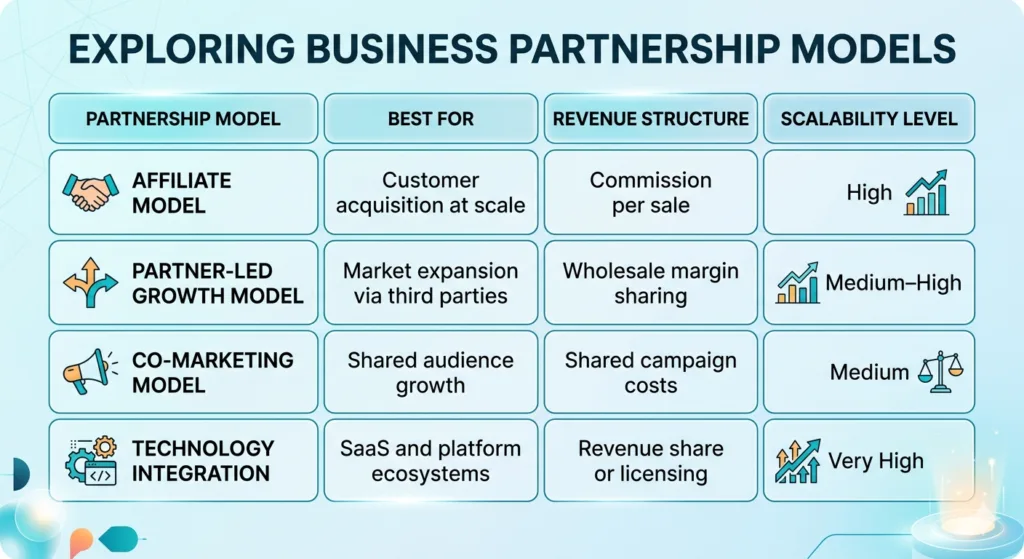
From Single Partnerships to Scalable Systems
One strong partnership is a win. Ten strong partnerships running through the same system is a growth engine. The leap from individual deals to a true scalable eCommerce partnership model requires a fundamental shift in how operations, onboarding, and coordination are structured.
Moving Beyond One-to-One Partnerships
A one-to-one partnership model requires dedicated effort for every single relationship. That is not scalable. Partner-driven eCommerce growth only becomes sustainable when the model moves from individual agreements to a shared framework one where the same structure serves every partner without custom-building each arrangement from scratch.
Standardizing Partner Onboarding and Operations
Standardization is what makes speed possible. When strategic partner onboarding for scalable growth follows a consistent process same steps, same tools, same expectations bringing on new partners stops being a bottleneck. Operational scalability in eCommerce partnerships starts here. Without a standardized system, every new partner adds complexity instead of capacity.
Creating Systems That Support Multi-Partner Growth
Systems built for one partner break under ten. Scalable partnership programs for eCommerce are designed from the start to handle volume. That means shared dashboards, centralized data, and workflows that do not require manual intervention at every step. Partner ecosystem management becomes manageable only when the underlying system is built to handle growth by design.
Reducing Dependency on Manual Coordination
Manual coordination is the silent growth killer. Every email chain, spreadsheet update, and phone call that replaces a system creates a ceiling. Partner program automation in eCommerce eliminates these friction points. Commerce Network Partners operates on this principle reducing human dependency in routine coordination so that the team can focus on strategy, not administration.
Growth Levers in Scalable eCommerce Partnerships
Scaling a partnership model is not just about adding more partners. It is about activating the right levers that multiply output without multiplying cost. These four levers define how scalable eCommerce partnerships turn structured collaboration into measurable, compounding eCommerce growth through strategic partnerships.
Co-Marketing and Shared Customer Acquisition
Through co-marketing and co-selling in eCommerce Partners can share the expenses associated with attracting new customers. Two or more partners will create a single campaign to target their audiences, source of funds, and brand equity for the collaboration, rather than having two separate campaigns operated by each party individually. Shared marketing efforts in eCommerce partnerships lower the cost per acquisition and increase reach making customer acquisition through partnerships far more efficient than solo efforts.
Leveraging Partner Networks for Market Expansion
Every partner brings an existing audience, channel, or geography. Partner network expansion in eCommerce means tapping into those existing assets rather than building them from scratch. A single well-aligned partner can open an entirely new market segment. E-commerce growth through strategic partnerships accelerates precisely because partners bring established trust, reach, and relationships that take years to build independently.
Increasing Efficiency Through Operational Alignment
When multiple partners collaborate through one system using one process, the compounded effect will be that they will have an opportunity to increase their efficiency. By collaborating through eCommerce partnerships toward a common set of goals, you will eliminate redundancy, decrease communication error, and shorted time to market. It is not about sweeping away any misconceptions regarding how efficiently you and your partner operate your respective business to maximize efficiency. It is eliminating waste due to a lack of structure that will hinder growth through all stages of partnership collaboration.
Operational Framework for Managing Scale
Growing a partner network without an operational framework leads to chaos. Structure is what keeps scale manageable. A solid framework covers partner segmentation, workflow automation, communication systems, and consistency the four pillars that keep a scalable eCommerce partnership model running cleanly as volume increases.
Partner Segmentation and Role Definition
Not every partner serves the same function. Partner ecosystem management requires clear segmentation defining who does what, at what level, and under which terms. When roles are defined upfront, the entire collaborative eCommerce business model runs with less confusion and stronger accountability across every tier of the network.
Workflow Automation in Partnership Management
Repetitive tasks should never require human attention at scale. Partner program automation in eCommerce handles reporting, notifications, approvals, and data updates automatically. This reduces operational load and allows the team at Commerce Network Partners to focus resources on decisions that actually require strategic input.
Communication and Coordination Systems
Poor communication breaks partnerships faster than poor performance. Structured communication systems shared portals, automated updates, and scheduled check-ins keep every partner informed. Aligning business goals in eCommerce partnerships depends on consistent, clear information flow that does not rely on individual effort to maintain.
Measuring and Managing Scalability
You cannot manage what you do not measure. Tracking the right metrics is what separates a partnership model that keeps improving from one that slowly drifts off course.
Identifying Key Metrics Beyond Revenue
Revenue is an outcome, not a signal. How to measure scalability in eCommerce partnerships starts with tracking partner activation rates, onboarding completion times, and engagement levels. These leading indicators reveal system health before revenue numbers ever reflect a problem. Business scalability in eCommerce depends on watching the right data early.
The following metrics are among the most reliable indicators of eCommerce partnership scalability at the operational level:
- Partner activation rate percentage of onboarded partners actively contributing within 30 days
- Onboarding completion time how quickly new partners become fully operational within the system
- Revenue per partner average contribution relative to the support resources invested
- Workflow automation success rate percentage of tasks completed without manual intervention
- Partner retention rate how many partners remain active and engaged after the first 90 days
Evaluating Partner Contribution and Efficiency
Not all partners contribute equally. Identifying which partnerships provide true value can be accomplished by measuring the output of each partner against the resources that were invested in them. Metrics like conversion rates, the number of referrals generated, and how many times a provider has advertised an event all indicate which partners are producing satisfactory results and which ones have used up their allocated capacity without generating any returns.
Monitoring System Performance Over Time
A system that works well today may develop friction as scale increases. Regular monitoring of eCommerce partnership scalability metrics response times, automation success rates, and workflow completion rates keeps the model healthy. Commerce Network Partners treats system performance reviews as a standard operational practice, not a reactive measure.
Using Data to Improve Partnership Outcomes
Data only creates value when it drives decisions. Using data to improve partnership outcomes means reviewing performance trends, identifying bottlenecks, and adjusting processes based on what the numbers actually show. Revenue sharing partnership models in eCommerce improve significantly when both parties can see the same performance data and act on it together.
Risks That Can Limit Scalability
Every partnership model carries risk. The ones that derail scalability most often are structural, built into the design before growth even begins. Identifying these risks early is what allows a scalable eCommerce partnership model to course-correct before small problems become expensive breakdowns.
Overcomplicated Partnership Structures
Complexity is the enemy of scale. When eCommerce partnership scalability is buried under layered approval chains, custom agreements, and unclear hierarchies, the model slows itself down. Strategic eCommerce partnership models must stay lean by design simple enough that any new partner can be onboarded and operational without weeks of internal coordination.
Misaligned Incentives Between Partners
When partners are rewarded for different outcomes, collaboration breaks down fast. Aligning business goals in eCommerce partnerships requires that every party works toward shared results. A misaligned eCommerce revenue sharing model creates friction, reduces engagement, and eventually pushes partners toward priorities that conflict with the broader system’s performance.
Operational Bottlenecks in Growth Phases
Growth phases expose every weakness in an operational system. Operational scalability in eCommerce partnerships breaks down when manual processes, approval delays, or under-resourced support teams cannot keep pace with partner volume. Ecommerce scalability solutions must be stress-tested before rapid expansion not patched together reactively once bottlenecks are already causing damage.
Strategic Approaches to Building Scalable Models
Strategy determines whether a partnership model grows with strength or collapses under its own weight. The decisions made at the design stage shape everything that follows. Building a scalable eCommerce partnership model requires deliberate choices around flexibility, control, technology, and adaptability not just ambition.
Designing Partnerships with Long-Term Flexibility
A model built only for today’s conditions will struggle tomorrow. Scalable eCommerce partnerships must be designed with enough flexibility to absorb new partner types, market shifts, and product changes without requiring a structural rebuild. Long-term flexibility is a design choice not something added later when the original model no longer fits.
Balancing Control and Decentralization
Too much central control creates bottlenecks. Too little creates inconsistency. Strategic eCommerce partnership models strike a deliberate balance centralizing brand standards, compliance, and data while decentralizing execution. This keeps the system both agile and accountable across the entire partner ecosystem in eCommerce.
Building Systems That Adapt to Market Changes
Markets shift. Partner needs evolve. A rigid system that cannot adapt will limit growth regardless of how well it was built initially. Ecommerce platform scalability depends on models with built-in review cycles and adjustment mechanisms. Commerce Network Partners prioritizes adaptability as a core structural feature not a reactive fix applied only when conditions force a change.
Real-World Structure of Scalable Partnership Ecosystems
Theory only matters when it translates into practice. Across D2C brands, marketplace platforms, and SaaS businesses, scalable eCommerce partnerships follow recognizable structural patterns.
D2C Brands Expanding Through Partner Networks
Direct-to-consumer brands use scalable eCommerce partnerships in D2C businesses to reach new customer segments without building new internal channels. By partnering with complementary brands, influencer networks, and affiliate platforms, D2C businesses expand their distribution footprint while keeping operational costs lean and customer acquisition through partnerships measurably efficient.
Platform-Based and Marketplace Ecosystems
Marketplace platforms scale through collaborative commerce models by enabling third-party sellers, service providers, and logistics partners to operate within one shared infrastructure. Marketplace partnerships for scalability work because the platform provides the system while partners provide the volume a structure that grows without requiring proportional increases in central operational resources.
SaaS-Driven Partnership Models
SaaS businesses use SaaS partnership models for eCommerce growth to expand through partner-led growth operators, integration partners, and co-marketing arrangements. These scalable partnership models for SaaS businesses are particularly efficient because the product scales digitally every new partner extends market reach without increasing product delivery costs or internal headcount requirements.
How Organizations Like Commerce Network Partners Operate Within Structured Ecosystems
Commerce Network Partners operates within a structured partner ecosystem in eCommerce built on standardized processes, defined roles, and technology-supported coordination. The model is designed so that participation follows a clear framework giving partners operational clarity while the system manages consistency, performance tracking, and eCommerce co-marketing opportunities across the entire network.
Future Direction of Scalable eCommerce Partnerships
The structure of scalable eCommerce partnerships is shifting fast. Automation, ecosystem-based models, and multi-channel integration are no longer emerging trends they are becoming the baseline expectation.
Automation and AI in Partner Management
AI is already reshaping how partner program automation in eCommerce operates from predictive performance scoring to automated communication triggers and smart onboarding flows. Businesses using AI-assisted partner ecosystem management can identify high-performing partners faster, reduce support overhead, and make data-driven decisions across a growing network without proportionally increasing management resources.
Expansion of Ecosystem-Based Growth Models
Standalone partnerships are giving way to full partner ecosystems in eCommerce where multiple partners interact, refer, and support each other within one shared structure. Each new partner strengthens the value of existing ones making partner-driven eCommerce growth increasingly self-reinforcing over time through compounding network effects.
Evaluating Whether a Scalable Model Fits Your Strategy
Not every business is ready to operate within a scalable eCommerce partnership model from day one. Readiness depends on infrastructure, resources, and strategic clarity. Evaluating fit honestly before committing prevents the costly mistake of scaling a model that the underlying business is not yet equipped to support.
Business Readiness for Partnership-Based Scaling
Before pursuing scalable eCommerce partnerships, a business must have stable core operations. Partnerships amplify what already exists they do not fix what is broken. How to evaluate scalable eCommerce partnership models starts with an honest assessment of internal systems, team capacity, and whether the business can support partner relationships consistently.
Resource and Infrastructure Considerations
Scalable partnership programs for eCommerce require technology, personnel, and financial resources to function properly. Businesses must evaluate whether their current infrastructure can support shared data systems, partner communication, and performance tracking. Ecommerce scalability solutions only work when the internal foundation is strong enough to carry the additional operational weight that partnerships introduce.
Implementation Overview: Building for Scale
Knowing what a scalable eCommerce partnership model looks like is one thing. Building it is another. Implementation requires a sequenced approach laying the right foundation first, expanding deliberately, and continuously improving the system as the partner network grows and market conditions evolve.
Laying the Foundation for a Partnership System
Strong foundations prevent costly rebuilds later. How to implement a scalable eCommerce partnership strategy begins with documenting processes, selecting the right technology stack, and defining partner roles clearly. Strategic partner onboarding for scalable growth must be built before the first partner joins not assembled reactively as the network starts to expand.
Gradual Expansion vs Rapid Scaling
Rapid scaling without system readiness creates operational strain. Scalable eCommerce growth strategy favors measured expansion adding partners at a pace the infrastructure can absorb. Commerce Network Partners applies this principle by validating each stage of growth before moving to the next, ensuring the system performs reliably rather than breaking under premature volume.
Conclusion
Why Scalability Requires System Thinking, Not Just Growth
Growth without structure is just noise. Every element covered in this article from partner ecosystem design to automation, revenue alignment to performance tracking points to the same truth: a scalable eCommerce partnership model is built on system thinking, not just growth ambition. The businesses that scale successfully are the ones that treat their partnership infrastructure as a product something to be designed, tested, refined, and improved continuously.
Making Strategic Decisions for Long-Term Expansion
Long-term eCommerce growth through strategic partnerships does not happen by chance. It happens through deliberate structural decisions made early and revisited consistently. Whether a business is evaluating its first eCommerce partner program or optimizing an existing network, the principles remain the same. Commerce Network Partners operates on exactly this foundation: a participation-based model built for sustainable, system-driven growth where results depend on execution, market conditions, and consistent operational discipline. Results may vary.