
Matteo Giorgi on the Future of SEO, AI Search, and Performance Marketing
Digital marketing has never stood still, but the pace of change today feels different. Search is no longer only about blue links on Google. Paid advertising is more automated, but also more competitive. Analytics tools are more advanced, yet many companies still struggle to understand which channels are actually bringing results. And now, with AI-powered search becoming part of everyday online behavior, businesses have another question to answer: how do they stay visible when people no longer search the way they used to?
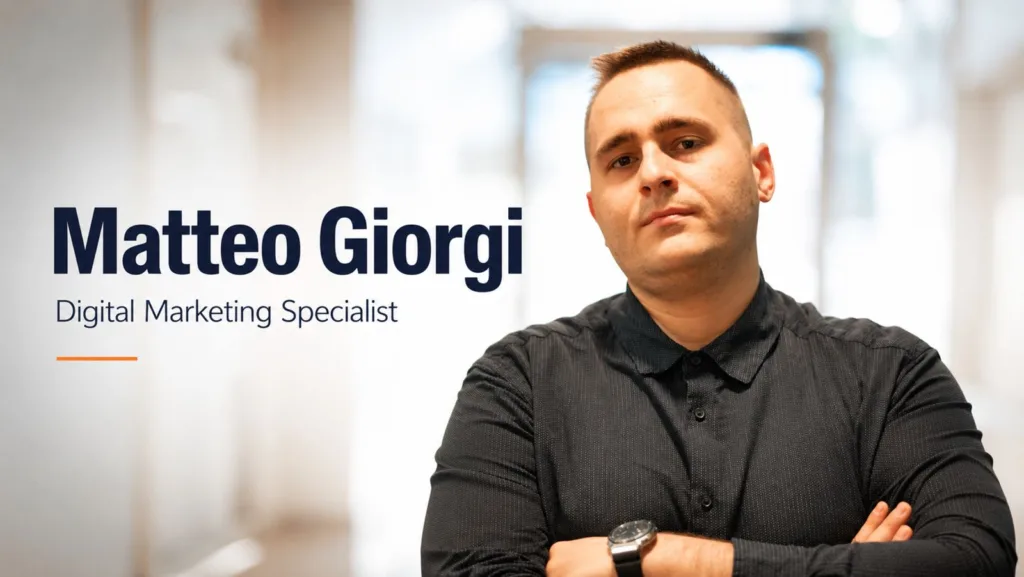
For Matteo Giorgi, a Bologna-based Digital Marketing Specialist with more than 15 years of experience, the answer is not to chase every new trend. It is to build a digital strategy that is connected, measurable and practical.
Giorgi works across SEO, Generative Engine Optimization, digital advertising, analytics and web development. He is a Google Partner, a Microsoft Advertising Certified Professional and a Meta Business Partner. Over the years, he has managed more than €4 million in annual advertising investments and worked with businesses across more than 20 industries, from retail and healthcare to finance, tourism, technology, education and luxury goods.
In this interview, Giorgi talks about where SEO is heading, why AI search matters, what many companies misunderstand about performance marketing, and why good data is still the starting point for any serious digital strategy.
Matteo, everyone talks about digital marketing, but the term means different things to different people. How do you define it today?
For me, digital marketing is not one single activity. It is not only SEO, or Google Ads, or social media, or a website. It is the way all of these elements work together to help a business become visible, trusted and profitable online.
A few years ago, many companies managed digital channels separately. The SEO work was in one place, advertising in another, analytics somewhere else, and the website was often treated as a design project. That approach creates problems because users do not experience a business in separate pieces. They search, they click, they compare, they read, they visit a page, and then they decide whether to take action.
So the real question is not “Are we doing SEO?” or “Are we running ads?” The question is: are all these activities helping the business move in the same direction?
That is where I focus my work. I look at visibility, traffic quality, user experience, tracking and conversion together. If one part is weak, the whole system can suffer.
Is SEO still as important as it used to be?
Yes, but it has changed. SEO is still one of the strongest long-term channels for digital growth, but it cannot be treated as a simple keyword exercise anymore.
In the past, some businesses thought SEO meant adding keywords to pages and publishing articles regularly. That was never the full picture, but today it is even less enough. Search engines have become much better at understanding quality, structure, intent and authority.
A good SEO strategy has to cover several areas. The content must be useful and match what people are really looking for. The website must be technically healthy, so search engines can crawl and index it properly. The site structure has to make sense. Pages should load quickly, especially on mobile. And the brand needs authority from credible sources, not just random links.
The businesses that do SEO well usually understand that it is a long-term asset. Paid campaigns can stop when the budget stops. Good SEO, when it is built correctly, can continue to bring qualified traffic over time.
What do businesses often get wrong with SEO?
The first mistake is impatience. Many companies want SEO results quickly, but SEO is not the same as turning on an advertising campaign. It takes time to build trust, improve the website, publish better content and earn authority.
Another common mistake is producing content without a clear purpose. A blog post should not exist just because someone said the website needs more content. It should answer a real question, solve a problem, support a service page, or help the user make a better decision.
Technical issues are also very common. A business may have good content, but if the site is slow, difficult to crawl, poorly structured or full of indexation problems, the performance will be limited. This happens more often than people think.
And then there is authority. In competitive markets, Google needs reasons to trust a website. That trust comes from experience, strong content, good reputation, and mentions or links from relevant sources. Without authority, many websites reach a point where they stop growing.
AI search is becoming a major topic. How do you explain GEO to a business owner?
I explain it in a simple way. People are starting to search differently. They still use Google, but they also use AI tools to get direct answers. Google AI Overviews, ChatGPT, Gemini, Perplexity and other systems are changing how information is discovered.
Before, a company mainly wanted to appear on the first page of Google. That still matters. But now, in some cases, the user may receive an AI-generated answer before they even click on a result. If your brand is not mentioned, cited or understood by these systems, you may be invisible in that moment.
Generative Engine Optimization, or GEO, is about making a brand easier for AI systems to understand and trust. It does not replace SEO. It uses many of the same foundations: clear content, technical quality, authority, consistency and expertise. But it also requires businesses to think more carefully about how their information is structured and how clearly their expertise is presented.
AI systems need reliable signals. If a company has vague content, weak information, no clear expertise and inconsistent details across the web, it becomes harder for those systems to identify it as a strong source.
What kind of content works better for AI search?
Clear content works better. Specific content works better. Content that actually answers questions works better.
Generic marketing content is becoming less useful. If every business says “we provide high-quality solutions,” that does not help users or AI systems understand what makes the business credible. A page should explain what the company does, who it helps, what problems it solves, and why it can be trusted.
I also think businesses need to write more like experts and less like brochures. This means including definitions, explanations, examples, comparisons, process details, case-based insights and direct answers to common questions. Not every page needs to be long, but it should be complete enough to be useful.
Consistency is also important. The way a brand describes its services, expertise, people and location should be clear across its website and other trusted platforms. AI search depends heavily on understanding entities. If the entity is weak or unclear, visibility becomes harder.
Some people think AI search will replace SEO. Do you agree?
No, I do not agree. AI search changes SEO, but it does not make SEO irrelevant.
In fact, many of the things that help a website perform in traditional search also help it become more visible in AI-driven discovery. Strong content, technical clarity, authority, structured information and trusted references still matter.
What is changing is the way the information is presented to users. In traditional search, the user sees a list of results. In AI search, the user may see a summarized answer. But that answer still needs sources and signals. Businesses that already have strong SEO foundations are usually in a better position to adapt.
The danger is for companies that treat SEO as tricks or shortcuts. That approach is becoming weaker. The future is not about manipulating search engines. It is about being genuinely useful, credible and easy to understand.
Let’s talk about performance marketing. How has paid advertising changed?
Paid advertising has become more intelligent, but also less forgiving. For companies that depend on measurable growth, performance marketing now requires a stronger connection between media buying, landing pages, conversion tracking and business goals.
Platforms like Google Ads, Meta Ads, Microsoft Ads and YouTube Ads now use more automation than before. That can be very useful, but automation is not magic. It needs good data, good structure and clear goals. If the campaign is built on weak tracking, poor landing pages or unclear messaging, the platform will not fix the business problem by itself.
I have seen companies spend a lot of money on traffic without understanding what happens after the click. That is a mistake. A campaign should not be judged only by impressions, clicks or even cost per click. The real question is whether the campaign is generating qualified leads, sales or revenue.
Performance marketing is about connecting the ad, the audience, the offer, the landing page and the measurement system. When those pieces are aligned, the campaign has a much better chance of producing real business results.
What makes a paid campaign successful?
A successful campaign starts with a clear objective. You need to know what you want: leads, purchases, bookings, calls, form submissions or another measurable action. Without that, optimization becomes confused.
Then you need to understand the audience and the intent. Someone searching on Google may be actively looking for a solution. Someone seeing an ad on Meta may not be ready yet, so the message has to work differently. You cannot use the same logic everywhere.
The landing page is also essential. Many campaigns fail not because the ads are bad, but because the page does not support the campaign. If the ad promises one thing and the page talks about something broader or unclear, the user leaves. This is why digital advertising should be planned with the full user journey in mind.
Finally, tracking must be correct. If conversions are not measured properly, you cannot know what is working. You may think a campaign is performing well when it is not, or stop a campaign that is actually bringing value.
You mentioned landing pages. Why are they so important?
Because the landing page is where the decision happens.
An ad can bring the right person to the website, but the page has to do the next job. It has to confirm the message, remove confusion, build trust and make the next step easy.
A good landing page is not just a nice design. It should be fast, focused, mobile-friendly and written for the user’s intent. If someone clicks an ad for a specific service, they should immediately see that service, understand the value, and know what to do next.
Too many businesses send paid traffic to a homepage and expect people to figure everything out. That creates friction. In advertising, friction costs money.
This is why I connect advertising strategy with landing page structure. The campaign and the page should be built together, not separately.
Analytics seems to be a major part of your work. Why do you put so much emphasis on it?
Because without good data, every decision becomes weaker.
Analytics is not just about seeing how many people visited the website. It is about understanding where users come from, what they do, where they drop off, which channels produce value, and which campaigns waste budget.
I work with Google Analytics 4, Google Tag Manager and Google Search Console because they help create a clearer picture of performance. But the tools only work if they are configured correctly.
A very common problem is broken or incomplete tracking. A business may think it is measuring leads, but some forms are not tracked. Or phone clicks are missing. Or events are duplicated. Or conversions are counted in a way that does not reflect real business value.
Bad data is worse than no data in some situations because it gives people confidence in the wrong conclusion. Before improving campaigns or SEO, I often need to check whether the business can actually trust its numbers.
How does web development fit into your digital marketing work?
The website is the place where all the strategy becomes real.
A business can invest in SEO, advertising and content, but if the website is slow, confusing or not built for conversion, a lot of that investment is wasted. Users judge a business quickly. Search engines also evaluate technical quality, structure and usability.
When I work on websites, I do not see them only as design projects. A website needs to support business goals. A showcase website should build credibility and explain services clearly. An e-commerce site should make products easy to find, understand and buy. A landing page should focus on one clear conversion action.
The technical side matters too. Speed, mobile performance, clean structure, SEO-friendly architecture and analytics integration are not optional details. They affect results.
A website should not only look good. It should work.
Who usually comes to you for help?
I work with different types of clients: small and medium-sized businesses, larger companies, startups and marketing agencies. Some need a full strategy. Some need specialist support in one area, such as SEO, advertising, analytics or landing pages.
The best clients are not defined by size. They are defined by mindset. They want to understand what is happening, they care about results, and they are willing to make decisions based on data instead of opinions.
I also work with agencies that need external specialist support for specific projects. That can be useful when an agency has clients with advanced needs but does not want to keep every skill in-house full time.
The strongest results usually happen when there is trust, clarity and a shared focus on measurable growth.
What should businesses focus on in 2026?
First, they should fix their measurement. If the data is wrong, the strategy will be weak. Before spending more money, make sure analytics, conversion tracking and reporting are reliable.
Second, they should strengthen SEO fundamentals. AI search is important, but it does not remove the need for a technically sound website, useful content and authority.
Third, they should start preparing for AI visibility. This means building content that is clear, factual, structured and based on real expertise. Businesses should think about whether they are visible not only in search results, but also in AI-generated answers.
Fourth, they should connect their channels. SEO, advertising, analytics and web development should not be managed as separate worlds. They influence each other every day.
The companies that understand this will be in a better position. Digital marketing is becoming more complex, but the basic idea is still simple: be visible to the right people, earn their trust, measure what matters, and make it easy for them to take action.
About Matteo Giorgi
Matteo Giorgi is a Digital Marketing Specialist based in Bologna, Italy, with more than 15 years of professional experience in SEO, Generative Engine Optimization, digital advertising, analytics and web development. He is a Google Partner, Microsoft Advertising Certified Professional and Meta Business Partner.
Giorgi manages more than €4 million in annual advertising investments across Google, Meta, Microsoft and YouTube, and works with companies across more than 20 industries. His services include SEO strategy, AI search visibility, Google Ads, Meta Ads, Microsoft Ads, YouTube Ads, Google Analytics 4 implementation, Google Tag Manager, Google Search Console consulting, website development, e-commerce solutions and landing page creation.
More information about his work and services is available at matteogiorgi.com. Businesses and professionals looking for measurable digital growth can contact him directly through the website.
Media Info
Contact Person Name: Matteo Giorgi
Organization Name: Matteo Giorgi
Email: info@matteogiorgi.com
Website: https://matteogiorgi.com/
Country: Italy