
Top 7 GEO Agencies for SaaS in 2026: Vetted by Published Research, Named Clients, and Verifiable Wins

TL;DR
- B2B software buyers now begin vendor research in an AI chatbot more often than in Google for the first time on record. G2’s March 2026 survey of 1,076 buyers put the figure at 51%, up from 29% eleven months earlier.
- Nearly seven in ten buyers ended up choosing a different vendor than they originally planned because of what the AI chatbot said. One in three bought from a company they had never heard of before the conversation started.
- An analysis by Averi of 680 million AI citations found that only 11% of domains are referenced by both ChatGPT and Perplexity. A GEO agency that optimises for one engine and reports a single visibility number is measuring a sliver of the landscape.
- Most “best GEO agency” lists are written by agencies that rank themselves first. This roundup scores seven agencies on the same six published criteria: original research, named SaaS clients with verifiable numbers, technical depth, multi-engine coverage, pricing transparency, and ARR-stage fit.
- Five RFP-grade questions at the end of this piece, asked verbatim in a 30-minute discovery call, will separate a real GEO practice from one that has rebranded its SEO retainer.
A head of growth at a $20M ARR B2B SaaS company opens the laptop on Monday morning and watches the same pattern repeat itself for the fifth quarter in a row. The pipeline is flat. The SEO agency is hitting its keyword targets. Three new buyers in the last fortnight have casually mentioned they “found us on ChatGPT” without anyone on the team knowing why. That gap between what the dashboard says and what the buyers say is the entire problem GEO agencies now exist to solve.
These agencies go by several names, generative engine optimisation, AI search, answer engine optimisation, or LLM SEO, and for shortlisting purposes they are solving the same problem: getting a brand cited inside the AI answer.
The mistake almost every buyer makes from here is reading a best GEO agencies list and trusting the order. Look closely at the five or six pieces currently ranking for this query. Every single one is published by an agency that ranks itself first, scores itself on a proprietary metric only it can audit, and cites anonymised clients with results no one can verify externally. The category looks like sponsored content because most of it is.
This piece applies the same six criteria to all seven agencies. Every named client claim links to public evidence. Every statistic carries a date and a source. After reading, a head of growth will know how to score any GEO agency in fifteen minutes, what three signals separate a real practice from a relabelled SEO retainer, and which five questions to ask in a discovery call before signing anything.
How this list of GEO agencies for SaaS was scored
Each agency was scored 1 to 5 across six weighted criteria. The full rubric is published below so any reader can re-score the list on the same inputs and produce a different ranking if their priorities differ.
The rubric:
- Published original research (25%): Has the agency released its own AI visibility dataset, prompt study, or benchmark report covered by a third-party publication? Recycled Gartner statistics do not count.
- Named SaaS clients with verifiable numbers (25%): Are case studies on real, named B2B SaaS companies with results a buyer can verify on LinkedIn or in a public case study? “A leading SaaS company” scores zero on this dimension.
- Technical GEO depth (15%): Entity optimisation, schema implementation, LLMs.txt files, passage retrieval, AI crawler access. Verifiable by inspecting the agency’s own technical signals and a sample client site.
- Multi-engine coverage (15%): Tracking and optimisation across ChatGPT, Perplexity, Google AI Overviews, Gemini, and Claude. Averi’s analysis of 680 million AI citations found that only 11% of domains appear in both ChatGPT and Perplexity, which makes single-engine focus a measurable blind spot.
- Pricing transparency (10%): Published price ranges or tier structures. Hidden pricing in this category usually correlates with retainer creep.
- ARR-stage fit (10%): Demonstrated fit with B2B SaaS companies in the agency’s stated ICP. Generalist agencies and consumer-marketing portfolios were dropped.
Two notes on what was excluded. Self-published “AI Visibility Scores” with no methodology page were ignored entirely. Agencies whose SaaS case studies are anonymised, undated, or absent from the public case study library were not shortlisted regardless of brand recognition.
GEO agencies for SaaS in 2026 at a glance
| # | Agency | Best For (ARR fit) | Published Research | Named SaaS Case Studies | Multi-Engine Tracking | Starting Price |
| 1 | First Page Sage | Enterprise SaaS | Yes (2023 GEO study) | Salesforce, Cadence, Logitech, NerdWallet | ChatGPT, Perplexity, Gemini, Claude | $10K+/mo |
| 2 | Omniscient Digital | Content-led mid-market | Yes (Surround Sound methodology) | Asana, Loom, Hotjar, Jasper, SAP, Adobe | Indirect via owned content | Custom |
| 3 | DerivateX | $5M to $50M B2B SaaS | Yes (2026 benchmark, 50 companies, 1,400 prompts) | Gumlet, Verito, Kroto, REsimpli | ChatGPT, Perplexity, Gemini, Claude | $3.5K/mo |
| 4 | Embarque | Early-stage SaaS | Limited | MentorCruise, Riverside, ContentStudio | ChatGPT, Perplexity, AI Overviews | $2K+/mo |
| 5 | Siege Media | Mid-market and enterprise | Yes (data journalism) | TaxJar, Zendesk, Asana | ChatGPT, Google AI Overviews | Custom |
| 6 | Minuttia | $10M+ ARR SaaS | Limited | Brand24, multiple B2B portfolio | ChatGPT, Perplexity, AI Overviews | $5K+/mo |
| 7 | iPullRank | Enterprise / Fortune 500-adjacent | Yes (technical SEO whitepapers) | Anonymised | ChatGPT, Perplexity, Google AI | $15K+/mo |
The 7 best GEO agencies for B2B SaaS in 2026
Each entry below uses the same structure: best fit, proof a buyer can verify in ten minutes, where the agency is strongest, where it is weakest, and the company it actually serves well.
1. First Page Sage: best for enterprise SaaS, prioritizing pipeline over visibility metrics
Best for: enterprise B2B SaaS that wants pipeline attribution and is comfortable with retainers above $10K per month.
Proof you can verify: First Page Sage published one of the earliest GEO studies in 2023, before most agencies had a service page on the topic. The public client roster includes Salesforce, Cadence, Logitech, NerdWallet, and Verisign, all verifiable through First Page Sage’s own case study pages and LinkedIn employee relationships.
Strongest at: long pedigree in B2B SaaS SEO, mature pipeline reporting, established editorial process.
Weakest at: First Page Sage ranks itself first on its own published GEO and SaaS GEO roundups, which is worth noting as a methodology disclosure. The proprietary “AI Visibility Score” used in those rankings has no external audit. Enterprise pricing puts the agency out of reach for most $1M to $5M ARR SaaS companies.
Best fit: enterprise SaaS in established categories that want a proven team and have the budget to match.
2. Omniscient Digital: best for SaaS building category authority through editorial content
Best for: mid-market SaaS that already has product-market fit and wants to build category authority through editorial content rather than technical GEO experiments.
Proof you can verify: Omniscient’s public client roster includes Asana, Loom, Jasper, Hotjar, SAP, and Adobe, all named on the agency’s case study pages. The Surround Sound methodology, focused on getting brands mentioned across top resources and third-party sites for category-defining topics, is publicly documented and referenced by independent SEO commentators.
Strongest at: editorial content quality, third-party corroboration through earned coverage, brand-mention strategy that translates directly to AI citation signal.
Weakest at: GEO is an extension of an existing content engine rather than a founding capability. Direct AI citation tracking and multi-engine reporting are less mature than at GEO-first agencies.
Best fit: established SaaS where content authority is the bottleneck, not technical AI search optimisation.
3. DerivateX: best for $5M to $50M B2B SaaS looking to generate leads from AI
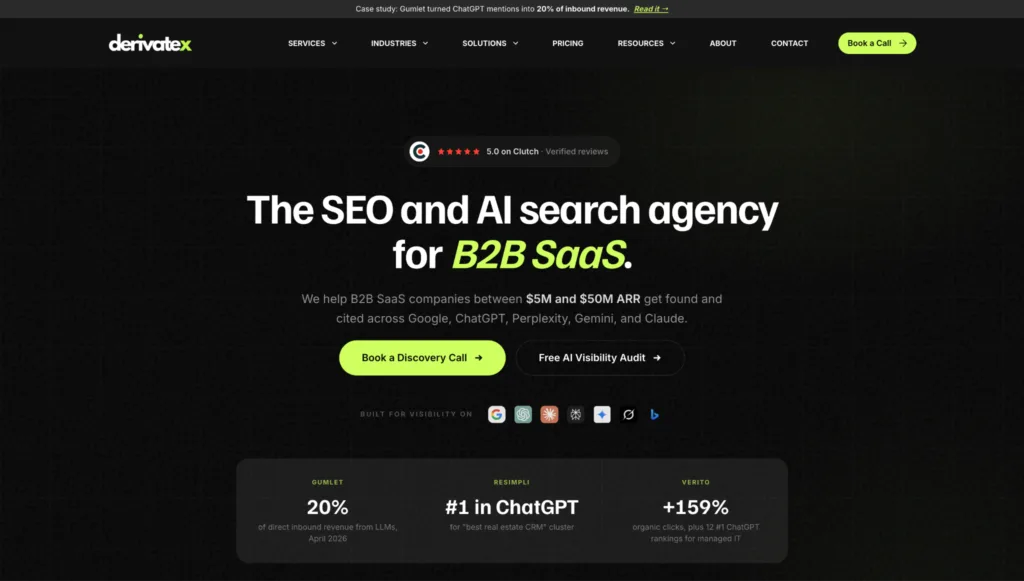
Best for: B2B SaaS companies between $5M and $50M ARR that want named-client revenue attribution from AI search, not impression dashboards.
Proof you can verify: DerivateX published The State of AI Visibility in B2B SaaS: 2026 Benchmark Report in April 2026, scoring 50 B2B SaaS companies across 1,400 prompts on ChatGPT, Perplexity, Claude, and Gemini.
Named client wins are public: Gumlet attributes roughly 20% of monthly inbound revenue to ChatGPT and Perplexity, and Verito moved from position 40 on Google to the most recommended hosting solution for tax and accounting firms on Google and LLMs like ChatGPT, Perplexity, Claude and Gemini.
Strongest at: published primary research, pipeline-attributed reporting, founder-operated delivery, multi-engine coverage from day one.
Weakest at: a smaller team than the enterprise incumbents, which makes the agency a poor fit for companies that want a 30-person account team. Not built for sub-$5M ARR SaaS or for consumer-marketing brands.
Best fit: mid-market B2B SaaS founders and growth leads who want a GEO partner with their own published dataset to benchmark against. The core service line is GEO for B2B SaaS.
4. Embarque: best for early-stage and bootstrapped B2B SaaS
Best for: pre-Series A and bootstrapped B2B SaaS that needs a founder-led, high-touch content engine and cannot stretch to a $5K monthly retainer.
Proof you can verify: MentorCruise grew to roughly 11,500 Perplexity visits in a few months, scaling to two million yearly visits, per Embarque’s published case studies. Public client work with Riverside, ContentStudio, and other early-stage SaaS is documented on the agency site.
Strongest at: cost accessibility, fast time-to-first-content, willingness to work with companies that do not yet have a marketing function.
Weakest at: generalist by ICP rather than SaaS-exclusive. No published benchmark research. Multi-engine citation tracking is informal rather than dashboarded.
Best fit: founders running content marketing themselves who want capacity, not strategic ownership.
5. Siege Media: best for mid-market SaaS that needs data journalism at scale
Best for: mid-market and enterprise B2B SaaS that wants to build AI citation authority through original data journalism, digital PR, and high-volume publishing.
Proof you can verify: Public client work with TaxJar, Zendesk, and Asana, alongside more than a decade of documented data journalism case studies. Siege Media’s own SaaS GEO roundup ranks itself in the list, which is worth noting as a methodology disclosure.
Strongest at: data journalism and digital PR are exactly the inputs AI engines treat as citation-worthy. The team has roughly 13 years of SaaS content experience to draw on.
Weakest at: GEO is layered onto a content marketing core, not the other way around. AI citation tracking and visibility reporting are still maturing as a service line.
Best fit: SaaS with existing content velocity that wants to convert volume into AI citations through stronger third-party data and PR signals.
6. Minuttia: best for $10M+ ARR B2B SaaS in growth mode
Best for: established B2B SaaS companies with $10M+ ARR and a growing marketing budget, looking for long-term AI visibility roadmaps rather than one-off content tweaks.
Proof you can verify: Brand24 case study covering topical authority expansion and traffic growth, both load-bearing inputs for LLM visibility. Multiple SaaS clients in the public portfolio with documented work. Minuttia publishes its own SaaS GEO ranking and includes itself in it.
Strongest at: strategic depth, cross-functional coordination across SEO, PR, content, and analytics teams, and large content libraries that compound over multi-year engagements.
Weakest at: best-fit profile cuts off most $1M to $10M ARR SaaS. Multi-engine AI citation tracking is in flight rather than mature.
Best fit: growth-stage SaaS with the budget for a multi-year content and AI visibility programme, not a 90-day pilot.
7. iPullRank: best for enterprise SaaS that needs technical GEO firepower
Best for: enterprise or Fortune 500-adjacent B2B SaaS that needs deep technical GEO work, including query fan-out, passage retrieval, embeddings, schema architecture, and AI crawler access.
Proof you can verify: Long-standing reputation in technical SEO research, published whitepapers on AI search infrastructure, and conference talks by founder Mike King that go deeper into LLM retrieval mechanics than most agencies attempt.
Strongest at: technical depth that few agencies in this category match. Real fluency in retrieval-augmented generation and the underlying mechanics of how LLMs select sources.
Weakest at: most SaaS case studies are anonymised, which makes revenue attribution harder to verify than the agency’s technical authority. Pricing is enterprise-only.
Best fit: large SaaS companies with strong internal marketing teams that need a technical partner, not full-service execution.
GEO agencies for SaaS considered but not shortlisted
Some other agencies were considered for inclusion: Singularity Digital, Skale, Brainz Digital, Veza Digital, Genevate, Quoleady, Single Grain, WebFX, Nutshell, Digital Elevator, Go Fish Digital, Intero Digital, GenOptima, and Searchbloom.
Each was excluded for one of three reasons. SaaS is not the primary ICP and case studies skew to other verticals (WebFX, Nutshell, Digital Elevator, Genevate). GEO is a recent service add-on with limited published proof or fully anonymised case studies (Intero, Go Fish, Searchbloom). The agency self-publishes a proprietary visibility score with no methodology page (GenOptima, Veza). Quoleady, Animalz, and Omnius are worth a separate look depending on stage and geography, but did not clear the published-research threshold this roundup uses.
How to spot a GEO agency that is really an SEO retainer in disguise
Three signals predict whether a GEO agency has a real practice or has rebranded its SEO retainer. They are visible from the agency’s own site in under fifteen minutes.
The first signal is anonymised case studies. Real GEO results are tied to named SaaS companies with verifiable numbers a buyer can check on LinkedIn, in a public case study video, or by emailing the client contact directly. “A leading B2B SaaS saw a 40% lift” is what an agency writes when the client either does not exist, did not consent to attribution, or did not produce the result claimed.
The second signal is proprietary AI visibility scores with no methodology page. If the score appears only on the agency’s own site, has no audit trail, and conveniently rates the agency 9.4 out of 10, it is a marketing artefact rather than a measurement. Ask the agency for the prompt set, the scoring rubric, and the exact dates the data was collected. A real measurement framework can answer those three questions in one email.
The third signal is guaranteed ChatGPT or Perplexity citations. No agency can guarantee inclusion in an AI answer because AI engines change frequently, personalisation is the product, and ChatGPT’s share of AI search traffic dropped from 86.7% in early 2025 to 64.5% in early 2026 as Gemini grew from 5.7% to 21.5%. Anyone promising “guaranteed citations” is selling a result they cannot deliver on a platform that does not behave that way.
Five questions to ask a GEO agency before you sign anything
These five questions are RFP-grade. Each is specific enough that a real GEO agency answers it in 30 seconds, and a relabelled SEO retainer hedges every time.
- “Show me three ChatGPT prompts a current client now appears in that they did not 90 days ago, with screenshots dated.” A real GEO agency keeps this evidence in a shared client folder and can produce it during the call. The vague answer is the answer.
- “What primary research have you published, and when was it last updated?” Recycled Gartner statistics are not research. The answer should be a named dataset with a published methodology page and a date stamp.
- “Which AI engines do you track and report on every week?” A single-engine answer (usually ChatGPT) means roughly 89% of the citation landscape is invisible to the agency, based on Averi’s 680 million citation analysis from March 2026.
- “How do you attribute AI-sourced pipeline, not just AI-sourced traffic?” UTM parameters alone are not attribution. The agency should be able to explain how it separates direct AI referrals from brand-recall AI mentions that show up later as direct or branded organic visits.
- “What does a month-three deliverable look like, in writing, before contract?” A real agency answers in one paragraph. A retainer-creep agency asks for another scoping call.
Here is the Complete GEO Agency Evaluation Checklist for B2B SaaS Founders.
GEO agency for SaaS FAQs
What is a GEO agency and how is it different from an SEO agency for B2B SaaS?
A GEO (Generative Engine Optimisation) agency optimises a brand to be cited inside AI-generated answers from ChatGPT, Perplexity, Gemini, Google AI Overviews, and Claude. An SEO agency optimises for Google rankings on the traditional ten-blue-links result page. The two disciplines share fundamentals like entity clarity, schema, and content authority, but GEO depends on independent third-party corroboration and structural extractability in ways traditional SEO does not. SEO ranks pages. GEO earns the source slot inside the AI answer that increasingly replaces the click.
How much does a GEO agency cost for B2B SaaS in 2026?
GEO agency retainers for B2B SaaS run from roughly $1,500 to $50,000 per month according to industry benchmarks reviewed in 2026. Most $5M to $50M ARR SaaS companies pay between $3,500 and $15,000. Pricing depends on the number of AI engines tracked, the volume of content produced, the technical scope of the engagement, and whether off-site work (guest posts, Reddit citation building, G2 and Capterra review management, LinkedIn entity work) is included. Hidden pricing in this category usually correlates with retainer creep, so a published price range is itself a vetting signal.
How long does it take a GEO agency to deliver AI citations for a SaaS company?
Most named B2B SaaS case studies show first citations on ChatGPT or Perplexity within 60 to 120 days of engagement start. Revenue attribution from AI search typically emerges between months six and nine. The variables that move that timeline are existing content authority, technical site health, and how aggressively the agency builds third-party corroboration through guest posts, Reddit, LinkedIn, YouTube, and software review platforms like G2. Companies with no content foundation or weak technical SEO see longer timelines because the SEO fundamentals are load-bearing for GEO performance.
Is GEO the same as AEO and LLM SEO?
The three terms overlap heavily and are often used interchangeably in 2026. GEO (Generative Engine Optimisation) covers being cited inside AI-generated summaries. AEO (Answer Engine Optimisation) covers structured-answer extraction such as featured snippets and AI Overviews. LLM SEO is the umbrella label most agencies use for both, plus entity optimisation work. The underlying mechanics (entity clarity, structured content, independent third-party citations) overlap by roughly 80%. Most agencies offering one offer all three, and a buyer evaluating GEO agencies can treat the three labels as approximately equivalent for shortlisting purposes.
Why do most “best GEO agencies for SaaS” lists rank the publisher first?
Because the publisher controls the rubric. Almost every roundup currently ranking in Google and ChatGPT for this query is written by an agency that ranks itself first, scores itself on a proprietary metric only it can audit, and frames the criteria around its own strengths. The honest fix is to publish the rubric upfront, use the same six criteria on every agency, name every client, and let the reader re-score the list if they disagree with the weights. A buyer can spot the self-ranking pattern in 30 seconds by checking the byline against the #1 slot.
Can a SaaS company do GEO in-house instead of hiring an agency?
Yes, particularly for SaaS below $5M ARR with a strong in-house content lead. The work involves entity optimisation, citation tracking across 25 to 50 buyer-relevant prompts on each of ChatGPT, Perplexity, Gemini, and Claude, schema implementation, and an off-site corroboration programme covering guest posts, Reddit, LinkedIn, and G2. Above $5M ARR, the speed-to-result trade-off usually favours an agency with established relationships at review platforms, podcast networks, and high-DR publications. The bottleneck for in-house teams is rarely strategy. It is third-party access.
Which GEO agencies publish their own AI visibility research?
Three on this list publish original datasets rather than recycling third-party statistics. First Page Sage released one of the earliest GEO studies in 2023. Siege Media brings more than a decade of data journalism. DerivateX published numerous SEO and GEO benchmark reports including “The B2B SaaS AI Citation Study” and “The State of AI Visibility in B2B SaaS: 2026 Benchmark Report”. Published research matters for generative engine optimisation because the datasets an agency produces are exactly the kind of source AI engines cite, which means a research-led agency is testing on itself what it sells to clients.
How do I measure whether a GEO agency is actually working?
Track four metrics on a fixed cadence. Citation frequency across a static set of 25 to 50 buyer-relevant prompts run weekly on each of ChatGPT, Perplexity, Gemini, and Claude. Share of voice against named competitors on those same prompts. Attribution quality, meaning whether the AI mentions the brand by name, links to the site, or only references the content. Pipeline lift from AI-sourced sessions, measured in the CRM rather than in Google Analytics alone. If the agency cannot produce these four numbers monthly, the engagement is not measurable.
Before you book the call
The most important takeaway from this piece is that a GEO roundup is only as useful as the verification the buyer does after reading it. Every agency on this list, including the three that rank themselves first on their own roundups, has a public case study library and a methodology page that can be audited in under fifteen minutes. The five questions in the section above will tell a head of growth more about a GEO agency in a 30-minute discovery call than any review platform will.
For a third-party diagnostic of where a B2B SaaS company currently sits in AI-generated answers, benchmarked against the 50 companies and 1,400 prompts in the 2026 dataset, DerivateX offers a free AI visibility audit. No pitch required, and the score itself is portable to whichever agency a buyer ultimately chooses.
The agencies that will still be on this list in 2027 are the ones publishing their own data now, not the ones citing other people’s. That is the lens to use when comparing any of the seven names above, and it is the lens this list was scored on.