
The Exit Plan: What Stepping Back Taught One Founder About Coming Back With Purpose
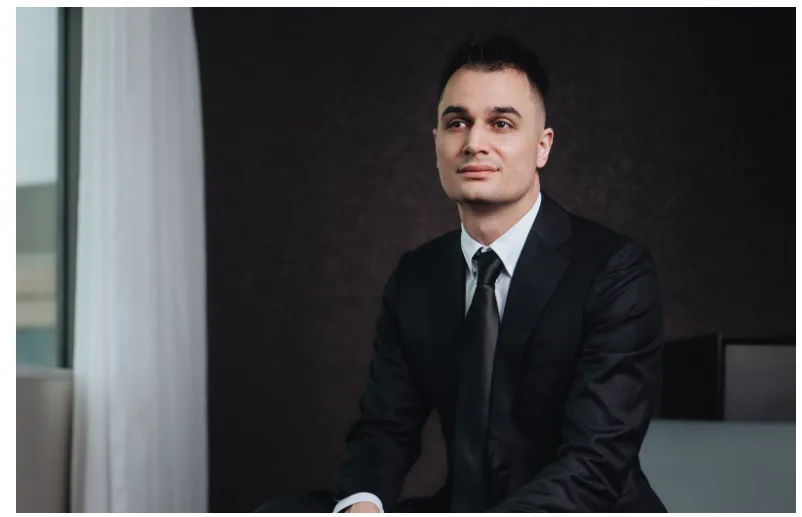
There is a version of success that looks productive from the outside and is quietly destructive from the inside. The founder is everywhere: in every client call, every hiring decision, every operational detail. The company is moving, but only as fast as one person can carry it.
For early-stage startups, that level of founder involvement is often necessary. In the beginning, there is no system. There is only judgment, improvised in real time, applied to problems that have not yet been categorized. Founders earn their early traction through proximity, not delegation.
But somewhere along the way, that proximity stops being an asset. The same habits that built the company begin to limit it. The founder, without meaning to, becomes the ceiling.
When Growth and Access to the Founder Become the Same Thing
Peter Kazan launched Atlantic Tech in 2020 with a clear problem to solve. Businesses needed data, but most of what they had access to was fragmented, unrefined, and difficult to act on. The solution he built was a vertically integrated model: harvest the data, refine it into something usable, and deploy it with precision.
What he could not have anticipated was how quickly that model would demand more than any one person could sustain.
Within a few years, the data intelligence firm Atlantic Tech had expanded beyond its original marketing-focused scope into commodity markets, logistics infrastructure, and enterprise resource planning systems. Operating across more than fifteen countries, supported by a global team of 120 specialized professionals, the company required coordination at a scale where no single decision-maker could remain effective at every level.
“Looking back, the biggest shift is realizing that scale is impossible to achieve alone,” Kazan has reflected. “While the do-it-yourself mindset is what gets a company off the ground, a strong, specialized team and robust technology are what actually keep it in the air.”
The language is precise. Getting off the ground and staying in the air are two different engineering problems. They require different solutions.
What “Stepping Back” Actually Requires
There is a popular misconception about what stepping back from day-to-day operations actually means for a founder. The framing often implies retreat: handing off problems, disengaging from the details, trusting that things will run without active oversight.
Sustainable delegation does not look like that.
What it actually requires is infrastructure. Not only the technical kind, though that matters, but organizational infrastructure: clear systems, defined accountability, and the kind of institutional knowledge that allows a company to function without relying on one person’s memory.
Atlantic Tech’s evolution reflects that understanding. The company’s expansion has not been characterized by loosening its grip on quality. Rather, ownership of quality has been distributed. Specialists across the global operation work within a framework where data accuracy, client accountability, and ethical handling of information are not managed from the top down, but embedded in how teams function at every level.
That kind of internal structure does not happen by accident. Founders have to build it, deliberately, during the periods when they are willing to stop being the answer to every question.
The Strategic Value of Creating Distance
There is something counterintuitive about stepping back, which is that distance tends to reveal things that proximity obscures.
When a founder’s attention is consumed by operational details, the broader pattern of a business becomes harder to see. Decisions get made in response to immediate conditions rather than long-term direction. Opportunities that require a longer view are harder to evaluate when the horizon keeps shifting.
For Kazan, creating space from day-to-day operations did not mean disengaging. It meant reorienting. The questions available to him changed: not “how do we execute this” but “where should this company be in three years, and what infrastructure needs to exist to get there.”
The results of that reorientation are visible in Atlantic Tech’s current trajectory. The company’s recently formalized exclusive 12-month partnership with Keystone Data Group, positioning Atlantic Tech as Keystone’s sole data provider and processing agent, represents exactly the kind of milestone that becomes possible when a founder has shifted from builder to strategist. Deals of that scope are not closed at the operational level. They are the outcome of sustained positioning, deliberate relationship-building, and a long view of where a company’s capabilities can ultimately land.
Community Values at the Core of How He Leads
One dimension of Kazan’s leadership resists easy categorization in conventional founder frameworks, and that resistance is part of what makes it worth examining.
His decision to step back from operational control was not motivated by efficiency alone. A conviction that success carries obligations beyond the balance sheet shaped it as well.
Kazan has been direct about the principle guiding him. “To whom much is given, much is required,” he has said, articulating a belief that runs through his business decisions and his philanthropic commitments in equal measure. Leadership, in his framework, functions not just as a driver of scale but as a responsibility held in trust for the people, the mission, and what the work is ultimately meant to serve.
That philosophy is visible in how he allocates his attention now that Atlantic Tech has the infrastructure to operate without his constant intervention. A meaningful portion of the space created by delegation goes toward the causes documented at Peter Kazan’s philanthropic platform, where his support spans healthcare institutions, humanitarian organizations, and local community relief efforts.
For Kazan, building Atlantic Tech and building a life that extends beyond it are not competing priorities. In his framework, they are part of the same project.
Coming Back With a Different Purpose
The phrase “coming back” in the context of founder evolution can sound like a return to old patterns. What most leaders who have been through the transition describe is something closer to a reorientation.
The operational founder, the one solving problems and holding institutional knowledge in a single set of hands, becomes something else over time. Not less involved, but differently involved. More focused on the conditions that allow the organization to function well than on the functioning itself.
For Kazan, that shift has been gradual and deliberate. Atlantic Tech now operates with the kind of international reach and structural complexity that requires leadership to work well above the daily details, while remaining anchored to the principles that define it.
Those principles, precision, accountability, and a belief that the business exists to serve purposes larger than itself, were not added after the fact. They were present at the beginning and embedded into the company’s infrastructure as it scaled.
That distinction separates founders who come back with purpose from those who simply step back.
Purpose, in that context, is not a personal statement. It is an architectural choice, made early, sustained through growth, and eventually visible in how a company behaves when no single person is managing every outcome.