
Why More Amazon Sellers Are Choosing Seller Fulfilled Prime Over FBA in 2026
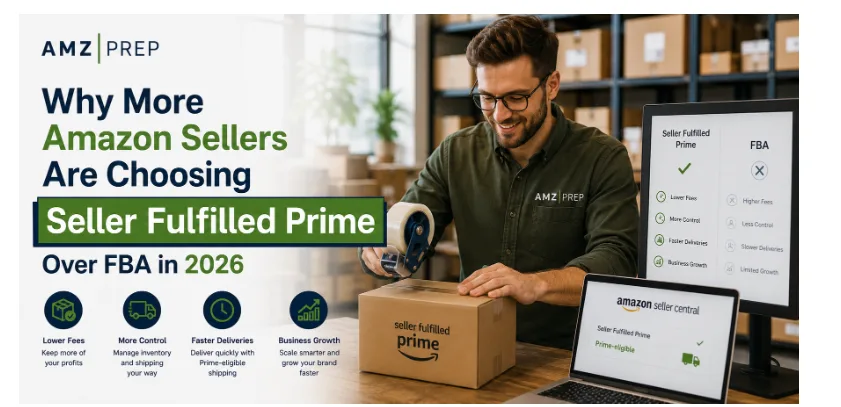
The math is changing. For thousands of Amazon sellers, the numbers no longer add up.
FBA fulfillment fees have climbed every year since 2022. In 2026, Amazon pushed them again. The question in seller Slack channels has shifted. It used to be “how do we optimize within FBA?” Now it’s “do we need FBA at all?”
What actually changed in Amazon’s 2026 fees
The 2026 changes are not one increase. They are a stack, and each layer lands on top of the last.
The January base increase
Starting January 15, Amazon raised FBA fulfillment fees an average of $0.08 per unit on standard size products, per Seller Central’s 2026 fee schedule. Products over $50 saw jumps between $0.31 and $0.51 per unit. A brand selling a $65 protein powder now pays $0.51 more per unit, before anything else hits.
The April surcharge that scales with you
Then April arrived. A 3.5 percent surcharge now applies to every FBA fulfillment fee, effective April 17, 2026. This one is the quiet problem. It is not flat. It scales with your existing costs, so the sellers already paying the most absorb the biggest dollar hit. An oversized item with a $15 fulfillment fee picks up an extra $0.53 per unit, on every order, all year.
The placement fees on top
Inbound placement fees add another layer. Amazon charges sellers who don’t split shipments across multiple centers, and the bulky and extra large tiers carry the steepest penalties. Buy with Prime fees rose $0.24 per unit. Multi-Channel Fulfillment rose $0.30. For tight-margin products, every line item compounds.
The two problems FBA can’t solve
Some FBA costs are about price. These two are about access, and they hit specific catalogs hard.
Meltables get locked out for five months
Every summer, sellers lose access to part of their own supply chain. Amazon flags more than 58,000 ASINs as meltable in warm months. From May through September, those products can’t go to FBA warehouses. Chocolate, gummy vitamins, wax, low-melt cosmetics, certain supplements. All grounded.
Run the math on a DTC chocolate brand doing $200,000 a month on Amazon. That’s $1 million in potential revenue sitting idle across peak gifting and impulse season. The product is there. The demand is there. FBA just won’t take it.
Oversized products pay a steep premium
FBA’s fee structure was built for things that fit in a shoebox. Go bigger and the costs climb fast. Oversized products face fulfillment fees five to eight times higher than standard items, per Amazon’s published tables. A mattress brand shipping a queen size unit can pay $45 or more per unit in oversize fulfillment and handling. Long-term storage fees on that inventory pile on more.
This isn’t a niche issue. Furniture, fitness gear, pet crates, large electronics, outdoor equipment. That category covers a big share of the catalog, and those sellers feel every increase at a larger scale.
What SFP is and how it fixes the stack
Seller Fulfilled Prime lets qualified sellers show the Prime badge while shipping from their own warehouse or a SFP 3pl fulfillment service. Customers see the same blue badge and the same delivery promise. The change sits behind the scenes. The seller runs the fulfillment.
The bar Amazon sets
SFP isn’t easy to qualify for, by design. Amazon protects the Prime experience.
- 99 percent plus on-time shipment rate
- Valid tracking on every order
- Cancellation rate under 0.5 percent
- One to two day nationwide delivery
- Weekend dispatch
- A 30-day trial with at least 100 Prime orders
Clear that bar, through your own operation or a qualified 3PL, and SFP drops the entire FBA fee stack while keeping the badge that drives the sale.
Blair Forrest, CEO at AMZ Prep, put it simply. “The brands leaving FBA are not leaving Amazon. They are leaving Amazon’s warehouse.” The Prime badge still lifts conversion well above a non-Prime listing, and SFP keeps that without the yearly fee creep.
A real example: oversized mattress economics
Oversized is where the SFP case gets sharpest, and mattresses are the clearest version of it.
A large, heavy, costly-to-ship product racks up oversize fulfillment fees, storage costs, and placement charges under FBA. Each one cuts into the margin on every sale. Move that same product to SFP and the per-unit structure changes.
Arishekar N, VP of Marketing at AMZ Prep, sees it in the onboarding data. “The fastest growing SFP segment is oversized products.” His example: a mattress brand paying $45 per unit in FBA oversize fees can fulfill the same order through SFP for under $20. At 2,000 orders a month, that’s $50,000 saved from one switch.
Who should switch and who should stay
SFP is not a universal answer. It solves specific problems for specific sellers.
SFP makes sense when
- Your products are oversized and FBA fees run high
- You sell meltables locked out of FBA for five months a year
- You want custom packaging and unboxing, not Amazon-branded boxes
- You need one inventory pool across Amazon, Shopify, Walmart, and wholesale
- Your products sell above $50, where the 2026 increases bite hardest
FBA still wins when
Small, light, fast-moving products are FBA’s home turf. A seller moving 50,000 units a month of a $12 phone case is almost always better off there. At that size and speed, Amazon’s network is hard to beat.
The honest read: if your average product is under 3 pounds and under $30, FBA is probably still your best call. If it’s oversized, temperature sensitive, premium, or multichannel, the 2026 changes make SFP worth a close look.
Frequently asked questions
What is Seller Fulfilled Prime?
SFP is Amazon’s program that lets qualified sellers show the Prime badge while shipping from their own warehouse or a 3PL partner instead of FBA. Customers get the same badge and delivery promise, while sellers control fulfillment.
How much can SFP save compared to FBA?
Sellers using SFP through a 3PL partner often save 30 to 40 percent on total fulfillment costs versus FBA. For oversized products, savings can reach 50 percent or more once Amazon’s oversize storage and handling fees drop off.
What are the requirements for Seller Fulfilled Prime?
SFP requires a 99 percent plus on-time shipment rate, valid tracking on every order, a cancellation rate under 0.5 percent, one to two day nationwide delivery, weekend dispatch, and a 30-day trial with at least 100 Prime orders.
Can meltable products use SFP?
Yes. Amazon restricts FBA for temperature sensitive products from May through September. SFP through a 3PL with cold storage keeps the Prime badge active all year for meltable products like chocolate and gummy supplements.
Is SFP better than FBA for all sellers?
No. FBA stays the best option for small, light, fast-moving products where Amazon’s scale drives the lowest per-unit cost. SFP fits oversized items, meltables, custom packaging, and multichannel inventory control better.
About the Author
Arishekar N is the VP of Marketing at AMZ Prep, North America’s largest independently owned 3PL fulfillment network operating 50 plus warehouses across the US and Canada. With over 15 years of experience in ecommerce growth and supply chain strategy, Arishekar leads AMZ Prep’s content, SEO, and brand visibility work for a client portfolio that includes Duracell, Unilever, JBL, and Eight Sleep.