
Why ACH and Pay-by-Bank Should Be Part of US Payment Readiness for Online Merchants
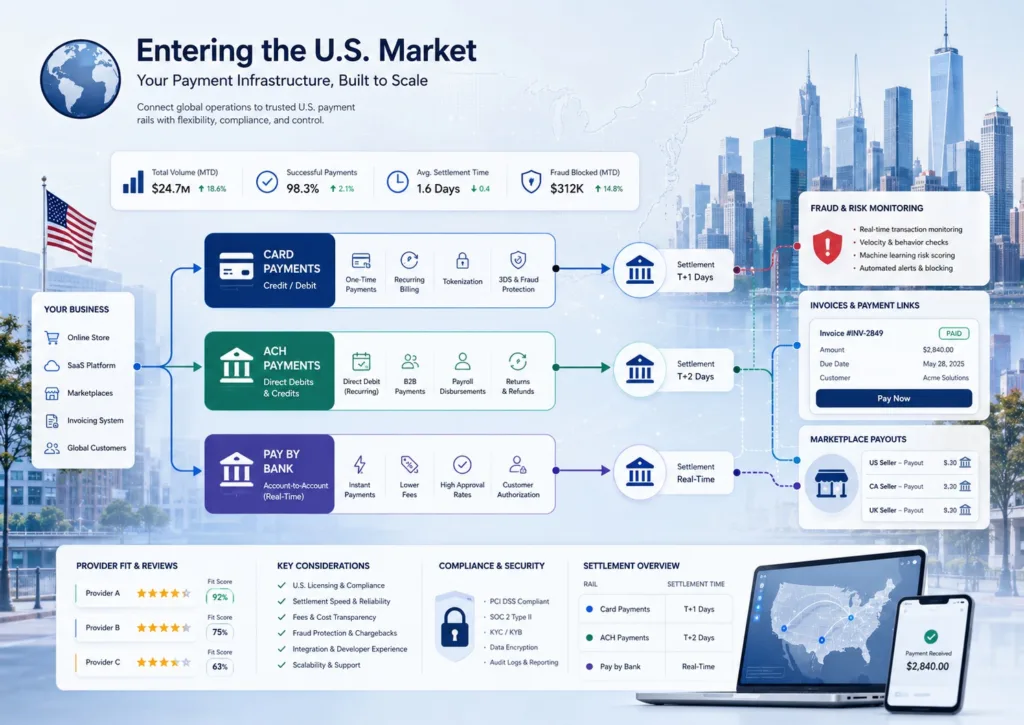
For international merchants, entering the US market often begins with a familiar question: how will customers pay?
The first answer is usually cards. That is understandable. Cards remain central to American commerce, and many online merchants build their US payment plans around card acceptance, authorisation rates, fraud screening and chargeback controls.
But cards are not the whole payment story.
The United States also has a large account-to-account payment ecosystem. ACH payments, pay-by-bank models and emerging faster payment options can be important for businesses that want to support subscriptions, invoices, high-value transactions, recurring payments, marketplace flows, B2B collections or more resilient settlement planning.
For merchants entering the US, the point is not to replace card processing. The point is to understand where bank-based payments can strengthen the payment mix.
A merchant that treats cards as the only payment rail may miss opportunities to reduce dependency on one route, improve payment resilience and design better options for customers or business clients.
The US market is large enough to expose weak payment planning
The US is one of the most attractive markets for online merchants.
The US Census Bureau estimated that retail eCommerce sales reached approximately $326.7 billion in the first quarter of 2026, adjusted for seasonal variation. That scale attracts international eCommerce brands, SaaS companies, marketplaces, digital services, education platforms, travel businesses and B2B providers.
But a large market also exposes operational weaknesses faster.
A payment setup that works in one country may not work the same way in the US. Merchants may face different issuer behaviour, fraud patterns, customer expectations, refund habits, settlement requirements and provider underwriting standards.
For UK, European and other international merchants, the US may feel commercially familiar because of the English language and the size of the customer base. Yet the payment environment has its own rules and expectations.
That is why US payment readiness should be reviewed before launch.
ACH is not a niche rail
ACH is sometimes misunderstood by merchants outside the United States.
It is not simply an old bank-transfer system. ACH is a major part of US payments infrastructure, supporting direct deposits, bill payments, business payments, account-to-account transfers and recurring collections.
Nacha reported that ACH Network payment volume reached 35.2 billion payments in 2025, with a total value of $93 trillion. Same Day ACH also reached 1.4 billion payments worth $3.9 trillion.
For merchants, this matters because ACH can support use cases that cards do not always handle efficiently.
A SaaS company may use bank payments for larger business subscriptions.
A B2B provider may collect invoice payments.
A marketplace may need predictable payouts and settlement reconciliation.
An online education platform may offer recurring tuition or programme fees.
A logistics or fulfilment business may handle larger account-based payments.
A travel or booking platform may need deposits, instalments or supplier payments.
ACH is not always the right rail for every transaction, but it deserves to be part of the US payment discussion.
Pay-by-bank is about customer choice and payment resilience
Pay-by-bank is often used as a broad term for account-to-account payments that allow customers to pay directly from a bank account rather than using a card.
For online merchants, the attraction is simple: it can create another payment path.
That matters when a business depends heavily on card acceptance. Card payments bring many advantages, including broad consumer familiarity and fast checkout experiences. But they also bring fraud exposure, chargebacks, interchange costs, authorisation declines and card lifecycle issues such as expired credentials or failed renewals.
Pay-by-bank can be useful when merchants want to support:
- recurring payments;
- high-value purchases;
- B2B invoices;
- account-based customer relationships;
- lower card dependency;
- alternative checkout options;
- predictable settlement planning.
The Federal Reserve has discussed pay-by-bank and merchant payment use cases, reflecting wider interest in how account-based payments may affect merchants and consumers.
The practical lesson for merchants is not that pay-by-bank is automatically better than cards. It is that payment choice can become part of payment resilience.
Which merchants should pay attention?
Pay-by-bank and ACH are most relevant when a merchant has recurring, high-value, invoice-based or account-based payment flows.
Good examples include SaaS companies, online memberships, B2B service providers, professional services firms, software vendors, digital education platforms, online training businesses, creator platforms, marketplaces, logistics providers, fulfilment companies, booking businesses, cross-border eCommerce merchants, wellness and specialty eCommerce brands, and relationship-focused subscription platforms.
These sectors may not all be high-risk in the same way. But they often have payment needs that go beyond a simple one-time card checkout.
A subscription company may want a backup for failed card renewals.
A B2B service provider may prefer account-based invoice collections.
A marketplace may need payout and reconciliation planning.
A logistics business may handle larger invoices and settlement timing.
A digital education provider may need recurring payment options and clear refund rules.
A travel or booking business may need deposit and cancellation workflows.
A wellness or specialty eCommerce brand may need clearer product documentation, refund terms and settlement planning before entering a new market.
A relationship-focused membership platform may need recurring billing controls, recognisable descriptors and customer-support processes that reduce avoidable disputes.
For documentation-heavy or higher-scrutiny merchants, payment readiness becomes even more important. Providers may ask about the business model, customer geography, refund policies, fulfilment process, fraud controls, processing history and expected volumes.
The payment rail matters, but the merchant’s operating model matters too.
ACH still needs fraud controls
Bank-based payments can reduce some card-specific risks, but they do not remove fraud risk.
ACH and pay-by-bank flows can still face account takeover, unauthorised transactions, social engineering, mule accounts, false-pretense payments, refund abuse and onboarding weaknesses.
Nacha’s 2026 risk-management changes make this point clear. Nacha announced that new fraud monitoring requirements affect ODFIs and, in phases, certain non-consumer originators, third-party service providers and third-party senders. The rules are intended to support risk-based processes for identifying ACH entries initiated due to fraud.
For merchants, the lesson is practical: account-to-account payments still need monitoring.
A business should understand:
- who is authorised to initiate the payment;
- how bank-account ownership is verified;
- when additional checks are required;
- how suspicious patterns are flagged;
- how refunds are handled;
- how failed payments are resolved;
- what evidence is available if a transaction is challenged.
A merchant entering the US should not view ACH as a shortcut around payment controls. It should view ACH as another rail that requires its own risk design.
Settlement timing affects cash flow
One reason merchants care about ACH and pay-by-bank is settlement planning.
Card settlement, ACH settlement, Same Day ACH, account-to-account payments and emerging instant payment options can all affect cash flow differently. The right mix depends on the business model.
A merchant selling low-value consumer products may prioritise checkout speed. A B2B service provider may care more about predictable invoice collection. A subscription business may want stable recurring revenue. A travel or booking company may need to manage deposits, supplier payments and cancellations. A marketplace may need to reconcile buyer payments and seller payouts.
Payment readiness should therefore include settlement questions:
- How quickly are funds available?
- Which payment methods match the transaction size?
- What happens when a payment fails?
- Are refunds funded from the same route?
- Can finance reconcile payments by customer, invoice or order?
- Does the payment partner support the merchant’s category?
- Is there a backup route if one rail becomes unavailable?
Merchants often focus on payment acceptance first. But settlement reliability is just as important for growth.
Cards and ACH should be designed together
The strongest payment setup is rarely a single rail.
For many US-facing merchants, the practical strategy is to design cards, ACH and pay-by-bank together.
Cards may remain the default for many consumer purchases. ACH may be better for recurring bank-account payments or B2B collections. Pay-by-bank may support account-based checkout. Instant payment options may become useful for certain payout and real-time transfer use cases as adoption grows.
The Federal Reserve’s FedNow Service is designed to help financial institutions deliver faster payment services to their customers. While merchant adoption depends on provider support, bank participation and use-case maturity, instant payments are part of the broader US payment landscape merchants should monitor.
The question for merchants is not, “Which rail is best?”
The better question is, “Which rail fits which transaction?”
A US payment plan should match payment methods to customer behaviour, transaction size, fraud risk, refund expectations, settlement needs and provider support.
Why this matters before US launch
Merchants often review payment alternatives after something goes wrong.
Card declines rise. Chargebacks increase. Settlement is delayed. A provider asks more questions. A subscription business loses renewals. A B2B client asks for bank payment options. A marketplace struggles with reconciliation. A travel company faces refund pressure. A wellness brand receives extra documentation questions. A relationship-focused membership platform sees avoidable disputes from unclear billing or weak support.
At that point, changing the payment setup becomes urgent and disruptive.
It is better to prepare earlier.
Before entering the US market, a merchant should review:
- whether cards alone are enough;
- where ACH could support the operating model;
- whether pay-by-bank makes sense for customers or clients;
- how fraud monitoring works across payment methods;
- whether refund and cancellation policies are clear;
- how settlement timing affects cash flow;
- what documentation payment partners may request;
- whether backup options are available.
This is especially important for international merchants. A company may have strong sales in its home market but still need a US-specific payment structure.
How WiseAlt fits into the planning process
Payment readiness is not only a technical integration question. It is also a provider-fit, documentation and operating-model question.
WiseAlt helps online merchants review payment infrastructure before expansion, including payment route suitability, onboarding preparation, fraud exposure, chargeback risk, settlement needs and backup options.
For international merchants preparing to enter the American market, WiseAlt also supports US payment readiness for online merchants by helping businesses think through card acceptance, ACH or bank-payment options, provider expectations, documentation and market-entry payment structure.
WiseAlt is not a PSP, acquiring bank, payment gateway, card processor, money transmitter, law firm or approval guarantor. Its role is to help merchants prepare their payment setup and coordinate discussions with relevant payment-solution partners where appropriate.
Final operating principle
US market entry should not begin with a single payment assumption.
Cards are important, but they are not the only rail merchants should understand. ACH, pay-by-bank and faster payment options can support payment resilience when they are matched to the right business model and supported by proper controls.
For online merchants, the practical lesson is simple: payment choice is part of growth strategy.
A business entering the US should know how customers want to pay, how funds will settle, how fraud will be monitored, how refunds will be handled and which providers can support the model.
ACH and pay-by-bank are not magic solutions. They are infrastructure options. Used carefully, they can help merchants reduce dependency on one payment route and build a stronger foundation for US growth.