
Who Makes Bentley Engines? History, W12 Legacy, V8 & Hybrid Powertrains Explained
Bentley has spent more than a century building some of the world’s most desirable luxury cars. From the elegant Continental GT and executive Flying Spur to the versatile Bentayga, every Bentley is designed to deliver effortless performance alongside handcrafted British luxury.
But one question continues to appear among automotive enthusiasts: Who makes Bentley engines?
The short answer is Bentley engines are developed within the Volkswagen Group and extensively engineered, calibrated, and refined by Bentley Motors at its headquarters in Crewe, England.
While Bentley shares technology with brands such as Audi and Porsche, its engines are not simply rebadged units. Bentley engineers tune each powertrain to deliver the smooth power delivery, refinement, and grand touring performance that define the marque.
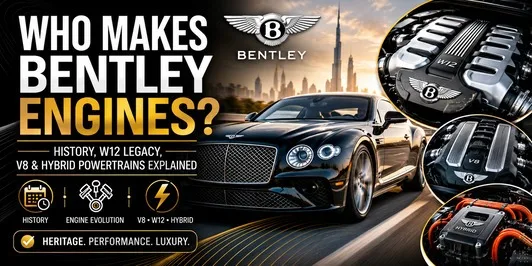
Over the years, Bentley’s engines have evolved from W.O. Bentley’s racing-inspired four-cylinder designs to the legendary 6.0-litre W12, modern 4.0-litre twin-turbo V8, and today’s advanced hybrid powertrains. Understanding this evolution explains why Bentley remains one of the most respected names in luxury automotive engineering.
Who Makes Bentley Engines Today?
Since joining the Volkswagen Group in 1998, Bentley has gained access to world-class engineering resources while maintaining its own development philosophy.
Modern Bentley engines combine shared Volkswagen Group technology with extensive work carried out by Bentley’s engineering teams in Crewe, Cheshire. This includes:
- ECU calibration
- Turbocharger tuning
- Cooling system optimisation
- Transmission programming
- NVH (Noise, Vibration and Harshness) refinement
- Performance testing
The result is an engine that feels distinctly Bentley, powerful, refined, and effortless rather than aggressive.
Today’s Bentley lineup includes:
- 6.0-litre W12 (legacy models)
- 4.0-litre twin-turbo V8
- Plug-in Hybrid powertrains
- Ultra Performance Hybrid systems powering Bentley’s newest flagship models
Rather than chasing maximum horsepower alone, Bentley engineers prioritise abundant torque, smooth acceleration, and long-distance comfort, qualities that have defined the brand for generations.
The Evolution of Bentley Engines
Bentley’s engineering story began in 1919 when Walter Owen Bentley (W.O. Bentley) founded Bentley Motors with a simple vision: build fast, reliable cars that could outperform their rivals.
The company’s first engines powered iconic models such as the 3-Litre, 4½ Litre, and Speed Six. These engines earned Bentley international recognition through multiple victories at the 24 Hours of Le Mans, proving that performance and durability could go hand in hand.
A major turning point came in 1931, when Rolls-Royce acquired Bentley. During the following decades, many Bentley models shared platforms and engines with Rolls-Royce vehicles. The famous L-Series V8 became the backbone of both brands, delivering smooth performance and exceptional refinement for luxury touring.
Everything changed again in 1998 when Bentley joined the Volkswagen Group. The investment transformed Bentley’s engineering capabilities and allowed the company to develop a new generation of high-performance powertrains while keeping design and vehicle development centred at Crewe.
The launch of the Continental GT in 2003 introduced the now legendary 6.0-litre twin-turbocharged W12. It quickly became Bentley’s signature engine, combining supercar performance with the comfort expected from a luxury grand tourer.
Today, Bentley’s engine lineup has evolved once again. Alongside the W12, the company introduced the 4.0-litre twin-turbo V8, followed by advanced plug-in hybrid systems that combine electric power with traditional internal combustion engines. These powertrains reflect Bentley’s commitment to preserving performance while preparing for an electrified future.
Although the technology has changed dramatically over the last century, Bentley’s philosophy remains the same. Every engine is designed to deliver effortless acceleration, refined performance, and long-distance comfort rather than chasing performance figures alone.
Bentley Engineering Timeline
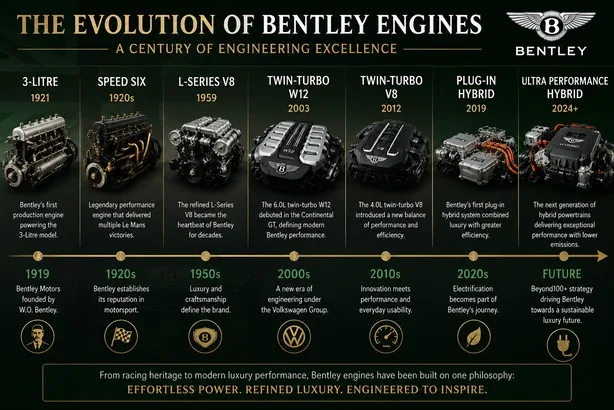
Bentley’s engine development reflects more than a century of innovation. Each generation introduced new technologies while preserving the brand’s focus on luxury, performance, and grand touring.
| Year | Engine Milestone |
| 1919 | Bentley Motors is founded by W.O. Bentley. |
| 1921 | The first 3-Litre Bentley enters production. |
| 1920s | 4½ Litre and Speed Six engines help Bentley secure multiple 24 Hours of Le Mans victories. |
| 1931 | Rolls-Royce acquires Bentley, beginning decades of shared engineering. |
| 1959 | The L-Series V8 becomes Bentley’s signature luxury engine for several decades. |
| 1998 | Bentley joins the Volkswagen Group, ushering in a new era of powertrain development. |
| 2003 | The 6.0-litre twin-turbocharged W12 debuts in the Continental GT. |
| 2012 | Bentley introduces the 4.0-litre twin-turbo V8. |
| 2019 | Bentley launches its first plug-in hybrid model. |
| 2024 | Production of the W12 ends as Bentley expands its Ultra Performance Hybrid lineup. |
This timeline shows how Bentley has continuously evolved its engines while staying true to its founding philosophy of delivering effortless performance and refined luxury.
Bentley Engine Comparison
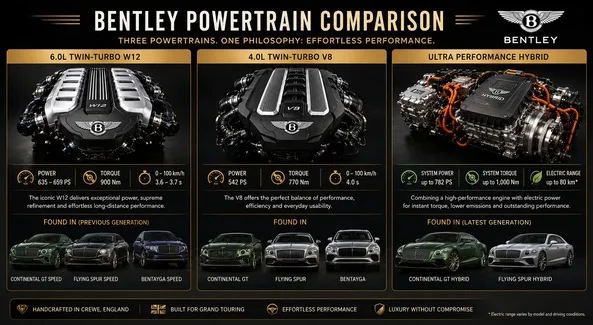
Although Bentley’s powertrains have changed significantly over the years, each one has been developed to deliver smooth power, exceptional refinement, and long-distance comfort.
| Engine | Found In | Best For |
| 6.0L Twin-Turbo W12 | Continental GT Speed, Flying Spur Speed, Bentayga Speed (previous generation) | Flagship performance, effortless acceleration, and grand touring. |
| 4.0L Twin-Turbo V8 | Continental GT, Flying Spur, Bentayga | Balanced performance, improved efficiency, and everyday driving. |
| Ultra Performance Hybrid | Latest Continental GT and Flying Spur | Instant torque, lower emissions, and next-generation luxury performance. |
Rather than replacing one another, these powertrains represent Bentley’s engineering evolution. The W12 established Bentley as a modern performance luxury brand, the V8 improved efficiency while maintaining its signature driving character, and the latest hybrid systems combine electric technology with high-performance engineering to shape Bentley’s future.
Did Bentley Ever Use Rolls-Royce Engines?
Yes. For much of the twentieth century, Bentley and Rolls-Royce shared engines because Bentley was owned by Rolls-Royce Motors after its acquisition in 1931.
One of the best-known examples was the L-Series V8, introduced in 1959. This engine powered numerous Bentley models, including the Turbo R, Brooklands, Azure, Arnage, and early Mulsanne variants. It became known for its smooth power delivery, strong low-end torque, and exceptional reliability.
The relationship changed in 1998, when Volkswagen Group acquired Bentley while BMW secured the rights to build future Rolls-Royce cars. After a short transition period, the two brands became independent competitors once again.
As a result, modern Bentley models do not use Rolls-Royce engines.
Today’s Bentleys are powered by engines developed within the Volkswagen Group and extensively engineered by Bentley. Rolls-Royce, on the other hand, develops its own V12 and electric powertrains under BMW ownership.
Although the two brands share British heritage and a long history together, their engineering philosophies are now very different.
Bentley focuses on grand touring performance, combining luxury with strong acceleration and engaging driving dynamics. Rolls-Royce prioritises effortless refinement, near-silent operation, and chauffeur-oriented comfort.
This separation gave Bentley the freedom to develop one of the most celebrated luxury engines of the modern era: the 6.0-litre twin-turbocharged W12, followed by today’s advanced V8 and hybrid powertrains.
The Bentley W12 Engine: A Modern Automotive Icon
Few engines have shaped a luxury brand as much as Bentley’s 6.0-litre twin-turbocharged W12. Introduced with the Continental GT in 2003, it became the flagship powertrain for Bentley’s most prestigious models for more than two decades.
Unlike a conventional V12, the W12 uses a compact “W” configuration that combines two narrow-angle VR6 engine banks around a single crankshaft. This design allows twelve cylinders to fit into a smaller space while maintaining exceptional smoothness and performance.
For Bentley, the compact layout offered several advantages:
- Better weight distribution
- More cabin and packaging space
- Improved all-wheel-drive integration
- High power with refined operation
Bentley engineers continuously evolved the W12 throughout its production life. Updates included larger turbochargers, improved engine management software, cylinder deactivation, and more efficient cooling systems. These refinements increased performance while reducing fuel consumption and emissions.
In its final form, the W12 produced more than 650 horsepower and 900 Nm of torque, enabling models like the Continental GT Speed, Flying Spur Speed, and Bentayga Speed to deliver supercar performance with the comfort of a luxury grand tourer.
More importantly, the W12 wasn’t just about impressive numbers. It delivered effortless acceleration, near-silent cruising, and instant power at almost any speed. These characteristics became central to Bentley’s identity and distinguished the brand from many other luxury manufacturers.
As emissions regulations became stricter and Bentley accelerated its Beyond100+ strategy, the company announced the end of W12 production. While its successor uses advanced hybrid technology, the W12 remains one of the most influential engines in modern luxury automotive history and a defining chapter in Bentley’s engineering legacy.
Bentley’s V8 and Hybrid Powertrains
While the W12 became Bentley’s flagship engine, the 4.0-litre twin-turbo V8 has become the backbone of the brand’s modern lineup. Available in models such as the Continental GT, Flying Spur, and Bentayga, the V8 delivers an excellent balance of performance, efficiency, and everyday usability.
Developed within the Volkswagen Group and extensively tuned by Bentley engineers, the V8 produces strong low-end torque, rapid throttle response, and refined cruising characteristics. Its lighter weight also improves handling without compromising the effortless driving experience Bentley is known for.
Bentley has also embraced electrification with plug-in hybrid and Ultra Performance Hybrid powertrains. These systems pair a powerful petrol engine with an electric motor, delivering instant torque, lower emissions, and improved fuel efficiency while maintaining the performance expected from a Bentley.
Today’s buyers can choose between multiple powertrains depending on their driving preferences:
- W12 for maximum grand touring performance.
- Twin-turbo V8 for a balance of power and agility.
- Hybrid for enhanced efficiency with impressive acceleration.
Experiencing these engines on the road highlights how each has its own personality. Whether it’s the effortless surge of the W12, the responsive character of the V8, or the silent low-speed operation of a hybrid, every powertrain reflects Bentley’s focus on refined performance. For enthusiasts who want to compare these driving experiences before ownership, many choose to rent Bentley in Dubai, where models like the Continental GT, Flying Spur, and Bentayga are available with different engine options.
Which Bentley Models Use Which Engines?
Bentley’s engine lineup has evolved over the years, with different models offering powertrains tailored to their purpose. While older vehicles relied on the iconic W12 and L-Series V8, today’s lineup combines high-performance V8 and hybrid technology.
| Bentley Model | Engine Options | Highlights |
| Continental GT | 4.0L Twin-Turbo V8, W12 (previous generation), Ultra Performance Hybrid | Luxury grand tourer with exceptional performance. |
| Flying Spur | 4.0L Twin-Turbo V8, W12 (previous generation), Hybrid | Executive sedan combining comfort with powerful acceleration. |
| Bentayga | 4.0L Twin-Turbo V8, Hybrid, W12 (Speed models) | Luxury SUV designed for everyday usability and long-distance touring. |
| Continental GTC | 4.0L Twin-Turbo V8, W12 (previous generation) | Convertible grand tourer with refined performance. |
| Batur | Hand-built 6.0L Twin-Turbo W12 | One of the final Bentley models to feature the legendary W12. |
Although these models share Bentley’s engineering philosophy, each delivers a distinct driving experience. The Continental GT is built for effortless high-speed touring, the Flying Spur prioritises executive luxury, and the Bentayga combines performance with SUV versatility.
Looking ahead, Bentley’s future models will increasingly rely on Ultra Performance Hybrid and fully electric powertrains as the company continues its Beyond100+ transformation. While the legendary W12 has reached the end of production, its legacy will continue to influence the next generation of Bentley engineering.
The Future of Bentley Engines
Bentley is entering a new era of automotive engineering. Through its Beyond100+ strategy, the company aims to become a leader in sustainable luxury by expanding its range of hybrid models and introducing fully electric vehicles.
The retirement of the iconic W12 does not signal the end of Bentley’s performance heritage. Instead, it marks a shift toward powertrains that combine electric motors with advanced combustion technology to deliver greater efficiency without sacrificing performance.
The latest Ultra Performance Hybrid system already demonstrates this approach. By pairing a twin-turbo V8 with an electric motor, Bentley has created a powertrain that offers impressive acceleration, instant torque, and lower emissions than its predecessor.
Future Bentley models will continue to focus on the qualities that have defined the brand for more than a century:
- Effortless performance
- Refined driving dynamics
- Handcrafted luxury
- Advanced engineering
- Sustainable innovation
While the technology beneath the bonnet will continue to evolve, Bentley’s commitment to building exceptional grand touring cars remains unchanged. Whether powered by a W12, a twin-turbo V8, a hybrid system, or a fully electric drivetrain, every Bentley is designed to deliver the same blend of luxury, craftsmanship, and performance that has made the marque one of the most respected names in the automotive world.
Frequently Asked Questions
Who makes Bentley engines today?
Bentley engines are developed within the Volkswagen Group and are extensively engineered, calibrated, and integrated by Bentley Motors at its headquarters in Crewe, England.
Does Bentley still use Rolls-Royce engines?
No. Modern Bentley vehicles no longer use Rolls-Royce engines. Since Bentley joined the Volkswagen Group in 1998, it has developed its powertrains independently of Rolls-Royce.
What is Bentley’s most famous engine?
The 6.0-litre twin-turbocharged W12 is widely regarded as Bentley’s most iconic modern engine. It powered models such as the Continental GT, Flying Spur, and Bentayga Speed for more than two decades.
Does Bentley still make the W12?
No. Bentley has ended W12 production as part of its transition toward hybrid and electric powertrains under the Beyond100+ strategy.
What engines do current Bentley models use?
Today’s Bentley models are powered by 4.0-litre twin-turbo V8, plug-in hybrid, and Ultra Performance Hybrid powertrains, depending on the model and specification.
Conclusion
So, who makes Bentley engines?
Today, Bentley engines are developed within the Volkswagen Group and refined by Bentley Motors at its engineering and manufacturing headquarters in Crewe, England. This collaboration combines advanced automotive technology with more than a century of British craftsmanship to produce some of the world’s finest luxury powertrains.
From the early racing engines designed by W.O. Bentley to the legendary W12, modern twin-turbo V8, and advanced hybrid systems, Bentley has continually evolved while staying true to its original philosophy of effortless performance and refined luxury.
As Bentley moves toward an all-electric future through its Beyond100+ strategy, its commitment to innovation, craftsmanship, and grand touring excellence remains unchanged. Whether you’re interested in Bentley’s engineering, its rich heritage, or simply want to experience these remarkable machines firsthand, understanding the story behind Bentley’s engines offers a deeper appreciation for one of the automotive industry’s most iconic brands.