
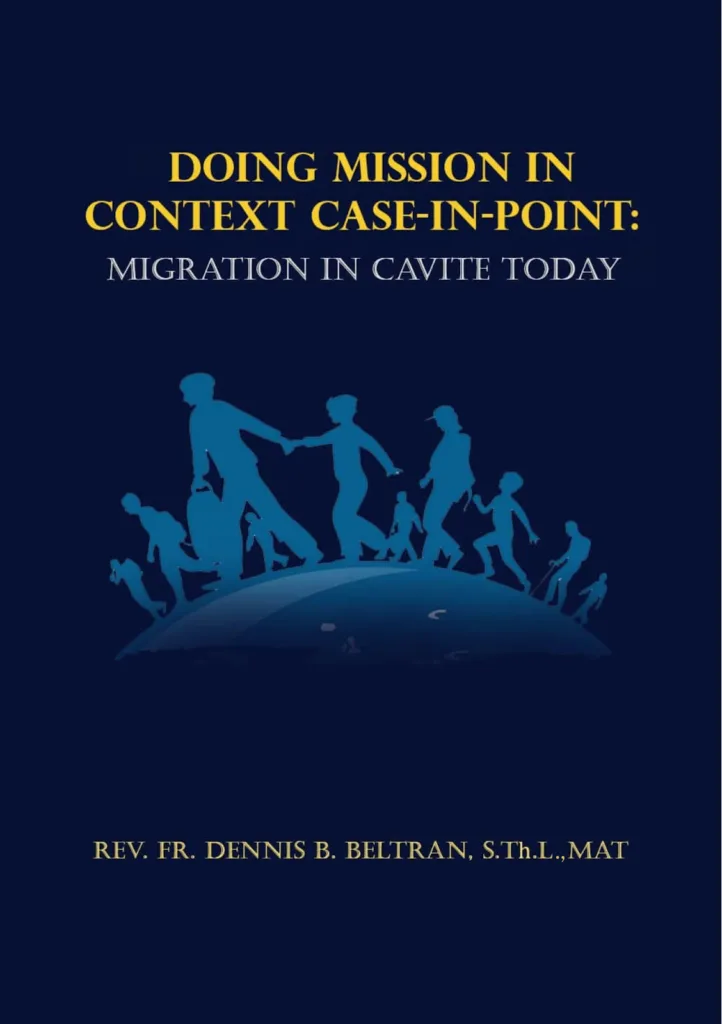
Migration as a Locus for Mission: Doing Mission in Context in the Face of Migration in Cavite Today
Abstract
Migration has become one of the most significant social realities shaping contemporary societies and ecclesial communities. In the Philippine context, the province of Cavite has undergone dramatic demographic transformation due to rapid industrialization, urbanization, and the influx of migrants from various regions of the country. This article presents a theological and pastoral reflection on migration as a locus for mission, drawn from the author’s study Doing Mission in Context: Case-in-Point – Migration in Cavite Today. By integrating sociological analysis, biblical theology, and the teaching of the Church, the study proposes that migration should not be understood merely as a social phenomenon but as a missionary context where the Church is called to proclaim the Gospel and foster communion among diverse communities. The article argues that the local Church must integrate ministry to migrants into its pastoral priorities, recognizing migrants not only as recipients of pastoral care but also as agents of evangelization.
Introduction
Migration has emerged as one of the defining realities of the contemporary world. Economic globalization, political instability, environmental challenges, and social inequalities have compelled millions of people to move from their places of origin in search of better opportunities and dignified living conditions. In many regions, migration has profoundly reshaped societies, cultures, and religious communities.
In the Philippines, migration has long been a part of the social fabric of national life. While the global movement of Filipino workers has attracted significant attention, internal migration within the country is equally significant. Provinces located near metropolitan centers have experienced rapid demographic growth as migrants relocate in search of employment and improved living conditions.
The province of Cavite provides a concrete example of this phenomenon. Over the past decades, Cavite has transformed from an agricultural province into a major industrial and residential hub. This transformation has attracted migrants from various regions of the Philippines, resulting in complex cultural, social, and pastoral realities.
This article presents a capsulized reflection on migration as a context for mission, drawing from my broader study on migration in Cavite. The study seeks to demonstrate that migration is not merely a sociological phenomenon but also a theological reality that calls the Church to renew its missionary commitment. As I argue in my book, “migration today constitutes a significant context in which the Church is called to carry out its mission of evangelization.”¹
Migration in Cavite: Historical and Social Context
Cavite has historically been a region shaped by mobility and migration. During the Spanish colonial period, the province served as an important port area connected to the Manila-Acapulco galleon trade. This early history of interaction with diverse peoples and cultures laid the groundwork for the province’s contemporary character as a place of migration.
In recent decades, the rapid industrialization of Cavite has significantly accelerated migration to the province. The establishment of economic zones, factories, and residential developments has attracted workers and families seeking employment and economic stability.
As noted in my study, “Cavite’s economic transformation has turned the province into a destination for migrants who seek better opportunities for livelihood and family life.”²
The influx of migrants has led to significant demographic changes. Many communities in the Diocese of Imus now consist largely of migrants who originate from different regions of the Philippines. This diversity enriches the life of the Church but also presents pastoral challenges related to integration, cultural differences, and social adjustment.
Migration in Cavite therefore cannot be understood merely in economic terms. It involves complex cultural, social, and religious dynamics that shape the life of the local Church.
Push and Pull Factors of Migration
Migration is often influenced by a combination of push and pull factors.
Push factors refer to the conditions that compel individuals to leave their places of origin. These include poverty, unemployment, lack of educational opportunities, and environmental challenges. Many migrants leave their hometowns because they perceive limited opportunities for economic and personal development.
In the context of Cavite, migrants often come from provinces where employment opportunities are scarce. As noted in the study, “economic hardship and the lack of sustainable livelihood in the provinces remain among the primary reasons why families decide to migrate.”³
Pull factors, on the other hand, attract migrants to particular locations. In Cavite, the availability of jobs in industrial zones, access to education, and proximity to Metro Manila serve as powerful incentives for migration.
However, migration also brings challenges. Migrants often struggle with social integration, housing conditions, and economic insecurity. These realities require a compassionate pastoral response from the Church.
Migration in the Light of Scripture
The experience of migration is deeply rooted in the biblical narrative. Throughout salvation history, migration has played a central role in the unfolding of God’s plan.
The Old Testament begins with the call of Abraham to leave his homeland and journey to a land that God would show him (Gen 12:1). This migration marks the beginning of the history of the people of Israel.
Similarly, the Exodus of the Israelites from Egypt represents a movement from slavery to freedom under God’s guidance.
These biblical narratives remind us that migration is not merely a historical phenomenon but also a spiritual journey marked by trust in God’s providence.
In the New Testament, the experience of migration continues to shape the story of salvation. The Holy Family’s flight into Egypt portrays Jesus himself as a migrant and refugee.
As I note in the book, “the experience of displacement and migration is not foreign to the Christian story; rather, it forms part of the very narrative of salvation history.”⁴
Migration therefore becomes a theological lens through which the Church can understand its mission in a world characterized by human mobility.
Migration in the Teaching of the Church
The Catholic Church has consistently affirmed the dignity and rights of migrants. Various ecclesial documents emphasize the Church’s responsibility to provide pastoral care for migrants and to defend their human dignity.
One of the most important documents in this regard is the instruction Erga Migrantes Caritas Christi, which highlights the Church’s commitment to migrants and refugees. The document emphasizes that migrants should not be regarded merely as recipients of pastoral assistance but as active participants in the mission of the Church.
Similarly, the missionary encyclical Redemptoris Missio reminds the Church that evangelization must reach all peoples and cultures, including those who are displaced or marginalized.
In this context, migration challenges the Church to adopt new pastoral approaches that respond to the realities of human mobility.
Migration as a Locus for Mission
A central thesis of my study is that migration should be understood as a locus for mission.
The presence of migrants invites the Church to encounter new cultures and experiences that enrich ecclesial life. Rather than viewing migration solely as a pastoral problem, the Church must recognize its missionary potential.
As I write in the book, “migration today is not only a social phenomenon but also a missionary opportunity through which the Church can proclaim the Gospel in new contexts.”⁵
Migrants themselves often become agents of evangelization. Filipino migrants, for instance, frequently bring their Catholic faith to new communities, thereby contributing to the spread of the Gospel.
In this sense, migration can be seen as part of the broader missionary movement of the Church.
Pastoral Implications for the Local Church
The reality of migration calls for concrete pastoral responses at the diocesan and parish levels.
First, the Church must cultivate a spirit of hospitality that welcomes migrants into the life of the community. Hospitality reflects the Gospel call to recognize Christ in the stranger.
Second, pastoral programs should encourage migrants to participate actively in parish life. Faith formation programs, small Christian communities, and cultural celebrations can help migrants feel at home in their new environment.
Third, pastoral workers must accompany migrants in their struggles. Many migrants experience loneliness, economic hardship, and family separation. The Church must provide both spiritual support and social assistance.
Finally, migrants themselves should be empowered to become missionary disciples who contribute to the evangelizing mission of the Church.
Conclusion
Migration has become one of the defining realities of the contemporary world. In the context of Cavite, migration has reshaped the social and ecclesial landscape of the province in profound ways.
The Church is called to respond to this reality not merely with social assistance but with a renewed missionary vision. Migration offers a unique opportunity for the Church to proclaim the Gospel, build inclusive communities, and foster intercultural dialogue.
By recognizing migration as a locus for mission, the local Church can transform pastoral challenges into opportunities for evangelization and renewal.
Footnotes
- Dennis B. Beltran, Doing Mission in Context: Case-in-Point – Migration in Cavite Today (Cavite: Publishift Press, 2025), 11.
- Beltran, Doing Mission in Context, 14.
- Ibid., 17–20.
- Ibid., 45.
- Ibid., 83.
Bibliography
Church and Magisterial Documents
Catholic Bishops’ Conference of the Philippines. Pastoral Letter on the Occasion of National Migration Day. February 21, 1998.
Catholic Bishops’ Conference of the Philippines. Poverty, Migration and Family. Manila, 2006.
Federation of Asian Bishops’ Conferences. Christian Discipleship in Asia Today. Sixth Plenary Assembly Background Paper No. 73f. Manila, January 10–19, 1995.
Federation of Asian Bishops’ Conferences. A Renewed Church in Asia: A Mission of Love and Service. Seventh Plenary Assembly. Bangkok, January 3–12, 2000.
Federation of Asian Bishops’ Conferences. FABC at Forty Years: Responding to the Challenges of Asia—A New Evangelization. Tenth Plenary Assembly. Xuan Loc and Ho Chi Minh City, December 10–16, 2012.
Pontifical Council for the Pastoral Care of Migrants and Itinerant People.
Erga Migrantes Caritas Christi. Vatican City, 2004.
Sacred Congregation for Bishops.
De Pastorali Migratorum Cura. Vatican City, 1969.
Second Plenary Council of the Philippines.
Acts and Decrees of the Second Plenary Council of the Philippines. Manila, 1991.
Books
Alinsangan, Gil A.
Treasures New and Old: Encounter with the Gospel on Weekdays. Makati City: St. Pauls, 2010.
Amaladoss, Michael.
“Response to Sung-Hae Kim.” In Mission in the Third Millennium, edited by Robert J. Schreiter. Maryknoll, NY: Orbis Books, 2001.
Baggio, Fabio, and Agnes M. Brazal, eds.
Faith on the Move: Towards a Theology of Migration. Quezon City: Ateneo de Manila University Press, 2008.
Beltran, Dennis B.
Doing Mission in Context: Case-in-Point – Migration in Cavite Today. Cavite: Publishift Press, 2025.
Brown, Raymond E., Joseph A. Fitzmyer, and Roland E. Murphy, eds.
The New Jerome Biblical Commentary. Bangalore: Theological Publications in India, 2004.
Calairo, Emmanuel F., and Neriza M. Villanueva, eds.
Modernization of Cavite from the Mid-1950s up to the Present. Dasmariñas City: Cavite Studies Center, 2006.
Creswell, John W.
Research Design: Qualitative, Quantitative, and Mixed Methods Approaches. 2nd ed. London: Sage Publications, 2003.
Eilers, Franz-Josef.
Communication in Community: An Introduction to Social Communication. 4th ed. Manila, 2009.
Grün, Anselm.
Images of Jesus. Translated by John Bowden. New York: Continuum International Publishing Group, 2002.
Hanciles, Jehu J.
Beyond Christendom: Globalization, African Migration, and the Transformation of the West. New York: Orbis Books, 2008.
Kroeger, James H.
“Living Faith in a Strange Land.” In Faith on the Move: Towards a Theology of Migration, edited by Fabio Baggio and Agnes Brazal. Quezon City: Ateneo de Manila University Press, 2008.
Lefebvre, Solange, and Luiz Carlos Susin, eds.
Migration in a Global World. London: SCM Press, 2008.
Mercado, Leonardo N.
Cross-Cultural Ministry: The Case of Filipino Priests in Canada. Manila: Logos Publications, 2009.
Mercado, Leonardo N.
Dialogue and Faith: A Philippine View. Manila: Logos Publications, 2009.
Mercado, Leonardo N.
Inter-Religious Explorations: The Challenge and Rewards of Interreligious Dialogue. Manila: Logos Publications, 2004.
Schreiter, Robert C., ed.
Mission in the Third Millennium. Maryknoll, NY: Orbis Books, 2001.
Susin, Luiz Carlos, and Solange Lefebvre, eds.
Migration in a Global World. London: Scalabrini Migration Center Press, 2008.
Tomasi, Silvano M., ed.
For the Love of the Immigrants: Migration Writings and Letters of Bishop John Baptist Scalabrini (1835–1905). New York: Center for Migration Studies, 2000.
Waterworth, J., ed. and trans.
The Canons and Decrees of the Council of Trent. London: Dolman, 1848.
Government and Demographic Sources
Cavite Provincial Planning and Development Office.
Cavite Provincial Development and Physical Framework Plan 2011–2020. Trece Martires City: PPDO, 2011.
Cavite Provincial Planning and Development Office.
Socio-Economic and Physical Profile 2012. Trece Martires City: PPDO, 2012.
National Statistics Office.
2010 Census of Population and Housing: Demographic and Housing Characteristics – Cavite. Manila: NSO, 2013.
Division of Cavite and Cavite Provincial Government.
The History and Cultural Life of Cavite Province. Trece Martires City, 1981.
Journals and Periodicals
Carroll, Daniel M.
“Biblical Perspectives on Migration and Mission: Contributions from the Old Testament.” Mission Studies 30 (2013): 9–26.
Cornish, Sandie.
“People on the Move and Catholic Social Teaching.” Asian Horizons 8, no. 4 (2014): 810–822.
Cruz, Gemma Tulud.
“Between Identity and Security: Theological Implications of Migration in the Context of Globalization.” Theological Studies 69 (2008): 357–375.
Engen, Charles Van.
“Biblical Perspectives on the Role of Immigrants in God’s Mission.” Evangelical Review of Theology 34, no. 1 (2010): 29–43.
Groody, Daniel.
“Crossing the Divide: Foundations of a Theology of Migration and Refugees.” Theological Studies 70 (2009): 638–667.
Groody, Daniel.
“The Church on the Move: Mission in an Age of Migration.” Mission Studies 30 (2013): 25–42.
Halliday, Adele.
“Migration and Multicultural Ministries as Mission.” International Review of Mission 101, no. 2 (2012): 407–414.
Prill, Thorsten.
“Migration, Mission and Multi-Ethnic Church.” Evangelical Review of Theology 33, no. 4 (2009): 332–346.
Tan, Jonathan Y.
“Migration in Asia and Its Missiological Implications: Insights from the Migration Theology of the Federation of Asian Bishops’ Conferences.” Mission Studies 29 (2012): 45–61.
Wood, Emma Wild.
“Common Witness ‘in Christ’: Peregrinations through Mission and Migration.” Mission Studies 30 (2013): 43–63.
Lectures
Pernia, Antonio.
“The Stranger and the Poor.” Lecture at the Carmelite Missionaries Center of Spirituality, Tagaytay City, 2014.
Tomasi, Silvano M.
“Celebrating the Beatification of Our Founder.” Presentation at the Interprovincial Convocation of the Scalabrinian Provinces of St. Charles Borromeo and St. John the Baptist, Chicago, 1998.
Electronic Sources
Dictionary.com.
“Migrate.” Accessed March 14, 2016.
http://www.dictionary.com/browse/migrate
National Geographic.
Human Migration Guide. 2015.
www.nationalgeographic.com/xpeditions
Nazarian, Vera.
“Reaching Out.” Accessed February 19, 2016.
http://www.goodreads.com
Biography of the Author
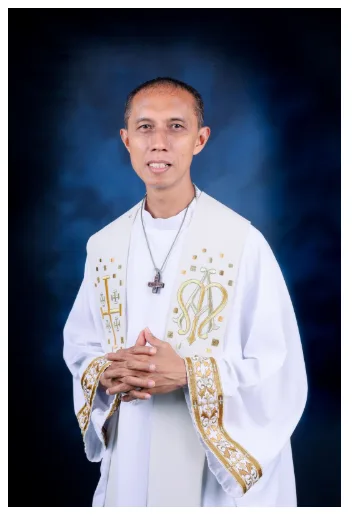
Rev. Fr. Dennis B. Beltran, S.Th.L., MAT
Rev. Fr. Dennis B. Beltran is a Filipino Catholic priest belonging to the Diocese of Imus in Cavite, Philippines. Born on December 7, 1972 in Bacacay, Albay, he belongs to the Bikolano cultural heritage yet has dedicated his priestly ministry to the Diocese of Imus. He was ordained to the diaconate on June 17, 2013 and to the priesthood on December 11, 2013.
Fr. Beltran pursued extensive theological and missionary formation. His academic journey includes studies at the Divine Word School of Theology and the Tahanan ng Mabuting Pastol Seminary in Tagaytay City, where he completed his foundational theological formation. He later obtained a Bachelor’s degree in Theology and a Master of Arts in Theology major in Missiology.
Continuing his academic pursuit, he earned a Baccalaureate in Sacred Theology from the Pontifical Urbaniana University in Rome, graduating cum laude. He also obtained a Licentiate in Sacred Theology major in Missiology from the Royal and Pontifical University of Santo Tomas in Manila in collaboration with the Divine Word Institute of Mission Studies in Tagaytay City.
His pastoral ministry includes service as a Parochial Vicar in several parishes in Cavite before becoming the Parish Priest of San Antonio de Padua Parish in Bucal, Maragondon. Beyond parish ministry, he also serves as Mission Director of the Diocese of Imus and participates in various diocesan initiatives as spiritual director, lecturer, and pastoral formator.
Fr. Beltran’s academic and pastoral interests converge particularly in the field of migration and mission. His research and writings focus on the pastoral care of migrants, the missionary dimension of migration, and the integration of migrants into the life and mission of the Church.
His scholarly work reflects his own experience as a “missionary migrant priest,” recognizing migration as both a challenge and an opportunity for evangelization within the Church’s pastoral mission.
Rev. Fr. Dennis B. Beltran, S.Th.L., MAT
Diocese of Imus, Cavite
Mission Director, Diocese of Imus