
DO CAMERA LENS PROTECTORS LOWER PHOTO RESOLUTION? THE FACTS EXPLAINED
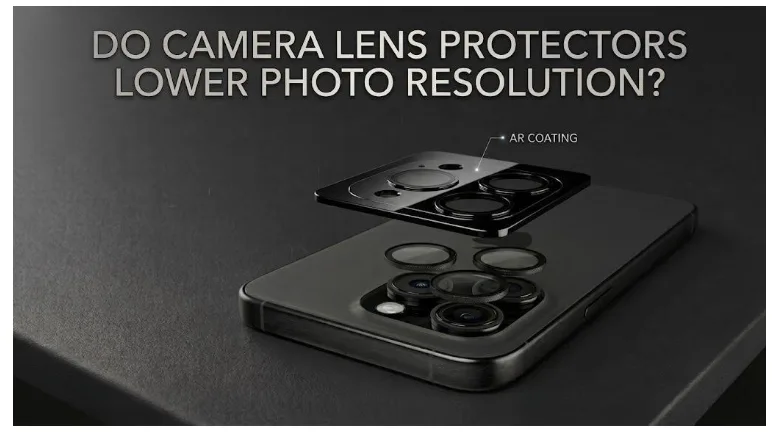
A properly designed camera lens protector made from optical-grade glass does not reduce photo resolution, megapixel count, or image sharpness. The protector sits in front of the lens and absorbs damage instead of the lens itself, while maintaining the exact optical clarity the original camera delivers.
This is the question that stops most people from buying camera lens protection: “Will a protector make my photos worse?” The answer depends entirely on the quality of the protector itself. A cheap, poorly made one might. A properly engineered optical grade protector with sapphire coating and anti-glare properties will not.
The fear is understandable you’ve invested in a good phone with a capable camera, and adding a protective layer feels like it should introduce some optical compromise. But modern optics don’t work that way. If the protector is made from the right materials and engineered with precision, it can sit completely invisibly between your camera and the world, absorbing scratches and impact while letting light pass through exactly as the bare lens would.
GadgetShieldz builds camera lens protectors specifically to preserve the optical path between your phone’s camera and the actual lens inside. Here’s how they work, why they don’t degrade image quality, and how to pick one that actually keeps your camera safe without compromising what it can do.
Why Phone Camera Lenses Get Damaged
Modern phone cameras are built tough, but they’re also exposed. They protrude slightly from the back of the device, which means they take impacts that the rest of the phone avoids.
Pocket and bag friction — Keys, coins, and rough fabric materials grind against the lens
every time the phone is in a pocket or bag
Desk and table drops — A phone set down at an angle often lands on the camera
module first, and that’s where corner damage starts
Fall impacts — Drops from pocket height or hand height frequently catch the camera
edge first, before the protective case absorbs anything
Dust and grit accumulation — Fine particles settle around the lens bezel and lens
barrel, causing micro-scratches during normal use
Cleaning contact — Rubbing the lens with a cloth or sleeve, even gently, can leave fine
scratches over time if there’s any grit present
Pressure and weight — Sitting on a phone or applying pressure to the back of a device
puts stress directly on the lens mount and glassA scratch on a camera lens is permanent and visible in every photo taken afterward.
Unlike the rest of the phone, a scratched lens can’t be fixed with a screen
replacement the entire camera module usually needs to be replaced, which is
expensive and often takes the phone out of service for days. The protector exists
specifically to take these impacts instead of the lens.
Why Cheap Camera Lens Protectors Do Reduce Image Quality
This is where the concern comes from, and it’s a legitimate one: the wrong protector
absolutely will degrade your photos. Here’s what makes a cheap protector fail
optically.
Low-quality glass contains impurities and air bubbles that scatter light as it passes through. This introduces hazing, reduces overall sharpness, and makes photos look less detailed than they should. The effect is subtle but noticeable colors appear slightly desaturated, fine details get softer, and the overall image looks like it was shot through a slightly cloudy window.
Additionally, poor anti-glare coatings or the absence of them reflect sunlight and bright light sources in ways that show up as artifacts or subtle glare in the final image. In low-light or backlit conditions, you might see lens flare that shouldn’t be there, or a subtle haze that makes the image look washed out.
Misaligned protectors can also introduce optical distortion. If the protector isn’t perfectly aligned with the actual lens, light bends unevenly as it passes through, which causes images to look soft or slightly warped at the edges. This is why precision manufacturing matters a millimeter of misalignment can degrade optical performance noticeably.
The difference is material and precision, not the concept of protection itself. A poorly made protector with cloudy glass and cheap adhesive will absolutely hurt image quality. An optically transparent protector with proper anti-reflective coating and perfect alignment will not it will sit invisibly in front of the lens and let all the light through exactly as the bare lens would.
How Quality Camera Lens Protectors Preserve Image Quality
GadgetShieldz camera lens protectors are engineered from the ground up to be
optically transparent. Here’s what that actually means in the layers and materials.
1. Optical-grade borosilicate glass as the base. This is the same type of glass used in
scientific instruments and high-end camera lenses. It’s harder than standard glass, has
minimal impurities, and transmits light with nearly 100% efficiency.
2. Sapphire coating for scratch resistance. Sapphire is a synthetic crystal that ranks 9 on
the Mohs hardness scale only diamond is harder. A sapphire-coated protector resists
scratches far longer than the bare glass would, which means it stays optically clear for
years instead of months.
3. Anti-glare coating on the outer surface. This reduces reflections from sunlight and
bright indoor light sources, which keeps glare out of your photos and makes the lens
more invisible in the image frame.
4. Anti-reflective coating on the inner surface. This layer prevents light bouncing
between the protector and the actual lens, which eliminates internal reflections that can
cause a subtle haze or soft focus effect.
5. Precision alignment during manufacturing. The protector is cut and positioned to sit
perfectly centered over the actual camera lens, so light passes through the same optical
path as it would on a bare lens.
6. Residue-free adhesive that won’t yellow or cloud. Unlike cheap adhesives that break
down over time and become cloudy or sticky, GadgetShieldz uses a clear, UV-stable
adhesive that maintains transparency indefinitely.
5 Reasons Quality Camera Lens Protectors Actually Improve Your Setup
This goes beyond just avoiding damage. A well-designed protector adds tangible
benefits to how you take photos.
1 Longer Lens Lifespan Means More Time for Perfect Shots
A scratch on the actual lens can’t be polished out or fixed replacement is the only option.
A scratched protector can be peeled off and replaced in minutes. This means you’re
protecting a multi-hundred-dollar component with a few-dollar protector that’s
swappable whenever needed.
2 Sapphire Coating Stays Optically Clear Longer
Sapphire is nearly as hard as diamond, so the protector surface resists the micro
scratches that come from daily contact with dust, pockets, and cleaning. Your photos
stay sharp longer before the protector eventually needs replacement.
3 Anti-Glare Coating Reduces Lens Flare and Artifacts
The outer anti-glare coating minimizes bright reflections that can show up as lens flare
or subtle hazing in backlit photos. Fewer internal reflections means cleaner, crisper
images, especially in high-contrast lighting conditions like shooting into the sun or
photographing a backlit subject. This is particularly noticeable in landscape and outdoor
photography where bright skies are common.
4 Perfect Alignment Maintains Optical Integrity
GadgetShieldz camera lens protectors are precision-cut for iPhone, Samsung, and
Nothing phones, with each model specifically aligned to the camera module geometry
and curve. This means the protector is optically centered and doesn’t introduce any
distortion or soft focus at the edges. The alignment also ensures the protector sits flush
with the camera bezel, with no gaps or overhang that could affect how light enters the
lens.
5 Peace of Mind Without Compromise
You can shoot confidently knowing the lens is protected from drops, scratches, and dust,
with the guarantee that image quality is not being sacrificed. This is the only protection
that truly gets out of the way.
How to Apply Camera Lens Protectors (Step-by-Step)
Application directly affects whether the protector stays optically clear and properly
aligned. A careless application introduces dust, bubbles, or misalignment that can
degrade image quality just as much as a cheap protector would.
1. Power off the phone and wait a few minutes for any static charge to dissipate.
2. Clean the camera lens and surrounding bezel with the included lens cleaning cloth,
removing all dust, oil, and residue.
3. Use the dust-removal sticker provided to lift any remaining dust particles from around
the lens module.
4. Identify the exact model of your phone before peeling the adhesive backing camera
layouts vary even within the same series.
5. Align the protector using the guide frame or template if one is provided, checking
that the lens opening lines up with the actual camera lens.
PRO T IP: Use a magnifying glass or the zoom function on another phone to verify perfect lens alignment before pressing down. This 30-second check prevents misalignment that could cause subtle image distortion.
1. Press down firmly from the center of the protector outward to seat the adhesive evenly.
2. Check from multiple angles to confirm the protector is sitting flush with no bubbles, wrinkles, or gaps.
3. Let it cure for 24 hours before taking photos, so the adhesive fully bonds and the optical clarity reaches its best.
Verdict: Camera lens protectors are the only protection method designed specifically for the camera itself. A protective case helps with overall device drops, but most case designs leave the camera module somewhat exposed. Using both a protective case and a camera lens protector provides the most complete protection: drop safety plus dedicated lens protection.
Which Phone Models Does GadgetShieldz Cover?
GadgetShieldz manufactures precision-cut camera lens protectors for the latest
flagship and popular mid-range phones, with each protector engineered for the
exact camera layout of that specific model.
Apple iPhone iPhone 13 Pro through iPhone 17 Pro Max
Samsung Galaxy Galaxy S24, S24 Ultra, Galaxy Z series
Nothing Phone Nothing Phone 1, 2, and upcoming models
Frequently Asked Questions
Do camera lens protectors reduce photo resolution?
No. A properly designed camera lens protector made from optical-grade glass does not reduce photo resolution or megapixel count. GadgetShieldz camera lens protectors are built to sit in front of the lens and absorb damage instead of the lens itself, while maintaining 100% optical transparency and preserving image quality exactly as you’d expect from an unprotected lens.
Can camera lens protectors affect photo sharpness?
Low-quality protectors with poor optical properties or misalignment can reduce sharpness. GadgetShieldz camera lens protectors use optical-grade borosilicate glass with anti-reflective coatings and precision alignment that preserves sharpness exactly as the bare lens would.
Do camera lens protectors cause glare or reflections in photos?
Quality protectors with anti-glare and anti-reflective coatings minimize glare. The sapphire-coated outer surface reduces external reflections, while the inner anti reflective layer prevents internal bouncing between the protector and the actual lens.
Will a camera lens protector affect autofocus?
No. Phone cameras use contrast-detection or laser autofocus that works through the glass. A thin, optically transparent protector doesn’t interfere with focus detection or autofocus performance the phone sees through the protector exactly as it would a bare lens.
What exactly is sapphire coating?
Sapphire is a synthetic crystal coating applied to the glass surface that ranks 9 on the Mohs hardness scale. It’s nearly as hard as diamond, which means it resists scratches far better than standard glass or tempered glass, keeping the protector optically clear for years.
Do I really need a camera lens protector?
If your phone’s camera is frequently in bags, pockets, or at risk of drops, a protector is worthwhile. Phone camera lenses are durable but not replaceable in the field a dedicated protector is much cheaper to replace than a scratched or cracked lens that requires full module replacement.
Can I remove and reapply camera lens protectors?
Most quality camera lens protectors use residue-free adhesive that allows removal and reapplication if needed. However, repeated applications reduce adhesive effectiveness, so careful initial alignment is important to avoid needing repositioning.
The Bottom Line
The question “Do camera lens protectors reduce photo resolution?” has two answers: bad ones do, good ones don’t. The difference comes down to material quality, optical engineering, and precision manufacturing.
A cheap protector with cloudy glass and misalignment will absolutely degrade your photos. You’ll notice softer details, slightly washed-out colors, and sometimes unwanted lens flare. But a properly engineered protector made from optical-grade glass with sapphire coating and anti-glare properties will sit completely invisibly in front of your lens protecting it from scratches, dust, and impact without changing the optical path or compromising image quality.
GadgetShieldz builds protectors that preserve the exact optical clarity of your phone’s camera while adding a replaceable layer that takes damage so the actual lens doesn’t have to. The result is a setup where you can shoot with confidence in any condition, knowing your camera module is protected but your image quality is not being sacrificed. That’s protection done right.