
The Real Difference Between a Prototype and an MVP (And Why Teams Keep Confusing Them)
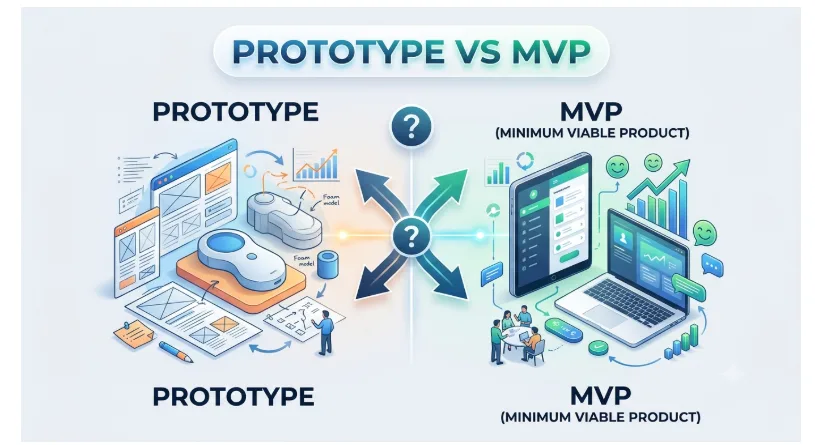
A founder I was talking to a few months back had this Figma file, real polished, clickable, the whole thing, and he kept calling it his MVP. The same week, a completely different team showed me an app where half the buttons didn’t even work yet, and they were calling that a prototype. Funny thing is, both had built something genuinely useful. They just had the labels backwards, or at least mixed up, and that mix-up ends up shaping how the next month of work actually goes.
Nobody explains this stuff badly. That’s not really the issue. The issue is deadline pressure. Whatever gets built first just gets called whatever word is lying around. A rough click-through turns into “the MVP” because someone has to show an investor something by Tuesday. A half-working app gets demoted to “prototype” because nobody wants to say out loud that it was supposed to be live weeks ago. I’ve watched this happen more times than I can count, and honestly, it’s rarely anyone’s fault.
So let’s actually work through the prototype vs MVP properly. Not as some dictionary definition thing, but as an actual decision you probably need to make this week if you’re building anything at all.
What a Prototype Actually Is
A prototype has one job: does this idea behave the way we think it will? That’s really it. You’re not supposed to charge anyone for a prototype, and nobody should be counting on it staying up next month. It exists to get poked at, argued about, and thrown away once it’s done its job.
They show up in more shapes than most people expect, too. Sometimes it’s a literal napkin sketch. Sometimes it’s a Figma file that looks done but has nothing actually running behind the buttons – pure surface. That same logic applies to the numbers behind a build — running quick sizing checks with a simple tool like this calculator is a cheap way to catch a problem before real money shows up. . This is exactly what makes rapid prototyping so valuable early on, it lets teams test an idea fast, before committing real time or money.
What an MVP Actually Is
An MVP is a different animal altogether. It’s the real product, just trimmed down to the smallest version a real customer could actually use – and, with any luck, pay for. Frank Robinson coined the term back in 2001. Steve Blank and Eric Ries picked it up later and built the whole Lean Startup thing around it, which is probably where most people first heard it.
The question an MVP is trying to answer isn’t “does the button work.” It’s closer to: will a total stranger, using their own credit card, pick this over whatever they’re already using? That’s a much harder question. You can’t answer it in a conference room, no matter how smart the people in the room are. It only gets answered out in the actual market, where money either changes hands or it doesn’t.
So you release something real. You watch what people actually do with it – not what they tell you they’d do, which is usually pretty different. Then you use that to decide the next move. That’s the build-measure-learn loop in a nutshell, and it falls apart the moment you start walking people through it yourself. If your MVP needs a salesperson standing there explaining it, you’re not really testing anything.
Prototype vs MVP: Where Teams Actually Get Stuck
Here’s something I’ve noticed working with product and engineering teams over the years – the mix-up almost never comes from people not knowing what the words mean. It comes from skipping a step because the calendar won’t allow otherwise. A team wires up just enough backend to make their prototype technically “live,” slaps the MVP label on it, ships it, and never actually checks whether a single person is willing to pay. Sometimes it goes the other way too. Months get poured into hardening an MVP’s codebase before anyone’s even confirmed, using a rough prototype, that the core interaction makes sense to a real user in the first place.
Side by side, here’s roughly how the difference between prototype and MVP breaks down:
| Prototype | MVP | |
| Purpose | Test if an idea or interaction works | Test if real customers want and will pay for it |
| Audience | Internal team, stakeholders, a small test group | Real early adopters in the actual market |
| Functionality | Often fake or partial, buttons that lead nowhere | Genuinely functional, even if minimal |
| Lifespan | Usually thrown away | Becomes the foundation you build on |
| Cost of being wrong | Low, it’s kind of expected | Higher, real money and time are already spent |
A Real Example: When the Gap Actually Costs You
Product agency Designli ran straight into this problem recently and actually built a program around fixing it. When they launched something called TractionLab, their CEO Keith Shields said something that’s stuck with me since I read it: founders spend months building products before they even find out whether anyone will use them, or pay for them. TractionLab is meant to shrink that gap on purpose, pushing founders toward an actual working MVP and real paying customers inside something like 90 days, instead of guessing their way through months of building first and hoping.
That one line, honestly, sums up the entire prototype vs MVP problem better than most of what I’ve read on the topic. A prototype can tell you the idea is usable. It tells you nothing about whether it’s wanted. You only get that answer from a real MVP, in front of real customers, with something actually at stake.
A Simple Way to Know Which One You Need
Before your next planning meeting, it might help to just ask yourself a few blunt questions.
Still not sure the core interaction even makes sense to a regular user? Build a prototype. Pretty confident the interaction works but genuinely unsure anyone wants it? That’s MVP territory. Just trying to convince an investor, or a skeptical stakeholder, that the concept is even feasible? A prototype usually does that job fine on its own. Trying to actually prove product-market fit validation with real usage numbers and retention data? Nothing but a real MVP is going to give you that.
Design thinking frameworks already treat these as two separate steps that happen one after another, not as competing choices. Prototype first, to sharpen the idea. Build the MVP after that, to see whether the sharpened idea actually survives contact with real people using it. Jumping straight to MVP because prototyping “feels like a waste of time” is, in my experience, exactly how teams end up with a fully working product that nobody asked for.
Where Rapid Prototyping vs MVP Thinking Breaks Down in Practice
There’s a pattern I keep running into. Teams treat rapid prototyping vs MVP like it’s a speed contest, when really it’s about sequencing, not raw speed. Rapid prototyping shrinks the time it takes to test one assumption – a day instead of a month, say. MVP development stages shrink the time it takes to test actual market demand – weeks instead of a year, roughly. Two different clocks. Two completely different kinds of risk being measured. Mix them up and you can ship fast and still fail, simply because you validated the wrong thing quickly instead of validating anything real at all.
This is partly why wireframing tools like Figma exist – they let you run the prototyping clock without touching the MVP clock at all. Paper prototypes do the same thing, just lower-tech. A Wizard of Oz MVP, where someone manually handles the work behind the scenes while the user assumes it’s all automated, works on a similar principle. So does a Concierge MVP, where you’re personally delivering the service by hand before automating any single piece of it. All of it exists for one reason really: test one layer of risk at a time, and don’t rush into the next layer before you’ve actually earned it.
The Bottom Line
At the end of the day, prototype vs MVP was never really about vocabulary. It’s about discipline. A prototype keeps you from building the wrong interaction in the first place. An MVP keeps you from building something that, technically, works fine, but that nobody actually wanted. Skip either one and you’re not moving faster. You’re just moving confidently in the wrong direction, which tends to be a much more expensive mistake to walk back later on.
So next time someone on your team says “let’s build an MVP” and “let’s just mock something up quick” in the same breath, it’s worth stopping for a second. Those are two different projects answering two completely different questions. Treating them as one and the same is usually how a genuinely good idea turns into an expensive lesson.
Frequently Asked Questions
Is a prototype the same as an MVP?
Not really, no. A prototype checks whether an idea or interaction works the way it’s supposed to. An MVP is a real, usable product put in front of actual customers to see if they want it and will pay for it. Different questions, different stages.
What is an MVP in product development, exactly?
It’s the smallest functional version of a product that still gives early users something genuinely valuable – enough to collect real usage data and test actual demand, without having to build out every feature on the roadmap first.
Should a startup always build a prototype before an MVP?
Most of the time, yes. It’s cheap insurance. Skipping the prototype stage usually just means you find out about usability problems later, after real customers and real money are already involved, which is a far more expensive place to discover them.
How long should MVP development stages take?
There’s no magic number here. What actually matters is discipline. Teams that keep the MVP stage tight, weeks rather than months, tend to hit a validate-or-pivot decision before they run out of runway, or run out of conviction, whichever comes first.
Prototype vs MVP – which one do investors want to see?
Depends heavily on the stage of the raise, honestly. Early conversations usually just need a prototype to show feasibility. Later-stage investors are increasingly asking for MVP-level proof instead, things like real usage, retention numbers, or actual paying customers, before they’ll write a check.