
Packaging Trends Shaping Consumer Electronics Brands in 2026
The consumer electronics industry is evolving faster than ever, driven by shorter product life cycles, growing SKU complexity, and increasing pressure on global supply chains. Mobile accessories such as chargers, earphones, charging cables, phone cases, screen protectors, and power banks are now released in multiple versions, sizes, and compatibility variations within a single product category. For electronics brands, importers, wholesalers, and private label buyers, packaging has become an important part of operational efficiency rather than simply a printed outer box.
As packaging programs become larger and more complex, electronics companies are placing greater emphasis on packaging scalability, export protection, engineering support, and manufacturing coordination. Modern packaging trends are no longer focused only on visual presentation. Instead, packaging decisions increasingly involve structural optimization, material efficiency, fulfillment performance, and integrated manufacturing capability. In 2026, the most competitive electronics brands are treating packaging as part of their broader supply chain strategy.
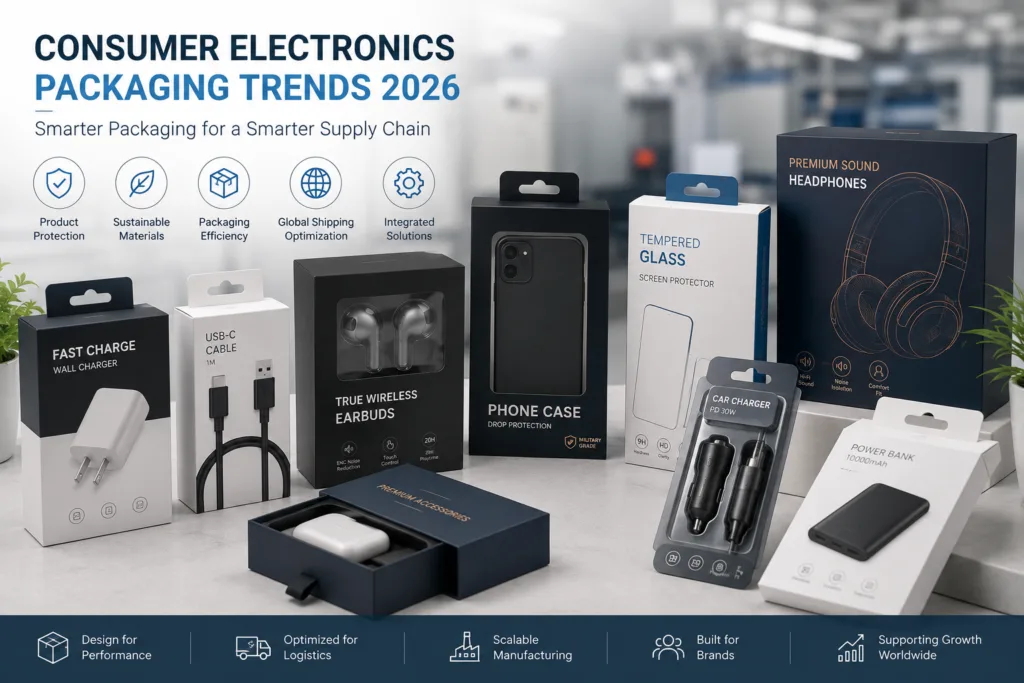
Why Packaging Strategy Is Becoming Critical for Electronics Brands
For electronics packaging brands, packaging now plays a much larger role in product management, logistics coordination, and operational consistency. As global distribution channels expand, packaging must support not only product protection, but also efficient warehousing, export shipping, assembly processes, and large-scale production programs.
Products such as mobile battery, headphones, chargers, phone lcd screen, and phone accessories often involve high-volume production and frequent SKU updates. Without a scalable packaging system, brands can face higher shipping costs, packaging inconsistencies, assembly inefficiencies, and increased inventory complexity. As a result, more electronics companies are working closely with packaging manufacturers earlier in the product development process to improve structural engineering, reduce waste, and optimize packaging performance across global supply chains.
Packaging strategy also affects long-term operational scalability. A packaging structure that works well for a small launch order may not remain efficient when production expands across multiple markets or distributors. In 2026, brands are increasingly prioritizing packaging suppliers that understand both packaging engineering and manufacturing coordination rather than focusing only on printing capability.
Packaging Trends in Consumer Electronics Manufacturing
Trend 1 — Premium Rigid Box Packaging for High-Value Electronics
Premium electronics products continue to drive strong demand for custom rigid boxes and electronics rigid box packaging solutions. Products such as smartphones, wireless earbuds, smart devices and electronic accessory kits increasingly use rigid packaging structures to support stronger product positioning and improved packaging protection.
Compared with standard cartons, rigid boxes provide better structural stability, cleaner presentation, and enhanced protection during export transportation and warehouse handling. Many electronics brands are also combining magnetic closure rigid boxes with EVA foam inserts to organize multiple accessories securely inside one package.
In 2026, rigid packaging trends are moving toward minimalist structural designs, precision insert engineering, and more efficient material combinations that maintain premium presentation while improving production scalability.
Trend 2 — Lightweight Folding Cartons for Large-Volume Packaging Programs
For high-volume electronics accessories, folding cartons remain one of the most cost-effective packaging solutions. Products such as tempered glass screen protectors, charging cables, phone cases, and retail accessory kits often require lightweight packaging structures that support large production runs and efficient shipping.
Electronics brands are increasingly optimizing folding carton packaging to reduce shipping volume, simplify assembly, and improve packaging consistency across multiple SKUs. Because mobile accessories frequently update models and compatibility versions, folding cartons also provide greater flexibility for packaging revisions and fast product launches.
Many wholesale electronics packaging programs now focus on balancing material efficiency, transportation cost reduction, and scalable production while maintaining strong visual branding across different product categories.
Trend 3 — Thermoformed Blister Packaging for Organized Accessory Packaging
Thermoformed blister packaging continues to grow in the electronics accessories industry because it provides both product organization and shipping stability. Blister packaging for electronics is widely used for chargers, repair kits, phone batteries, cables, adapters, and multi-component accessory sets.
One major trend in 2026 is the increasing use of custom thermoformed blister trays designed with precision cavities for different accessory combinations. These structures help reduce product movement, improve assembly efficiency, and maintain organized packaging layouts during export transportation.
For example, mobile phone battery kits sold to repair shops and distributors often combine batteries, adhesive strips, charging components, and repair tools within one package. Multi-slot blister trays allow each component to remain securely positioned while improving packaging clarity and operational efficiency.
Trend 4 — Integrated Packaging Manufacturing Becoming a Competitive Advantage
As electronics packaging projects become more complex, integrated packaging manufacturing is becoming increasingly important for global brands and importers. Instead of sourcing rigid boxes, blister trays, inserts, and printing from multiple suppliers, many companies now prefer integrated packaging manufacturers that can manage multiple production processes internally.
In-house production capabilities such as offset printing, rigid box manufacturing, blister thermoforming, insert assembly, lamination, die-cutting, and final packaging assembly help reduce coordination delays and improve production consistency across large packaging programs.
Integrated manufacturing also allows packaging suppliers to respond more efficiently to engineering changes, urgent production schedules, and large-volume export orders. For electronics brands managing multiple SKUs and fast-moving supply chains, this level of manufacturing coordination is becoming a major competitive advantage.
How Electronics Brands Evaluate Packaging Suppliers in 2026
Engineering and Structural Design Capability
In 2026, electronics brands are placing greater emphasis on packaging engineering support during the early stages of product development. Structural optimization is becoming increasingly important as companies seek to reduce shipping costs, improve packaging efficiency, and simplify large-scale assembly operations.
Many brands now expect packaging suppliers to provide CAD structural design support, insert engineering, and transportation-focused packaging optimization rather than simply manufacturing existing artwork files. More attention is also being given to packaging dimensions, internal space utilization, and insert selection to reduce unnecessary material usage while maintaining product protection standards.
For electronics accessories with multiple components, packaging engineering also helps improve assembly efficiency and reduce product movement during transportation. Proper insert systems using EVA foam, thermoformed trays, or paperboard partitions can significantly improve packaging stability without increasing packaging complexity.
Production Capacity and Scalability
Production scalability remains one of the most important evaluation factors for electronics brands and wholesalers. Packaging suppliers must be able to support fast production schedules, large-volume orders, and repeat production consistency across multiple packaging programs.
In the consumer electronics industry, packaging projects often involve frequent product launches and seasonal demand fluctuations. As a result, brands increasingly prefer packaging manufacturers with strong internal production coordination, stable scheduling systems, and scalable manufacturing capacity capable of supporting long-term supply chain growth.
Lead time management is also becoming more critical for export-oriented electronics brands. Reliable production scheduling helps distributors and importers maintain inventory planning and reduce supply chain delays during peak sales periods.
Material Consistency and Manufacturing Quality
Material consistency is becoming a major priority as electronics packaging programs expand across global distribution channels. Brands increasingly expect packaging suppliers to maintain stable material quality across repeat orders, multiple production batches, and different product categories.
For paper packaging, materials such as SBS paperboard, greyboard, specialty paper, and coated art paper are selected based on product positioning and structural requirements. Premium electronics packaging often combines rigid structures with specialty finishes to create stronger product presentation while maintaining production efficiency.
For thermoformed packaging, PET, PVC, and PP materials continue to be widely used depending on transparency, durability, and structural performance requirements. In 2026, more brands are also evaluating how packaging materials affect export durability, moisture resistance, and long-term storage stability.
Beyond material selection itself, manufacturing quality consistency has become equally important. Surface finishing accuracy, structural precision, insert fit, blister clarity, and print consistency all directly affect large-scale packaging programs and long-term brand reliability.
Global Shipping and Export Packaging Support
Global shipping requirements are also reshaping electronics packaging strategies. Packaging must now support international transportation, warehouse stacking, container loading, and ecommerce fulfillment without compromising structural stability or product safety.
Many electronics brands are paying closer attention to master carton strength, pallet optimization, moisture protection, and transportation durability during packaging development. For sea freight shipments, protective PE moisture bags are commonly added inside export cartons before loading products to help reduce humidity exposure during long-distance transportation and container storage.
Export packaging is no longer viewed as a secondary consideration. Instead, it has become an important part of overall packaging engineering and supply chain planning.
The Growing Demand for Integrated Packaging Solutions
As electronics supply chains become more complex, brands are increasingly moving toward integrated packaging solutions rather than managing multiple specialized suppliers separately. Coordinating different packaging vendors for rigid boxes, blister trays, inserts, printing, and final assembly often increases communication costs, lead time risks, and quality inconsistencies.
Integrated packaging suppliers can provide more efficient project coordination by combining structural engineering, printing, blister thermoforming, rigid box production, insert assembly, and export packaging management within one manufacturing system.
For electronics brands with large SKU systems and global distribution requirements, integrated packaging manufacturing helps simplify procurement processes, improve packaging consistency, and reduce operational complexity across long-term packaging programs.
Case Study — Cost-Optimized Packaging Development for a Mobile Phone Case Brand
Project Background
One of our customers from Brazil specializes in wholesale mobile phone accessories and required a new packaging solution for its phone case product line. The customer’s target market was positioned between the mid-range and premium segments, meaning the packaging needed to maintain a more professional and higher-end appearance while still meeting strict cost control requirements for large-volume orders.
The client also wanted to reduce international shipping costs because phone case packaging programs typically involve high quantities and frequent SKU updates. Traditional rigid box packaging provided a premium appearance, but the overall material and transportation costs were too high for this category.
Packaging Challenges
The project required balancing several important factors at the same time:
- Premium visual presentation for a competitive accessories market
- Lower packaging and shipping costs for large-volume wholesale
- Flat shipping capability to improve container efficiency
- Packaging structures suitable for frequent SKU changes
- Strong product visibility for mobile phone case display
For products such as phone cases, packaging must remain lightweight and scalable while still maintaining good shelf presentation and organized structure.
Packaging Solution
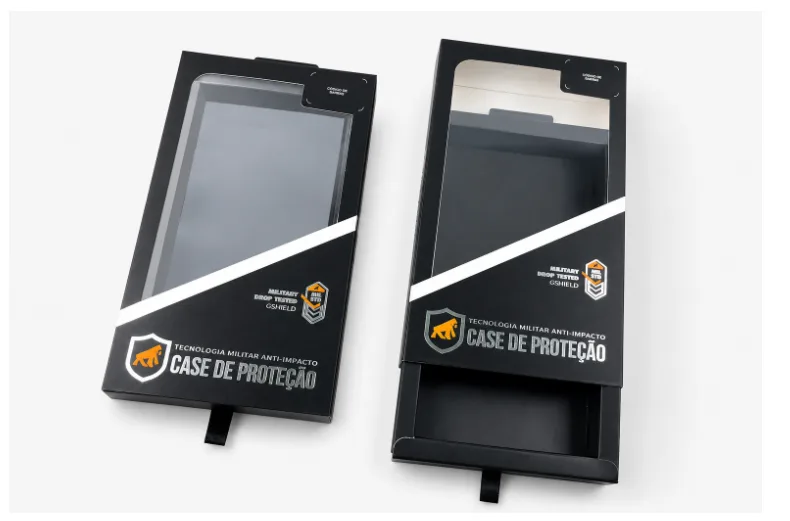
Based on the customer’s requirements, we developed a drawer-style packaging structure using black specialty paper as the primary material instead of traditional rigid greyboard construction. The packaging combined a printed outer sleeve with a foldable inner tray structure, creating the appearance of a premium drawer box while significantly reducing material and transportation costs.
To improve product visibility, the outer sleeve was designed with a transparent window opening, allowing customers and distributors to view the phone case directly without opening the package. The black specialty paper also helped create a cleaner and more premium visual appearance compared with standard folding cartons.
One of the key engineering optimizations was the flat-pack shipping structure. Both the outer sleeve and inner tray were produced as pre-cut and pre-creased paperboard sheets delivered completely flat during transportation. After delivery, the customer could manually fold and assemble the packaging into its final drawer-box structure quickly and efficiently.
Engineering Outcome
This packaging solution successfully balanced premium presentation, shipping efficiency, and large-scale cost control for the customer’s wholesale phone case packaging program. By replacing traditional rigid board structures with foldable specialty paper engineering, the packaging maintained a higher-end appearance while significantly reducing export shipping volume and overall packaging cost.
For large-volume mobile accessories categories such as phone cases, this type of semi-rigid foldable drawer packaging has become an increasingly practical solution for brands and distributors seeking both visual quality and operational efficiency.
Choosing the Right Packaging Partner for Long-Term Growth
For electronics brands, wholesalers, and distributors, choosing a packaging manufacturer is no longer simply about sourcing printed boxes. As product lines expand and packaging requirements become more complex, packaging gradually becomes part of the broader supply chain and operational management system.
Long-term packaging partnerships increasingly require stable engineering support, scalable production coordination, integrated manufacturing capability, and consistent packaging quality across different product categories and global markets. Manufacturers that understand structural optimization, export packaging, insert engineering, and large-scale production management are better positioned to support electronics brands over time.
At epackfactory, we focus on integrated packaging solutions for consumer electronics and mobile accessories brands, combining in-house printing, rigid box manufacturing, thermoformed blister production, and custom insert assembly to support scalable packaging programs for global B2B customers.
FAQ
What packaging is best for consumer electronics products?
The best packaging depends on the product category, positioning, shipping requirements, and distribution channels. High-value electronics often use rigid boxes, while high-volume accessories commonly use folding cartons or blister packaging structures.
Why do electronics brands use rigid box packaging?
Rigid boxes provide stronger protection, premium presentation, and better structural stability for products such as wireless earbuds, smart devices, and accessory kits.
What materials are commonly used in electronics packaging?
Common materials include SBS paperboard, greyboard, coated art paper, PET blister materials, PVC blister materials, PP thermoformed trays, EVA foam inserts, and corrugated export cartons.
How does blister packaging protect electronic accessories?
Thermoformed blister trays create custom cavities that hold accessories securely in position, helping reduce movement, improve organization, and protect products during transportation.
What should brands look for in a packaging manufacturer?
Brands should evaluate engineering capability, structural optimization experience, production scalability, material consistency, integrated manufacturing capability, and export packaging support.
Why is integrated packaging manufacturing important?
Integrated manufacturing improves production coordination, shortens lead times, reduces communication issues, and helps maintain stable packaging quality across large packaging programs.
How can packaging reduce shipping damage for electronics?
Protective inserts, optimized packaging structures, moisture protection systems, reinforced export cartons, and transportation-focused engineering can significantly reduce shipping damage.
What insert materials are best for electronic accessories?
EVA foam inserts, thermoformed blister trays, and paperboard partitions are commonly used depending on the product weight, fragility, and packaging budget.
How do packaging suppliers support large-volume electronics orders?
Scalable packaging suppliers support large orders through integrated production systems, stable scheduling, quality control processes, and coordinated export packaging management.
What packaging structures are commonly used for mobile accessories?
Common structures include rigid boxes, folding cartons, magnetic boxes, blister packaging, clamshell packaging, thermoformed trays, and EVA insert systems.