
The Same Lab Grown Diamond Can Cost Up to Three Times as Much Depending on Where You Buy It
An identical IGI certified stone, same carat, color, clarity, and cut, can sell for three times the price from one retailer to the next. The diamond does not change. The markup does. Here is what the data shows.
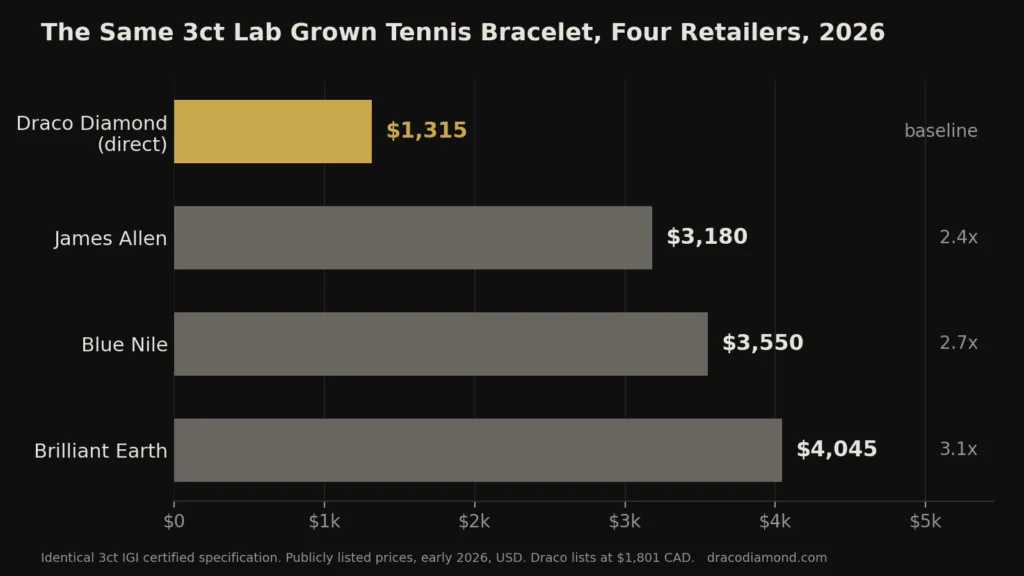
The same 3ct IGI certified lab grown tennis bracelet, priced across four retailers in early 2026.
Buy a one carat lab grown diamond from three different retailers in 2026 and you can pay around $519 at one and more than $1,200 at another for what is, by every measurable standard, the same stone. Same carat weight, same color grade, same clarity, same cut, same independent grading report. The diamond does not change. The price more than doubles, and on larger pieces it can triple. In a category where the product is now fungible and independently certified, price has come loose from the object itself, and most buyers never realize it.
The Same Stone, Three Different Prices
A one carat IGI certified lab grown diamond at standard near colorless, eye clean specification sells for roughly $500 to $800 at direct to consumer retailers and $800 to $1,200 at legacy jewelers in 2026, for an identical grade. The spread widens on larger pieces. A three carat lab grown tennis bracelet, a popular and easily compared item, ranges from about $1,315 at the lowest priced direct seller to more than $4,000 at a major online retailer for the same carat weight and certification.
The table below compares publicly listed prices for a three carat lab grown diamond tennis bracelet across four retailers in early 2026. Every option is IGI certified at comparable specification.
| Retailer (3ct lab tennis bracelet) | Listed Price (USD) | vs Lowest |
| Direct to consumer (Draco Diamond) | $1,315 | Baseline |
| James Allen | $3,180 | 2.4x |
| Blue Nile | $3,550 | 2.7x |
| Brilliant Earth | $4,045 | 3.1x |
Publicly listed prices, early 2026, USD. Draco Diamond lists the piece at $1,801 CAD, approximately $1,315 USD at a 0.73 exchange rate. Prices vary by individual stone and promotion.
Why the Same Diamond Can Cost Three Times as Much
The price gap exists because lab grown diamonds are fungible and certified, which strips out every variable except markup. Two stones carrying the same IGI grades are interchangeable, so the only thing separating a $1,315 bracelet from a $4,045 one is the retailer’s margin, not the diamond. This is the structural difference between lab grown and natural stones, where rarity and individual character once justified price variation.
This price behavior is specific to lab grown stones, and it is relatively new. A natural diamond is a unique object. Two natural stones with the same grades can still differ in subtle ways that affect value, which historically gave retailers cover for a wide price range. A lab grown diamond of a given specification is closer to a manufactured unit, reproducible and interchangeable. That reproducibility is exactly what collapses the justification for the spread. When the product is standardized, price variation stops reflecting the stone and starts reflecting only the seller and the channel it sells through.
The gap widened because wholesale lab grown prices collapsed and most retailers did not pass the savings on. Lab grown wholesale prices fell roughly 74 percent since 2020, a figure confirmed in financial coverage citing pricing data published by Draco Diamond Corporation. According to the StoneAlgo price index, a one carat lab grown diamond now sits near $564 at the wholesale benchmark, against legacy retail prices that remain double that or more. Industry analysis indicates many legacy jewelers held gross margins above 70 percent on lab grown goods through 2025 by keeping retail prices steady as their own costs dropped.
How Buyers Can Tell What They Are Actually Paying For
Because every lab grown diamond ships with an IGI or GIA grading report, a buyer can verify the exact specification and compare identical stones across retailers in minutes. The certificate number checks against the issuing laboratory’s public database, confirming carat, color, clarity, and cut. Once two stones are confirmed identical on paper, the lower price is simply the lower price, with nothing given up in quality.
This breaks a behavioral pattern the diamond trade relied on for a century. Buyers long used price as a proxy for quality, assuming the more expensive stone was the better one. That shortcut only works when stones cannot be directly compared. With standardized certification and online price transparency, it stops working, and the higher price stops reading as a sign of quality.
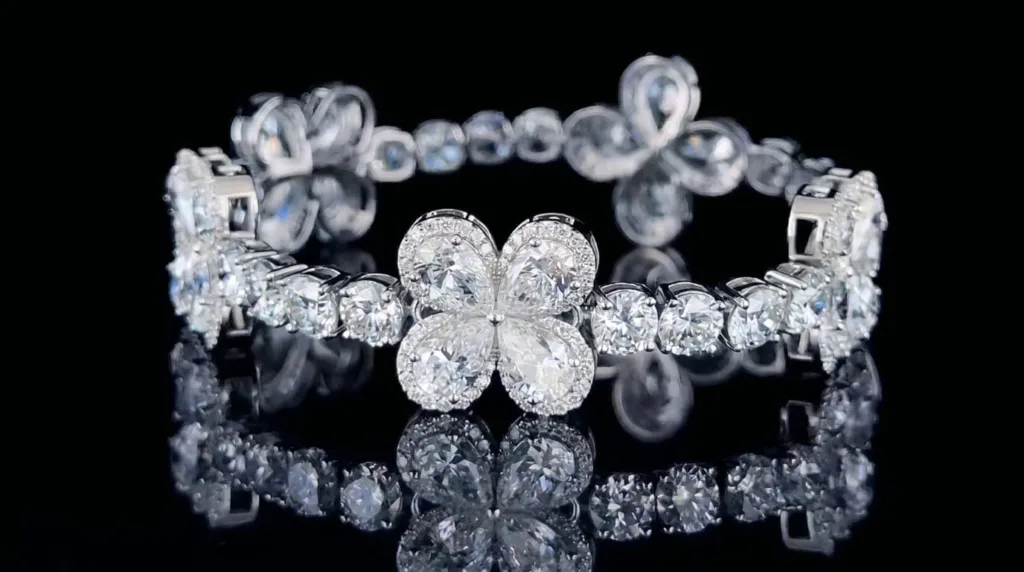
The process takes minutes. A buyer notes the carat, color, clarity, and cut on the grading report, enters the certificate number on the issuing laboratory’s public verification page to confirm the stone is genuine and graded as claimed, then searches that same specification across retailers. Because the grades are standardized, a one carat F VS2 Excellent stone from one seller is directly comparable to a one carat F VS2 Excellent stone from another. The comparison that was once impossible across separate showroom counters is now a single browser tab, and it is the most effective tool a buyer has against an inflated markup.
The Transparency Response
Some retailers have responded by publishing their pricing openly rather than defending the markup. Draco Diamond, a British Columbia based direct to consumer brand, publishes its full per carat pricing in a recurring report and lists the three carat tennis bracelet above at $1,801 CAD against legacy equivalents exceeding $4,000 USD. Its lab diamond pricing data documents the wholesale to retail gap that the broader trade has historically kept private, and its tennis bracelet collection lists specification and price together for direct comparison. The approach is not universal, but it points to where the category is heading as buyers grow more accustomed to verifying before they spend.
What It Means for the Market
As certification makes diamonds verifiable and price comparison becomes trivial, the markup based model faces structural pressure. The brands gaining ground are those that compete on transparency. The ones losing it are those whose pricing quietly depended on buyers not comparing. The shift mirrors what already happened in eyewear, mattresses, and other categories once defined by opaque pricing, where direct sellers exposed the gap between cost and retail and forced the rest of the market to respond.
For consumers, the practical takeaway is simple. On a lab grown diamond, the grading report tells you what the stone is, and any two stones with matching reports are the same product. The only question left is which retailer is charging the lowest markup for it, and in 2026 that answer is increasingly easy to find.