
Why AI Search Visibility Is the Metric SEO Teams Are Missing
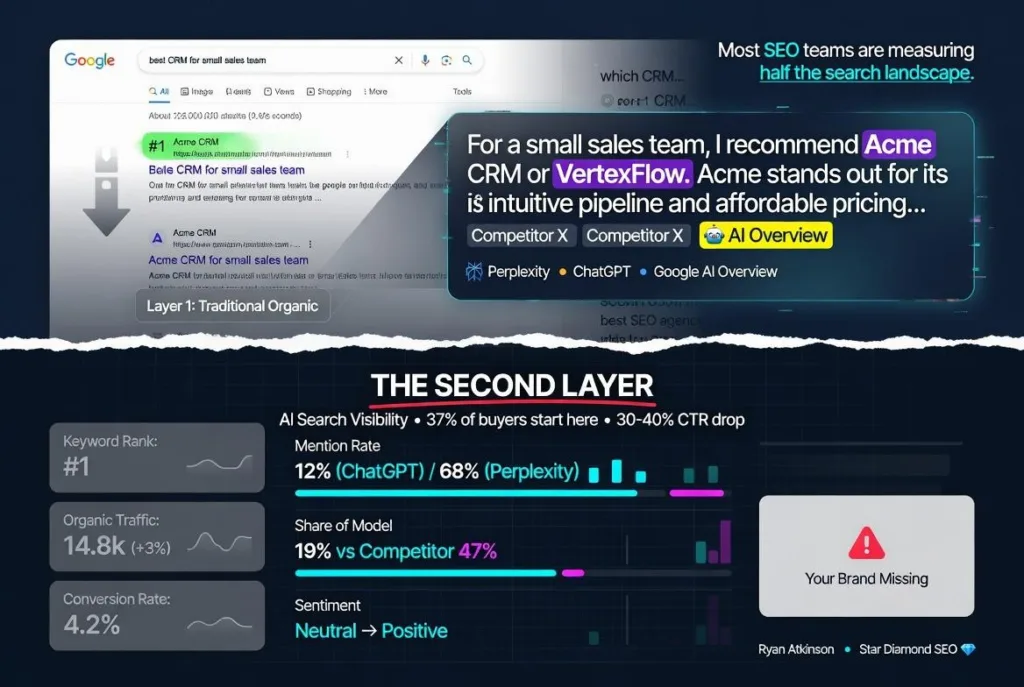
Most SEO teams track the same three numbers they have tracked for the last decade: keyword rankings, organic traffic, and conversion rate. Those metrics still matter. They will matter for years. But they are now measuring roughly half of the search landscape, and the half they are missing is the half that is growing fastest.
AI-generated search responses now appear across Google AI Overviews, ChatGPT, Perplexity, Gemini, and Microsoft Copilot. These platforms synthesize answers from web sources and present them directly to users, often resolving the query before anyone scrolls to the organic results below. When a buyer asks ChatGPT which CRM to use for a small sales team or asks Perplexity which SEO agency delivers real results, the brands mentioned in that response gain a competitive advantage that no organic ranking can fully replicate. The buyer has a shortlist before they ever open Google.
The problem is that none of the standard SEO measurement tools capture this. Google Search Console does not show whether an AI Overview appeared for your keyword. Ahrefs does not track whether ChatGPT mentioned your brand. Google Analytics attributes AI-initiated traffic to organic or direct channels, giving the AI platform zero credit for starting the journey. The infrastructure that modern SEO relies on was designed for a world where search meant a list of ten blue links. That world still exists, but it is no longer the complete picture.
The Second Layer of Search
Search now operates on two layers. The first layer is traditional organic results: ranked pages, click-through rates, measurable traffic. The second layer is AI-generated responses: synthesized answers that cite sources, mention brands, and shape buyer perception before a click ever happens.
The two layers run on different logic. A site can hold the number one organic ranking for a commercial keyword and be completely absent from the AI Overview that appears above it. A brand that ChatGPT recommends consistently might not rank in Google’s top 100 for the same query. The signals that win organic rankings, comprehensive content, strong backlinks, and technical optimization, overlap with but do not guarantee AI visibility. AI platforms prioritize content that is structured for extraction, published by sources they consider trustworthy, and supported by third-party coverage across the web.
This means a business measuring only organic performance has no way of knowing whether AI platforms are recommending their competitors instead of them. The data does not exist in any traditional SEO dashboard.
What AI Search Visibility Measures
AI search visibility tracks how often, how prominently, and in what context a brand appears in AI-generated responses. The core metrics are different from traditional SEO. Mention rate measures the percentage of relevant queries where your brand appears in the AI response. Share of model measures your competitive positioning, how often you appear versus competitors across the same queries. Sentiment captures how the AI describes your brand when it mentions you. Citation quality distinguishes between being linked as a source and being named without a link.
These metrics need to be tracked per platform because each AI system behaves differently. ChatGPT mentions brands frequently but rarely provides links. Perplexity cites sources with inline links on every response. Google AI Overviews pull from the indexed web and display citation links alongside the generated text. A brand dominating on one platform can be invisible on another. Monitoring a single platform gives a partial view of a picture that requires multiple angles to understand.
Why the Gap Matters Now
Research from 2026 shows that 37 percent of consumers now start product and service research with AI platforms rather than Google. AI Overviews appear on 30 to 40 percent of Google searches and reduce organic click-through rates by 30 to 40 percent on queries where they appear. These are not projections. These are current numbers describing current behavior.
For businesses in competitive categories, the impact is already measurable. When a prospective customer asks an AI platform for a recommendation and your competitor is named while you are not, the competitor gains an advantage that operates entirely outside your analytics. The prospect builds a mental shortlist before ever visiting a search engine. Your organic ranking, no matter how strong, cannot offset an absence from that shortlist.
The attribution challenge compounds the problem. When ChatGPT recommends a brand, the user often searches that brand name on Google next. The traffic arrives as a branded organic search or a direct visit. Google gets the credit. ChatGPT gets none. Marketing teams reviewing their analytics conclude that AI search is irrelevant because the numbers say so. The numbers are not lying. They are simply blind to the AI touchpoint that initiated the journey.
What Teams Should Do About It
The starting point is a manual audit. Take your five most commercially important keywords and query them on ChatGPT, Perplexity, and Google. Record whether your brand appears, which competitors appear, and how the AI frames each one. This takes thirty minutes. It produces a baseline that answers the most fundamental question: is AI search relevant for your business right now?
If the audit reveals that competitors are being cited and you are not, the gap is urgent. The optimization work involves structuring content so that key answers appear under descriptive headings rather than buried in long paragraphs, building FAQ sections with questions pulled from real search data, and strengthening entity authority through third-party coverage. The brands that AI platforms cite are the ones they recognize as trustworthy sources, and that recognition comes from the same expertise, authority, and trust signals that have always driven quality SEO.
For a deeper look at the metrics, tools, and strategic framework for measuring and improving AI search visibility, Star Diamond SEO has published a comprehensive guide to AI search visibility that covers the full landscape from manual auditing through automated tracking.
The Measurement Infrastructure Will Catch Up
AI search visibility measurement in 2026 is where social media measurement was in 2010. Everyone in the industry acknowledges it influences buyer behavior. Nobody can prove exactly how much. The companies that begin tracking now will have the data advantage when the attribution infrastructure eventually catches up, and it will catch up, because the economic incentive to solve it is too large to ignore.
The question for SEO teams is not whether AI search visibility matters. The data has answered that. The question is whether you are measuring it or measuring around it and hoping the gap does not widen. For most competitive categories, it already has.
About the Author
Ryan Atkinson is the founder of Star Diamond SEO, an SEO strategy and content authority firm focused on E-E-A-T-driven organic growth and generative engine optimization.