
Angelo Zandona Educates Organizations About Water Infrastructure Planning for BESS Facilities
Introduction
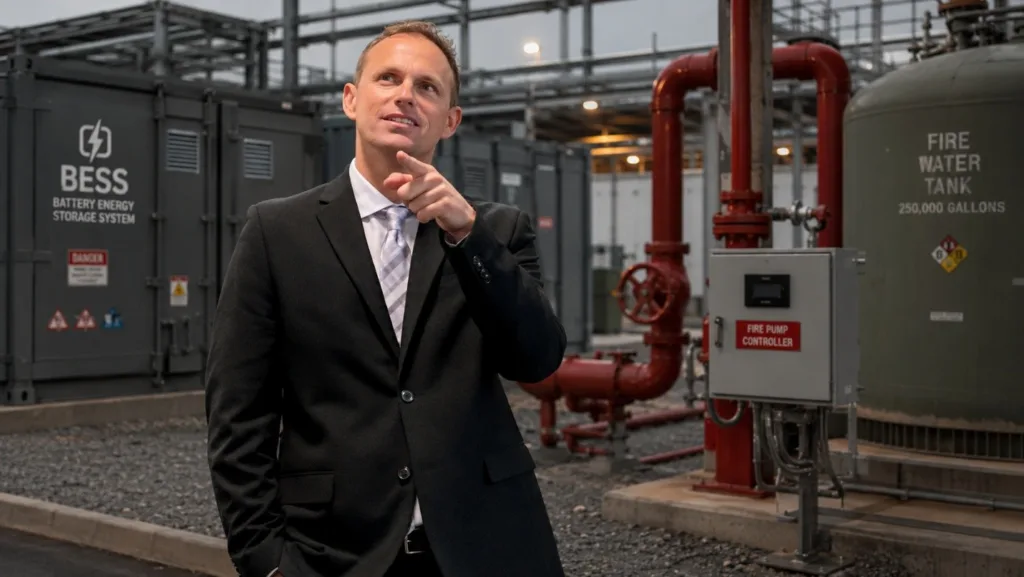
The numbers can be startling for first-time battery energy storage developers. A single utility-scale BESS project may require anywhere from 30,000 to over 250,000 gallons of dedicated on-site water storage, and according to research from the Electric Power Research Institute (EPRI) Storage Wiki, water demand for exposure protection at lithium-ion storage facilities can exceed 500 gallons per minute sustained over multi-hour incidents. The Fire Safety Research Institute has further documented that large-scale fire tests under UL 9540A protocols routinely show water application rates of 0.2 to 0.4 gallons per minute per square foot are necessary simply to keep adjacent units below propagation temperatures.
These figures often come as a shock to site developers who assumed BESS water requirements would resemble those of a conventional electrical substation. As Angelo Zandona has explained to clients across the country, the water supply question for battery storage is fundamentally different from any other infrastructure category, and getting the analysis right early in project development can mean the difference between a site that breezes through permitting and one that requires expensive redesign late in the process.
For site developers, EPC contractors, and project owners working in this space, this article breaks down what a Water Supply Analysis actually evaluates, why the numbers vary so widely, and how the strategic shift from suppression to exposure protection has reshaped the entire conversation.
What Is a Water Supply Analysis?
A Water Supply Analysis (WSA) is a quantitative engineering evaluation that determines the volume, flow rate, and delivery infrastructure required to safely manage a fire incident at a battery energy storage facility. Required as a companion document to the Hazard Mitigation Analysis under NFPA 855, the WSA translates fire scenario modeling into concrete specifications for tanks, hydrants, pumps, and piping.
Unlike water supply calculations for warehouses or commercial buildings, which rely on long-established sprinkler hydraulic standards, BESS water analysis must account for a unique set of variables: the specific battery chemistry, the enclosure design, the spacing between units, the duration of credible incidents, and the response time of local fire departments. The output is a defensible number, supported by test data and engineering judgment, that the AHJ can either accept or challenge during permitting review.
The WSA serves three primary purposes: it establishes the on-site water storage volume, it specifies the flow rate and pressure required at the point of use, and it identifies any supplemental infrastructure such as fire pumps, pressure-maintenance systems, or tanker shuttle operations needed to sustain operations.
Why BESS Water Requirements Are Different
To understand why a 100 MWh battery storage facility might require ten times the water of a similarly sized industrial building, it helps to look at how lithium-ion fires actually behave.
Traditional fire suppression strategies rely on cooling the fuel below its ignition temperature, removing oxygen, or interrupting the chemical reaction. Lithium-ion thermal runaway defeats all three approaches. The cells generate their own oxygen through decomposition of the cathode material, the reaction is electrochemical rather than combustion-based, and the energy density means cooling demands are extraordinary.
What water can accomplish in a lithium-ion incident, however, is highly valuable. It can keep adjacent battery units below their thermal runaway threshold, preventing cascading failures that turn a single-unit incident into a facility-wide loss. This shift in strategic purpose, from extinguishment to exposure protection, is the single most important concept in modern BESS water analysis.
Angelo Zandona frequently emphasizes this distinction in client conversations. The question is “how much water do I need to prevent the fire from spreading until the involved unit safely consumes its stored energy.” The answer typically involves sustained, lower-volume application over many hours rather than the high-flow, short-duration approach traditional firefighting assumes.
The Range Explained: 30,000 to 250,000 Gallons
The wide variation in published BESS water storage requirements reflects genuine differences in project scale, site conditions, and code interpretation:
- At the lower end of the range, around 30,000 to 50,000 gallons, are smaller commercial installations, sites with strong municipal water infrastructure where on-site storage supplements rather than replaces hydrant supply, projects with significant separation distances that reduce exposure protection demands, and installations using newer lithium iron phosphate chemistry with lower thermal runaway propagation rates as documented in UL 9540A testing.
- In the middle range, 75,000 to 150,000 gallons, sit typical utility-scale projects in suburban or rural locations with moderate fire department response times. These facilities generally feature dedicated tanks, fire pumps, and hydrant networks designed specifically for the BESS application.
- At the upper end, 200,000 gallons and beyond, are large-capacity projects in remote locations with limited or no municipal water infrastructure. These sites must self-supply for the entire credible incident duration, which for some chemistries and configurations can extend well beyond 24 hours. Wildland-urban interface locations also drive the volume upward, since vegetation protection adds another sustained demand layer on top of exposure protection.
The factors that move a project up or down within this range include battery chemistry and tested propagation behavior, total facility capacity and unit count, separation distances between units and to property lines, fire department response time and water delivery capability, climate and water availability, and the presence of nearby exposures such as occupied structures, transmission infrastructure, or wildland fuels.
Vegetation Protection Versus Exposure Protection
A point of frequent confusion for developers is the dual purpose of on-site water at many BESS facilities. The WSA must address both fire suppression and exposure protection requirements, and these can have very different volume and flow profiles.
Exposure protection refers to keeping adjacent battery units, electrical equipment, or structures below temperatures that would cause damage or propagation. This is the dominant water demand at most BESS sites and typically requires moderate flow rates sustained over long durations. The application is targeted, applied through fixed deluge systems or hand lines onto specific surfaces.
Vegetation protection becomes critical at sites in wildland-urban interface zones or areas with significant grass, brush, or forest coverage. Here, the water supply must address the risk of fire spreading from the BESS to surrounding vegetation, or in some cases, from a wildfire reaching the BESS. This demand is often calculated separately and can require substantial additional volume beyond what exposure protection alone would dictate.
In Angelo Zandona‘s experience working across diverse climate zones, projects in California, Texas, and the western United States frequently see vegetation protection requirements that double or triple the baseline water storage needs compared to similar projects in less fire-prone regions. The WSA must transparently document these dual demands and demonstrate that the total water supply can meet both simultaneously, since a single incident could trigger both protection scenarios at once.
What a Comprehensive Water Supply Analysis Contains
While specific contents vary by jurisdiction, a thorough WSA generally includes a defined set of elements that together build the case for a specific water supply specification.
- The analysis begins with a description of the site, the BESS configuration, and the surrounding exposures. It identifies the credible fire scenarios drawn from the project’s HMA and translates these into water demand calculations. UL 9540A test data provides the empirical foundation for heat release rates and propagation thresholds, which the analysis uses to calculate the flow rate needed for exposure protection.
- The duration of demand is then established based on the longest credible incident scenario, which for many lithium-ion configurations extends well beyond the durations assumed in conventional fire codes. Multiplying flow rate by duration yields the total volume requirement, with additional capacity factored in for vegetation protection, mop-up operations, and reignition response.
- The analysis also addresses delivery infrastructure: tank sizing, fire pump specifications, hydrant placement, hose lay distances, and any pressure-maintenance requirements. It must demonstrate compatibility with the responding fire department’s equipment and tactics, since a water supply that cannot be effectively accessed during an incident is functionally useless regardless of its volume.
- Finally, the WSA addresses replenishment. For incidents extending beyond the on-site storage capacity, the analysis identifies how additional water will reach the site, whether through municipal supply, tanker shuttles from nearby sources, or mutual aid arrangements with neighboring jurisdictions.
Common Pitfalls in Water Supply Planning
Several recurring mistakes appear in inadequate water supply analyses, and Angelo Zandona has encountered each of them in his consulting work across data centers, power generation, and energy storage projects:
- The most common pitfall is using prescriptive code minimums rather than performance-based analysis. NFPA 855 explicitly requires that water supply be evaluated based on the specific hazards of the installation. Projects that submit water supply calculations based on warehouse fire flow tables routinely face AHJ rejection.
- A second pitfall is underestimating duration. Multi-hour and even multi-day incidents are well documented in BESS fire literature. Analyses that assume a two-hour duration for budgeting purposes often prove inadequate when actual incidents unfold.
- A third pitfall is ignoring climate and seasonal factors. Tank freezing in cold climates, evaporation losses in hot climates, and water availability during drought conditions all affect actual deliverable volume. A 100,000-gallon tank that is partially frozen or has been drawn down for other purposes during a drought is not a 100,000-gallon resource.
- A fourth pitfall is failing to coordinate with the responding fire department. The most beautifully calculated water supply infrastructure becomes useless if the responding apparatus cannot connect to it, if hose threads are incompatible, or if access roads cannot accommodate apparatus weight.
The Cost of Getting It Wrong
The financial consequences of inadequate water supply planning can be substantial. Permitting delays from rejected analyses can extend project schedules by months, with corresponding revenue losses for utility-scale projects that generate income through capacity payments and energy arbitrage. Retrofit costs for adding water storage after construction routinely run five to ten times higher than incorporating the same capacity during initial design.
Insurance implications are equally significant. Underwriters increasingly scrutinize water supply documentation during BESS coverage evaluation, and inadequate supplies can result in higher premiums, coverage exclusions, or refusal to write policies. Some carriers now require third-party verification of water supply analyses as a condition of coverage.
The most serious consequences, however, are operational. A facility that experiences an incident with insufficient water supply faces total loss of involved equipment, potential propagation to additional units, environmental liability from uncontrolled fire spread, and significant reputational damage that affects future project development.
Conclusion
Water supply for battery energy storage represents one of the most consequential and most frequently underestimated elements of BESS project development. The shift in strategic purpose from extinguishment to exposure protection, the wide range of credible volume requirements, and the dual demands of vegetation and exposure protection all combine to make this a domain where engineering rigor pays direct dividends.
For site developers and EPC contractors entering this space, Angelo Zandona‘s guidance is consistent. Engage qualified fire and life safety expertise during early site selection rather than after preliminary engineering is complete, treat the Water Supply Analysis as an integrated document with the HMA and ERP rather than a standalone calculation, and recognize that the cost of generous, well-designed water infrastructure during initial construction is a fraction of the cost of retrofit or, worse, an inadequate response during an actual incident.
In an industry where project economics depend on time-to-energization and operational reliability, getting the water supply right is one of the highest-leverage technical decisions a development team will make. The analysis is the foundation that determines whether your facility will safely weather the worst day it might ever face.
FAQs
Is a Water Supply Analysis required for every BESS project?
ANS: Most commercial and utility-scale BESS installations require a WSA under NFPA 855, typically aligned with the same capacity thresholds that trigger HMA requirements. The specific requirements depend on the jurisdiction’s adopted code edition and the AHJ’s discretion.
Why can’t we just rely on the local fire department’s water supply?
ANS: Many BESS sites are located in remote areas where municipal water infrastructure is limited or nonexistent. Even in serviced areas, the sustained flow rates and durations required for lithium-ion incidents can exceed what hydrant networks were designed to deliver.
How does battery chemistry affect water requirements?
ANS: Different lithium-ion chemistries exhibit different thermal runaway behaviors, propagation rates, and heat release characteristics. Lithium iron phosphate (LFP) generally shows lower propagation tendency and reduced heat release compared to nickel manganese cobalt (NMC) chemistries, which can translate to lower water supply requirements.
What happens if a project’s water supply runs out during an extended incident?
ANS: The WSA must address replenishment scenarios, identifying how additional water will reach the site through municipal connections, tanker shuttle operations, or mutual aid from neighboring jurisdictions. Projects in remote locations without robust replenishment options must seize on-site storage to handle the longest credible incident duration without external resupply, which is one of the primary drivers of upper-range volume requirements.
Can water supply infrastructure be added or upgraded after construction?
ANS: Technically yes, but at significant cost and disruption. Retrofitting water tanks, fire pumps, and underground piping after a facility is operational typically costs five to ten times more than incorporating the same capacity during initial construction. It may also require taking the facility offline during construction, which directly affects revenue.