
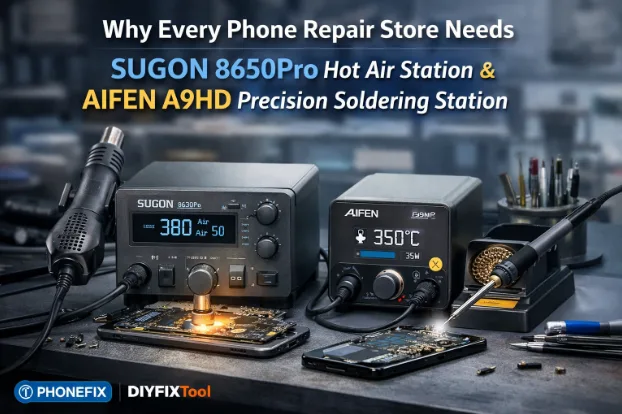
Why Every Phone Repair Store Needs SUGON 8650Pro Hot Air Station and AIFEN A9HD Precision Soldering Station
It’s three in the afternoon. A customer walks in with an iPhone 17 Pro Max that looks fine on the outside but won’t charge. Open it up, and there it is – a small darkened area around the charging management IC on the main board, surrounded by a dozen tiny capacitors and resistors. This kind of job is neither too big nor too small. Use a cheap hot air gun, and the airflow might blow away those tiny components. Poor temperature control, and the pads underneath the chip could be ruined. Scenes like this happen almost every day in a phone repair shop. The inside of a modern smartphone is nothing like what it was five years ago. Multi‑layer PCBs, densely packed chips, lead‑free solder, and heat‑sensitive parts – all of them test the limits of repair tools. Whether the board gets fixed or ends up as scrap often comes down to the equipment in your hand.
What’s inside today’s phones
Take a recent flagship like the iPhone 17 Pro Max or a Galaxy S series. What a repair technician sees is no longer a simple two‑layer board. Rigid‑flex PCBs, ICs with pin pitches as small as 0.3mm, and passive components down to 0201 size are common. Liquid damage, shorts, or physical breakage often concentrate in a very small area.
This means repair tools have to meet a few requirements: stable temperature output, adjustable airflow, fast heat‑up, and minimal thermal impact on surrounding parts. A standard hot air gun and soldering station struggle with these demands. That’s why more repair shops are moving to professional‑grade workstations such as the SUGON 8650Pro Hot Air Station and the AIFEN A9HD Precision Soldering Station.
On temperature control
Let’s start with the hot air side. The SUGON 8650Pro Hot Air Station stands out for its heating system and airflow control. In actual use, the temperature stays steady – it doesn’t drop from 350°C to 280°C the moment you bring the nozzle near the board. The airflow can be fine‑tuned, which makes a real difference when working with different types of components.
Take a power management IC as an example. Removing it requires fairly high temperature and airflow, but there is often a plastic connector sitting right next to it. If the hot air gun has a wide, unfocused heating pattern or unstable airflow, that connector will deform. The SUGON 8650Pro keeps the heat relatively concentrated, so the technician can direct most of the energy to the target component. It also heats up fast – from power‑on to working temperature in under a minute. When you have several devices waiting on the bench, that kind of efficiency adds up.
For jobs like CPU rework, audio chip replacement, or liquid‑damaged board repair, a reliable hot air station is almost mandatory. Trying to do those repairs with entry‑level gear leads to noticeably lower success rates.
The soldering part
After removing a damaged component, the next step is to put a new one on. This is where the soldering station comes in. The AIFEN A9HD Precision Soldering Station is designed for small‑component soldering and trace repair.
Its temperature control is precise – little deviation between the set temperature and the actual tip temperature. The tip recovers heat quickly, so soldering large ground planes doesn’t cause a sudden drop in temperature. The handle feels balanced, which matters during long repair sessions. These characteristics are important for tasks like soldering 0201 capacitors, running jumper wires to fix broken traces, or replacing a charging port.
Common issues like cold joints, solder bridges, or lifted pads are often not a matter of technician skill alone. The tool itself plays a big part. The AIFEN A9HD provides stable output and properly designed tip thermal mass, which helps produce a clean joint on the first pass and reduces the need for touch‑ups. For a repair shop, fewer reworks means lower costs and happier customers.
How the two tools work together
In a typical motherboard repair flow, the two tools play different roles. First, the SUGON 8650Pro Hot Air Station heats and removes the faulty part. After cleaning and tinning the pads, the technician switches to the AIFEN A9HD Precision Soldering Station to solder the new component. Separating the removal and soldering steps lets each tool do what it does best, making the whole process smoother.
This combination is especially useful for complex failures on high‑end phones, such as multi‑layer board repairs on iPhones, CPU reballing on Android devices, or HDMI port replacements on game consoles. Many repair shops turn down these jobs not because their technicians lack skill, but because their equipment isn’t up to the task.
What it means for repair shops and DIY users
From a business perspective, good tools directly affect operations. Faster repairs mean more jobs per day. Higher success rates reduce customer disputes. The ability to handle complex failures raises the average ticket value. When customers see professional‑grade equipment like the SUGON 8650Pro and AIFEN A9HD on the bench, their trust in the repair quality goes up.
For people who repair phones at home, the situation is similar. Many failed DIY motherboard repairs happen because the tools were too basic. If someone wants to do serious repair work – or simply get a device fixed properly without multiple attempts – investing in a professional soldering station and hot air workstation is worth it. Platforms like DIYFIXTool offer complete tool kits, including accessories and consumables from brands like PHONEFIX.
A few common real‑world uses
These tools show up frequently in everyday repairs:
- Replacing a charging port: remove the old port with a hot air station, then solder the new one.
- Fixing a short on the main board: locate the shorted component, remove it with hot air, clean the pads, and solder a replacement.
- Water damage repair: remove corroded ICs, clean the area, and re‑solder new ones.
- Trace repair: use a precision soldering station to solder a jumper wire onto a broken circuit line.
In every case, temperature control and soldering accuracy decide the outcome.
Setting up a reliable repair bench
A professional repair workspace is more than a pile of tools. Tool quality, bench organization, and repair process all affect the final result. Cleaning equipment regularly, calibrating temperatures, and using proper consumables are basic habits. For shop owners or individual technicians thinking about upgrading their gear, the SUGON 8650Pro Hot Air Station and AIFEN A9HD Precision Soldering Station have proven themselves in the field. They cover everything from daily screen swaps to board‑level repairs. Paired with a solid phone repair kit, they can handle most common faults on current mainstream devices. At the end of the day, phone repair relies on a combination of skill and tools. Good hands with good equipment bring a device back to near‑factory condition. Investing in tools is not an expense – it is what gives a repair shop the confidence to take on more and go further.