
Evaluating Self Storage for Sale in a Changing Commercial Landscape
In the self-storage sector, investment decisions are no longer based on location and square footage alone. Buyers are now weighing speed to market, operational flexibility, development risk, and capital efficiency just as heavily as long-term revenue potential. That shift is changing how businesses evaluate self storage opportunities, especially in markets where land, labor, and construction costs continue to put pressure on traditional development models.
High Upfront Costs Are Changing How Buyers Assess Opportunity
One of the biggest challenges in the self-storage market is the capital required to enter or expand. A conventional facility often involves land acquisition, site work, permitting, utilities, security infrastructure, and a lengthy construction schedule before revenue begins. For investors and operators, that can create a long runway between purchase and performance.
As a result, the phrase “self storage for sale” increasingly reflects more than a search for available assets. It often signals a search for viable entry points into the market. Buyers want to understand whether an opportunity can be activated efficiently, whether the cost structure supports long-term returns, and whether the model can scale without triggering another round of major capital expense. In a market defined by tighter margins and closer scrutiny of deployment timelines, cost predictability matters as much as asset availability.
Time to Revenue Matters More Than Ever
In many cases, the most attractive storage opportunity is not the largest one. It is the one that can begin generating value quickly. Traditional self-storage development can be slow by nature, especially when approvals, contracting delays, and phased construction are involved. That lag creates risk for operators who need to respond to near-term demand or prove performance before expanding further.
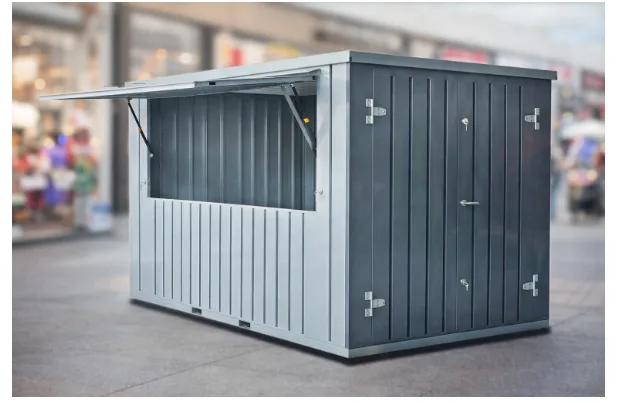
This is one reason flexible infrastructure models are getting more attention. When businesses evaluateSelf Storage for Sale, many are also exploring solutions that allow them to reduce build time and shorten the path from planning to use. Modular and relocatable storage formats can play a role in that discussion because they allow organizations to think beyond fixed construction and toward more adaptable deployment strategies. Used as a reference point, that approach can help buyers compare the operational tradeoffs between a conventional build and a more agile storage model.
The U.S. Small Business Administration has long emphasized the importance of capital planning and cash-flow awareness when evaluating growth opportunities, and those principles apply directly to storage investment decisions as well. A faster route to operational readiness can materially improve how an opportunity performs in its early stages.
Zoning, Permitting, and Local Constraints Can Slow Good Ideas
Even when market demand is strong, local approvals can complicate execution. Zoning classifications, land-use restrictions, parking requirements, stormwater considerations, and neighborhood objections can all affect the viability of a project. In some municipalities, storage development is welcomed. In others, it can face delays that reshape the economics of the investment.
That is why experienced buyers increasingly evaluate the regulatory environment with the same discipline they apply to occupancy projections or competitive analysis. A promising site is not necessarily a practical one if the timeline to deploy is uncertain. In these situations, flexibility becomes a strategic advantage. Storage solutions that can be introduced with fewer structural dependencies may allow businesses to test demand, support overflow needs, or extend service capacity while broader development questions are still being resolved.
The U.S. Environmental Protection Agency also notes that site planning and land-use decisions can significantly affect project timelines and compliance obligations. For storage investors, that reinforces the need to think about feasibility in operational terms, not just real estate terms.
Scalability Is a Competitive Advantage, Not a Nice-to-Have
A storage opportunity may look attractive today but still underperform tomorrow if it cannot scale efficiently. This is especially important for operators expanding across multiple markets or testing demand in secondary locations. Traditional facilities can be highly effective once stabilized, but they are also inherently fixed. Expansion usually means another round of site work, construction cost, and lead time.
Scalable storage models offer a different path. Instead of committing all capacity upfront, businesses can expand in phases, align supply with demand, and make decisions based on actual market response. That is a meaningful operational advantage in sectors where demand can shift by region, season, or customer segment. It also supports better capital discipline because investment can follow performance rather than precede it.
For corporate buyers, this changes the evaluation framework. The question is no longer simply whether a storage asset is available for purchase. It is whether the opportunity can support a repeatable and adaptable growth strategy. In a market where agility often influences returns, scalable deployment deserves a central place in the decision-making process.
The Best Opportunities Balance Demand, Speed, and Flexibility
The strongest self-storage opportunities are rarely defined by one metric alone. They tend to sit at the intersection of market demand, manageable execution risk, and operational flexibility. Buyers who focus only on property availability may miss the larger picture. The more durable strategy is to assess how quickly the model can be deployed, how efficiently it can be expanded, and how well it can adapt if conditions change.
That broader view helps explain why the market conversation is evolving. Self-storage remains an attractive category, but the most sophisticated buyers are looking beyond the traditional playbook. They are evaluating storage as infrastructure, not just as a fixed asset class, and that mindset opens the door to more responsive, more scalable investment strategies.
In practical terms, a good opportunity is not simply the one that is for sale. It is the one that is positioned to perform under real operating conditions.