
Geniatech i.MX 95 SoM Family Targets Scalable Edge AI
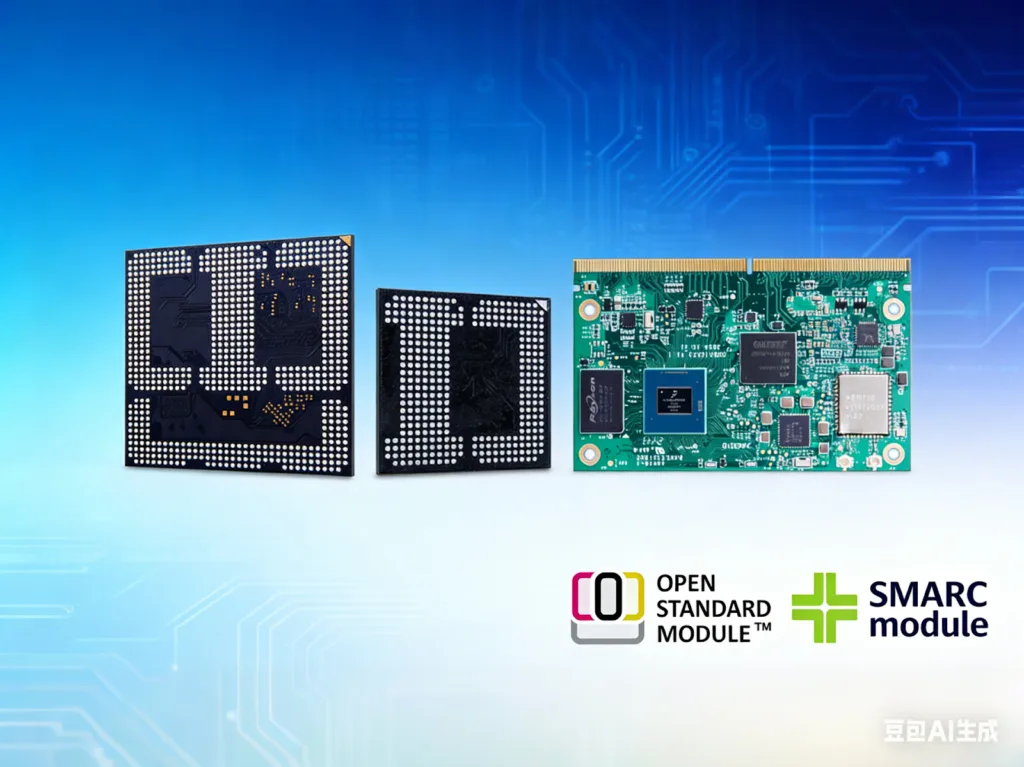
Geniatech has introduced a complete series of ARM SoMs based on NXP’s i.MX 95 Edge AI processor, aimed at smart retail, industrial automation, transportation, medical devices, and commercial IoT. The lineup centers on two core products—SOM‑iMX95‑SMARC and SOM‑iMX95‑OSM—that share the same processing platform but address different mechanical and reliability requirements.
Core platform and AI capability
At the heart of the series is NXP’s i.MX 95, combining up to six Arm Cortex‑A55 application cores with a real‑time Cortex‑M7 and a safety‑oriented Cortex‑M33 to support mixed‑criticality workloads on one module. The SoC integrates an Arm Mali‑G310 GPU for modern HMI needs and a multimedia engine capable of 4K video encode/decode, enabling rich display and vision applications at the edge. A built‑in NPU delivers up to 2 TOPS of AI performance, suitable for use cases such as video analytics, anomaly detection, and predictive maintenance without relying heavily on the cloud. Typical power consumption in the 3–8 W range helps keep designs fanless and compact while still meeting performance requirements.
Key i.MX 95 SoM features
| Category | Specification (shared family traits) |
| CPU | Up to 6× Arm Cortex-A55 application cores |
| Real-time cores | 1× Cortex-M7, 1× Cortex-M33 safety core |
| AI engine | Up to 2 TOPS NPU for edge inference |
| Memory | Up to 16 GB LPDDR5 |
| Storage | Up to 128 GB eMMC, SD card support |
| Power | Typical 3–8 W “Energy Flex” operation |
| Temperature | −40 °C to 85 °C industrial range |
SOM‑iMX95‑SMARC: Flexible modular design
The SOM‑iMX95‑SMARC follows the SMARC 2.1 form factor, using an MXM edge connector that allows the module to be easily swapped, upgraded, or serviced in the field. It integrates dual Gigabit Ethernet PHYs and an on‑board Wi‑Fi/Bluetooth module, making it well suited for connected kiosks, gateways, and HMI panels that need multiple networks and wireless connectivity. Rich graphics support comes from dual LVDS outputs and a 4‑lane MIPI‑DSI interface, enabling either multi‑display configurations or high‑resolution single panels alongside an MIPI‑CSI camera input. Designers also benefit from multiple USB 3.0/2.0 ports, PCIe lanes, and a wide range of low‑speed interfaces such as UART, I2C, SPI, CAN, and GPIO, plus optional security via TPM.
SOM‑iMX95‑OSM: Compact and rugged
The SOM‑iMX95‑OSM adopts the OSM Size‑L standard and is soldered directly to the carrier board, prioritizing robustness in environments with vibration, shock, or strict space constraints. Despite its smaller 45 × 45 mm footprint, it maintains dual Gigabit Ethernet with TSN and time‑synchronization features, making it attractive for industrial networking, motion control, and time‑sensitive control systems. The module still offers MIPI‑DSI and MIPI‑CSI interfaces, multiple UART/SPI/I2C channels, PWM, and ample GPIO, which is important for tightly integrated controllers and compact edge nodes. This solder‑down design is especially suitable for transportation, factory floor equipment, and long‑life embedded systems where mechanical connectors are potential failure points.
SMARC vs OSM at a glance
| Aspect | SOM-iMX95-SMARC | SOM-iMX95-OSM |
|---|---|---|
| Form factor | SMARC 2.1 with MXM edge connector | OSM Size-L, soldered to carrier |
| Typical use | Upgradable, modular systems | Rugged, space-constrained systems |
| Networking | Dual GbE with on-board PHYs, Wi-Fi/BT | Dual GbE with TSN/AVB focus |
| Serviceability | Easy field replacement | Maximized mechanical reliability |
Software ecosystem and availability
Geniatech supports the i.MX 95 SoM family with Yocto‑based BSPs, ready‑to‑run images, and pre‑verified drivers to shorten development time for OEMs and solution providers. The modules are compatible with NXP’s eIQ software stack, allowing developers to deploy computer vision and other AI workloads onto the on‑chip NPU with reduced integration effort. Samples of both SOM‑iMX95‑SMARC and SOM‑iMX95‑OSM are already available, and interested customers are encouraged to contact Geniatech directly for evaluation units, detailed documentation, and design support.