
Integrating a Prediction Market API: Step by Step Guide
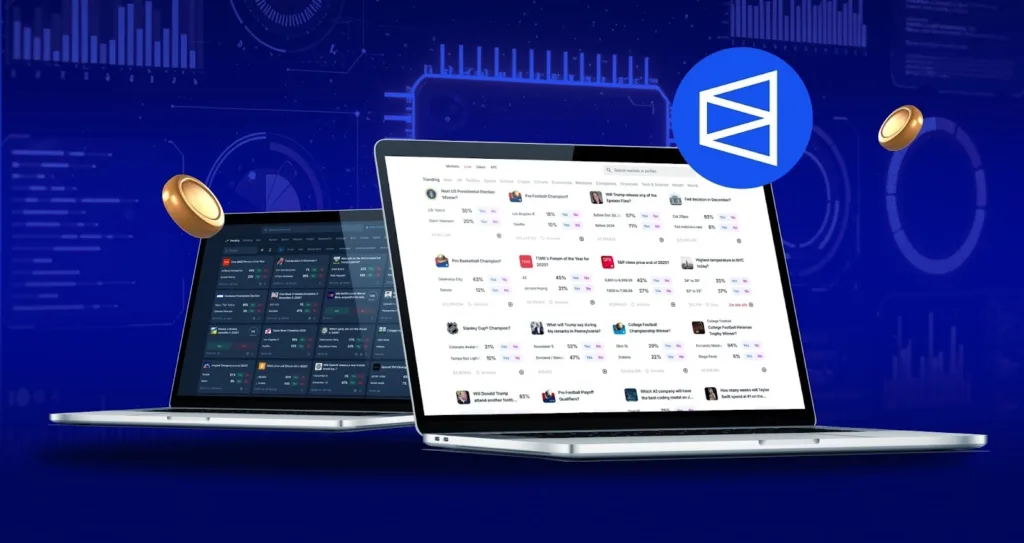
Prediction markets have matured from experimental DeFi protocols into institutional-grade trading infrastructure. In October 2025, Polymarket processed $2.76 billion in monthly trading volume with over 445,000 active traders. Regulated counterparts such as Kalshi now operate under direct CFTC oversight, signaling that prediction markets have entered the financial mainstream.
For platforms seeking to add prediction market functionality without rebuilding their core systems, API integration has become the fastest and most defensible route to market. However, prediction market API Integrations differ fundamentally from traditional exchange APIs. They introduce unique technical challenges around outcome definition, oracle trust, settlement integrity, liquidity behavior, and regulatory exposure.
This guide outlines the practical decisions and implementation steps product teams must address to integrate prediction market APIs successfully.
What You Are Actually Integrating?
A prediction market API manages the entire lifecycle of a market, not just pricing data. This includes market creation, outcome definition, real-time pricing, order execution, settlement, and dispute resolution.
Polymarket illustrates this complexity well. Trading occurs on an off-chain central limit order book for performance, while settlement is executed on Polygon using USDC-based collateral. The platform supports deposits from multiple blockchains, requiring cross-chain bridge coordination. Kalshi, by contrast, uses FIX 4.4 for institutional access and deterministic settlement tied to authoritative data sources.
Selecting an API provider is therefore an architectural decision. Decentralized oracle models prioritize flexibility but introduce settlement delays and disputes. Regulated frameworks offer faster resolution but limit market scope. These trade-offs must be understood before integration begins.
Step 1: Define Market Structure Before Writing Code
Market structure decisions drive downstream complexity and liquidity behavior.
- Binary markets (YES/NO outcomes) are the simplest to implement and concentrate liquidity efficiently.
- Scalar markets use predefined ranges to model probability distributions, reducing hedging basis risk but fragmenting liquidity across multiple outcome buckets.
- Multi-outcome markets support three or more results and are common in sports or political forecasting.
Liquidity fragmentation matters. A $500,000 trade in a fragmented scalar market can experience double-digit slippage compared to a unified binary pool. Once launched, changing market structure requires rewriting settlement logic and redefining outcomes, which is operationally expensive and risky.
Step 2: Pricing and Liquidity Management
Most modern prediction markets rely on Automated Market Makers (AMMs) rather than pure order books. AMMs solve cold-start liquidity but introduce predictable slippage proportional to trade size.
From an integration standpoint, this requires:
- Continuous pricing updates via REST or WebSocket feeds
- Real-time order routing with minimal latency
- Redundant API connectivity and failover handling
Execution latency is critical. Delays above 100–200 milliseconds in volatile markets can materially alter execution prices, degrading user trust. Production platforms implement circuit breakers that halt trading if latency exceeds defined thresholds.
Liquidity visibility is equally important. Platforms should surface real-time pool depth, warn users of slippage risk, or algorithmically split large orders to minimize price impact.
Step 3: Oracle Selection and Settlement Integrity
Settlement is the trust anchor of prediction markets.
Decentralized platforms often rely on optimistic oracle frameworks. Polymarket uses UMA’s Optimistic Oracle, where outcomes are assumed correct unless disputed within a challenge window. While effective at scale, this model introduces settlement delays of 48–96 hours.
Regulated platforms like Kalshi use deterministic settlement tied to published economic or government data, enabling rapid finality but restricting market types.
Regardless of oracle choice, platforms must implement settlement reconciliation logic:
- Verify positions and payouts exactly match internal records
- Ensure settlement fees are applied correctly
- Store immutable settlement reports for audit and dispute resolution
This is essential for both regulatory compliance and operational risk management.
Step 4: User Accounts and Balance Management
Prediction markets handling real money require deterministic accounting.
Key considerations include:
- Wallet architecture: self-custodial wallets increase user control but raise operational risk, while custodial models simplify compliance.
- Position limits: caps prevent market manipulation and liquidity distortion.
- Ledger synchronization: hybrid on-chain and off-chain systems must reconcile continuously, with the blockchain treated as canonical in case of divergence.
Balance mismatches are not cosmetic bugs. They represent financial and regulatory liabilities.
Step 5: Compliance and Access Controls
Regulatory scrutiny intensified following Polymarket’s CFTC settlement and subsequent operational changes. Today, compliance is non-negotiable.
A production-grade integration enforces:
- KYC and identity verification before market access
- Real-time transaction monitoring for suspicious behavior
- Jurisdictional geofencing with VPN detection
- Sanctions screening against OFAC and global watchlists
These checks must run synchronously at account creation, market access, trade execution, and withdrawal. Retrofitting compliance after launch invites regulatory exposure and operational disruption.
Step 6: Settlement Transparency and Post-Market Operations
After resolution, settlement data must be auditable and transparent.
Well-designed APIs deliver structured settlement reports containing market identifiers, outcomes, position counts, fees, and timestamps. Platforms should publish anonymized settlement logs and outcome proofs to enable user verification and regulatory audits.
Post-market analytics such as realized volatility, liquidity behavior, and arbitrage patterns feed back into improved market design and pricing models.
Step 7: Testing Before Production
Prediction market APIs tolerate no guesswork.
Before launch, teams must complete:
- Functional testing across market creation, trading, and settlement
- Full settlement reconciliation against blockchain and database records
- Latency stress testing under concurrent load
- Compliance testing for KYC, geofencing, and sanctions enforcement
- Error-handling validation for API failures and edge cases
Industry data shows a significant percentage of API incidents stem from inadequate error handling, not faulty business logic.
A Realistic Integration Timeline
Most production deployments follow this sequence:
- Week 1: Requirements definition, sandbox access, initial market data ingestion
- Week 2: Trade execution, pricing feeds, basic settlement workflows
- Week 3: Compliance enforcement, reconciliation logic, load testing
- Week 4: Security review, audit readiness, monitored production launch
Multi-chain or multi-jurisdictional deployments may extend to six to eight weeks.
Choosing the Right Integration Approach
While in-house integration is feasible, complexity rises quickly when managing multiple exchanges, oracle models, compliance frameworks, and settlement pipelines.
Specialized Prediction Market Platform Development Companies like TRUEiGTECH abstract this complexity through unified APIs that normalize data schemas, automate compliance workflows, and standardize settlement reporting across platforms including Polymarket, Kalshi, and others. This approach typically compresses timelines from months to weeks while reducing regulatory and operational risk.
Conclusion
Prediction market APIs transform platforms into active trading environments, but success depends on disciplined execution. Market structure design, pricing integrity, oracle trust, settlement verification, compliance enforcement, and rigorous testing are not optional steps.
The platforms that invest in clean architecture and transparent operations earn user trust, attract liquidity, and scale sustainably. As prediction markets expand beyond crypto into policy, economics, and global forecasting, infrastructure quality, not hype, will define the winners.
The future of prediction markets is reliable, compliant, and auditable systems. That future begins with thoughtful API integration.
TRUEiGTECH enables prediction market platforms to launch through unified APIs, automated compliance workflows, and production-grade settlement infrastructure. Learn more at trueigtech.com.