
Why Small Businesses Struggle with Facebook Ads in 2026?
Small businesses still see Facebook as one of the fastest ways to get customers. Many business owners still believe that they only need to create an ad, target the right people, and then expect sales to follow. Unfortunately, the reality looks very different in 2026. Most small businesses feel stuck, and they fail because they are still using these outdated methods.
Ads stop working without warning. Costs go up. Accounts get restricted. Campaigns that worked last month suddenly fail. This is not just bad luck. The system itself has changed, and advertisers must shift their focus to technical infrastructure and data accuracy if they want to find a place in the market.
Facebook Ads in 2026: What Changed for Small Businesses?
Small businesses face a very different Facebook Ads landscape in 2026. Platforms change fast, and competition grows every year. Costs rise, and targeting becomes less precise due to privacy updates. Many brands now rely on ad agency accounts to scale faster and stay compliant.

Creative quality now drives more results than technical setup. Data tracking becomes harder and requires smarter strategies. Many businesses struggle to keep up with these shifts. To stay effective, you need to understand exactly what has changed and why it matters.
1. The Rise of Full Automation
The Meta algorithm now handles most targeting decisions. Small businesses no longer need to build complex interest groups. The Advantage+ system uses AI to find your buyers. You provide the budget and the creative assets. The system tests different versions of your ad automatically. This shift saves time for business owners. It also reduces the risk of human error in campaign setup.
2. Creative as the New Targeting
Content quality determines your reach in 2026. Meta prioritizes ads that generate positive engagement. Static images with heavy text often fail. Small businesses must produce high-quality video content. Your video should look like a native post. Users prefer authentic stories over polished commercials. The algorithm analyzes the “vibe” of your creative. It then shows your ad to people who enjoy similar content.
3. Privacy and Data Signals
Privacy laws have changed how we track conversions. Third-party cookies no longer provide reliable data. Meta uses its own internal signals to measure success. You should implement the Conversions API for better results. This tool connects your website directly to Meta’s servers. It helps the AI understand which ads lead to sales. Accurate data allows the algorithm to optimize your spending.
4. Rising Costs and Competition
Ad space on Facebook is more expensive than before. Big brands spend heavily on the platform. Small businesses must focus on Retention and Lifetime Value. You cannot survive on one-time sales alone. Successful advertisers build long-term relationships with their audience. They use ads to grow email lists or community groups. This strategy lowers the overall cost of customer acquisition.
Why Small Businesses Struggle with Facebook Ads in 2026?
Small businesses struggle with Facebook Ads in 2026 because the system no longer treats all advertisers the same.
Meta Platforms now evaluates your account quality, history, and behavior, not just your ad creative. That’s also the reason why more and more advertisers move from personal ad accounts to agency facebook ad account. That shift creates a gap between small businesses and established advertisers.
Here are the real reasons behind the struggle:
1. Low Trust Slows Everything Down
Small businesses often launch ads from fresh accounts. These accounts lack history and consistent spending. The system reacts by limiting delivery, increasing costs, and watching behavior closely. This creates a slow and expensive start.
2. Sudden Restrictions Break Campaigns
Many advertisers experience account limits without a clear warning. Campaigns stop even when ads follow policy. This happens because:
- Risk systems act fast
- Behavior patterns trigger flags
- Trust signals remain weak
Just a single restriction can stop your whole revenue for days or even weeks.
3. Costs rise without clear logic
Small businesses often see higher costs compared to larger advertisers. Because the platform rewards accounts that show stable spending, a long history, and predictable performance, a weaker account has to pay more to reach the same audience, leading to a rise in costs.
4. Scaling Creates Instability
Growth requires higher budgets. The system expects stability before it allows scale. When small businesses increase spending too quickly:
- Performance drops
- Campaigns reset learning
- Costs increase
The account cannot support the growth yet.
5. DIY Setup Limits Performance
Many owners manage ads on their own. Though this approach used to work in the past, the environment now requires more structure. A basic setup lacks: strong account history, reliable infrastructure, and risk management.
As a business owner, I fully understand why other owners want to keep complete control over their advertising. To be honest, this approach, this strategy may be correct, but the foundation remains weak.
What Actually Works For Small Businesses in 2026?
In April 2026, the Facebook (Meta) algorithm had moved beyond simple demographics. It now prioritizes Creative Signals and Data Pipelines. If you want your ads to actually convert today, you have to feed the AI what it wants.
Here is the current playbook for what is working right now:
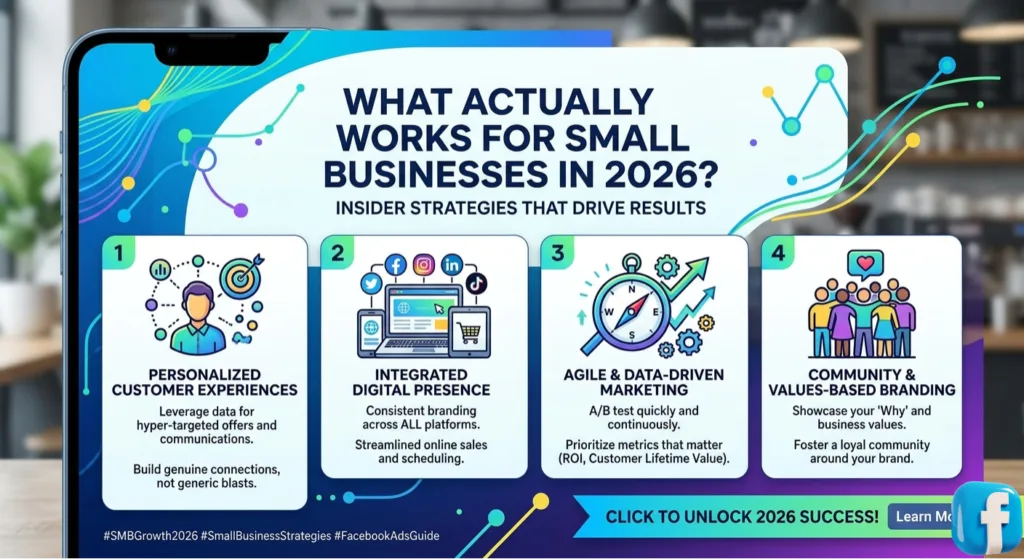
1. Creative as Targeting
The biggest shift in 2026 is that your ad is your targeting. Meta’s AI now uses computer vision to scan your images and videos. If your ad shows a person drinking coffee in a home office, the AI automatically finds people who work from home and like coffee.
Stop using narrow interest groups. Instead, you should use Broad Targeting (Age, Gender, Location only) and let the visual content find the audience.
- Asset Volume: You now need 15 to 50 active creatives per campaign to maintain stability. The algorithm needs “creative diversity” to test different psychological hooks simultaneously.
2. The Resurgence of “Authentic” Statistics
While video is still huge, users are experiencing “short-form video fatigue.” Therefore, simple Lifestyle Static Images are making a massive comeback.
A high-contrast static image with a clear, bold headline often stops the scroll faster than a video that requires 3 seconds to get to the point. You can use “UGC-style” photos that look like they were taken on an iPhone by a real customer.
Avoid polished studio photography; it looks too much like an ad and is ignored.
3. Advantage+ Everything
Meta’s Advantage+ Shopping Campaigns (ASC) are now the gold standard. You can consolidate your budget into one ASC campaign. Keep in mind to not split your budget into dozens of manual ad sets.
Besides, you can also use Multi-Advertiser Ads and Flexible Ad Formats. This allows Meta to automatically swap your headline, image, and description to match the specific person viewing the ad in that second.
4. The “Signal” Health Check (CAPI)
In 2026, the Pixel alone is insufficient due to privacy laws and cookie blocking. You must implement the Conversions API (CAPI). This sends data directly from your server to Meta.
According to Stormy (2026), accounts with properly implemented Meta Conversions API (CAPI), particularly when used in conjunction with the Meta Pixel, typically achieve higher ROAS (an average of 18-20%) compared to those relying solely on browser‑based pixel tracking, as CAPI reduces data loss and improves the accuracy of conversion signals.
Final Thought
The Facebook advertising landscape in 2026 demands a shift from technical manipulation to creative strategy. Success now relies on feeding the Andromeda algorithm high-quality signals through broad targeting and the Conversions API rather than restrictive interest groups. You must prioritize creative velocity by testing multiple authentic hooks that allow the AI to find your audience visually. Small businesses win when they stop over-managing the settings and start focusing on human-centric content that builds genuine trust.