
The True Cost of Hiring a PR Agency vs. DIY vs. AI-Powered PR
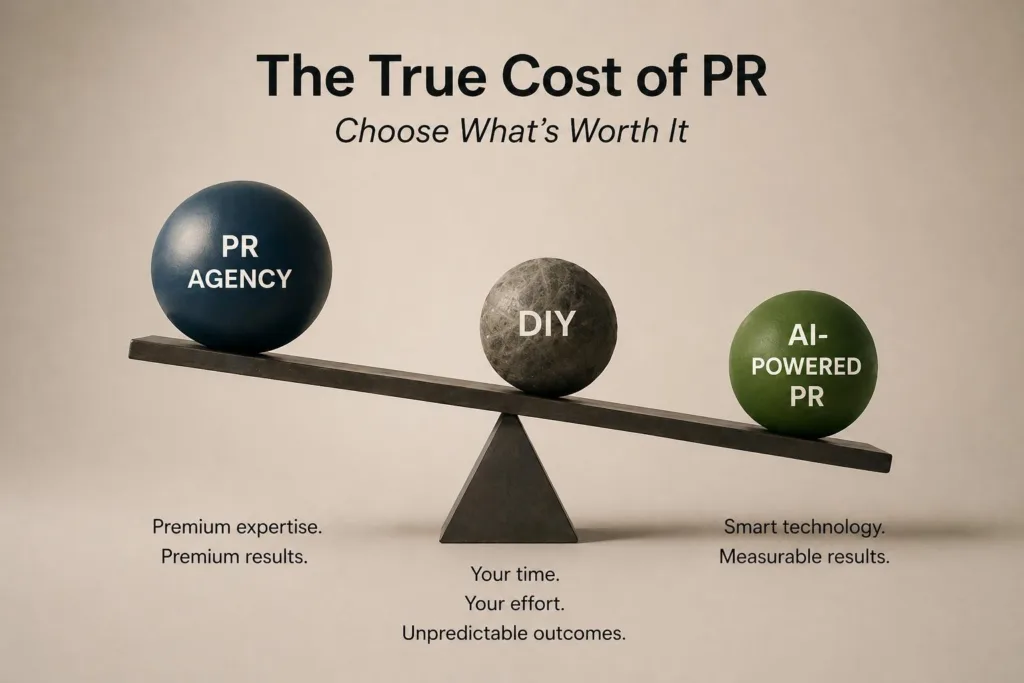
Public relations has long been viewed as a line item reserved for established companies with deep marketing budgets. That perception is shifting. Founders, creators, and small business owners now have three viable paths to earning media coverage: hiring a traditional PR agency, building visibility on their own, or working with AI-powered PR services. Each comes with a different price tag, and more importantly, a different set of trade-offs that go well beyond what a brand pays each month.
Understanding the true cost of each option requires looking at the full picture: the dollars spent, the hours invested, the expertise required, and the kind of results a brand can realistically expect.
Option 1: Hiring a Traditional PR Agency
Traditional agencies remain the gold standard in many industries. They bring established journalist relationships, strategic counsel, and the experience needed to navigate everything from product launches to crisis response.
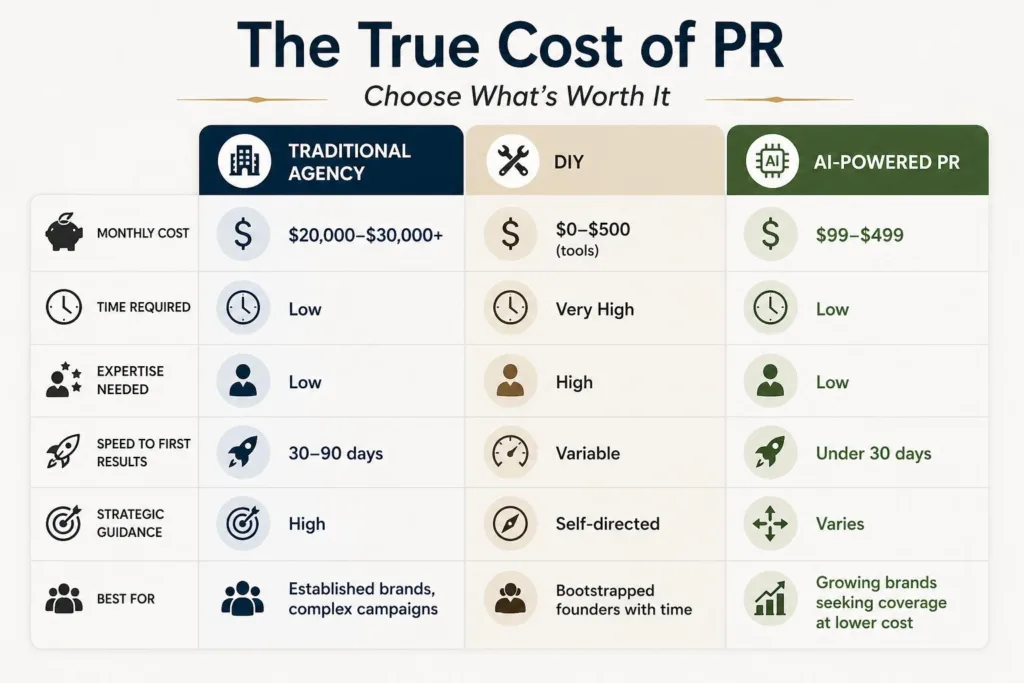
The cost, however, is significant. Most established firms charge monthly retainers ranging from $10,000 on the low end to $20,000 or more for boutique and mid-sized agencies. Larger firms working with national brands routinely command $30,000 a month and up. These retainers typically cover a defined scope, media outreach, messaging strategy, press release distribution, and a set number of hours from the account team, but extras like crisis work, event coordination, or expanded campaigns often carry separate fees.
Beyond the financial cost, there is a time cost. Agency relationships generally require a 30 to 90 day onboarding period before any meaningful coverage appears, and most contracts run for six to twelve months. For brands with the budget and patience, the return can be substantial. For early-stage companies though, the math rarely works.
Option 2: The DIY Approach
Doing PR in-house has become more accessible thanks to media databases, journalist platforms, and pitching tools. Founders can subscribe to services like Muck Rack, monitor coverage with Google Alerts, and pitch reporters directly through email or LinkedIn.
The out-of-pocket cost is modest. Tool subscriptions typically run between $100 and $500 per month, and a free version of many of these platforms exists for those just starting out. The real expense is time. Effective PR requires building a media list, researching journalists’ beats, crafting tailored pitches, following up consistently, and tracking results. Founders who take this seriously often spend ten to twenty hours a week on the work, which is time pulled from product, sales, or operations.
The DIY route also comes with a learning curve. Knowing how to angle a pitch, when to send it, and how to follow up without becoming a nuisance takes practice. Brands with a compelling founder story and a willingness to invest the time can absolutely earn coverage this way, but the trade-off is real: every hour spent pitching is an hour not spent running the business.
Option 3: AI-Powered PR Services
A newer category has emerged in recent years: services that use AI to automate parts of the PR process while still operating as a managed service. These platforms typically analyze a brand’s profile, match it with relevant journalists across hundreds or thousands of outlets, generate tailored pitches, and handle outreach on the brand’s behalf.
Savon PR is one example of a company operating in the AI PR space. According to its public materials, the service uses AI to match brands with journalists across more than 1,250 outlets and offers tiered packages aimed at brands looking for coverage without the cost of a traditional retainer.
Pricing in this category varies widely. Entry-level packages can start at a few hundred dollars per month, while more comprehensive offerings with tier-one media targeting can run several thousand. The appeal is straightforward: brands get the structure of an agency engagement and the reach of a media database, without the full retainer commitment. The trade-off is that AI-driven services tend to operate at scale, which can mean less of the bespoke strategic counsel a traditional agency provides. Quality also varies significantly between providers, so due diligence matters.
Comparing the Three at a Glance
When stacked side by side, the differences become clearer:
Choosing What Actually Fits
The right choice depends less on which option is “best” in the abstract and more on a brand’s stage, budget, and goals. A Series B startup launching a new product probably needs the strategic firepower of an agency. A solo founder validating a new brand may get more from a DIY approach combined with consistent content. Small business owners looking for credibility-building coverage without a five-figure monthly burn may find an AI-powered service strikes the right balance.
It is also worth noting that these paths are not mutually exclusive. Many growing brands blend approaches: an AI-powered service to generate steady coverage, a freelance publicist for high-stakes moments, and DIY thought leadership from the founder on social channels. The PR landscape in 2026 rewards brands that think practically about what they need, rather than assuming they need to spend like a fintech Fortune 500 company.
The true cost of PR, in the end, is not just what a brand pays, it’s what it gets in return for the dollars and hours invested. Asking the right questions up front tends to be the best protection against overpaying for the wrong fit.