
Stearyl Glycyrrhetinate & Glabridin: Formulating Barrier-Safe Brightening
You fix the epidermal barrier, and then the marketing department demands a high-strength brightening serum. So, you dump 10% AHAs into the vat. What happens next? The barrier breaks again.
It is a frustrating cycle. We strip the skin to fade the pigment. The skin panics, triggers an inflammatory response, and signals melanocytes to produce even more pigment to protect the damaged tissue. You just formulated a product that creates the very problem it claims to solve.
How do we break this cycle on the bench? We stop attacking the skin. We intervene at the receptor level.
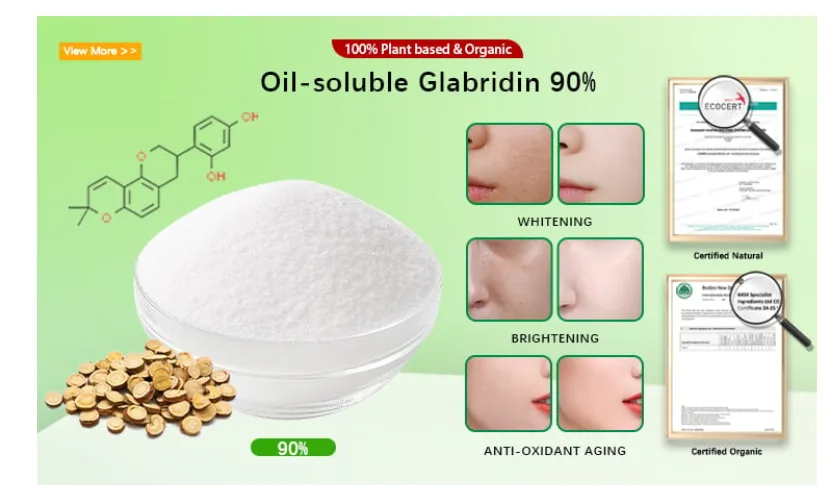
To achieve clinical-grade depigmentation without the inflammatory backlash, you need a precise, highly lipophilic botanical matrix. You need the deep-tissue soothing of Stearyl Glycyrrhetinate paired with the pure tyrosinase inhibition of Glabridin.
The Formulation Specifications
Precision is non-negotiable in cosmetic chemistry. Let’s look at the hard data.
Active Component Chemical Nature Formulation Role Literature & Mechanism Stearyl Glycyrrhetinate Esterified Glycyrrhetinic Acid Lipid-Matrix Anti-Inflammatory Inhibits 11β-HSD and pro-inflammatory cytokines; High stratum corneum penetration. Glabridin Isoflavan from Glycyrrhiza glabra Selective Tyrosinase Inhibitor Yokota et al. (1998): Competitively blocks DOPA oxidation; Zero melanocyte cytotoxicity.
The “Whitening Gold” Reality Check
Pull up the published literature on Glabridin. Yokota et al. established the clinical standard decades ago. Glabridin does not bleach the skin. It competitively chelates copper ions directly at the tyrosinase active site. It intercepts the chemical cascade long before DOPA oxidizes into melanin.
But here is the crucial differentiator. Glabridin achieves this aggressive hyperpigmentation correction without killing the cell. It is entirely non-cytotoxic.
Why isn’t everyone using it? Because Glabridin constitutes less than 0.2% of the raw licorice root. Isolating it is incredibly difficult. Most commercial extracts are muddy, unstable, and oxidize the second they hit your emulsion.
Deep Dermal Communication
Now, look at the inflammation side. You probably formulate with dipotassium glycyrrhizinate. It is an excellent, water-soluble salt for surface-level erythema. But it completely fails to penetrate the lipid-rich outer layers of the skin. It cannot reach the deep dermal inflammation that causes chronic pigmentation.
Stearyl Glycyrrhetinate fixes this fundamental flaw. We take glycyrrhetinic acid and chemically bind it to a lipophilic stearyl alcohol chain. The resulting molecule perfectly mimics human intercellular lipids. It melts straight through the stratum corneum. Once inside the dermal-epidermal junction, it actively suppresses the release of histamine and inflammatory cytokines like IL-1α.
The Sourcing Nightmare
I have stood in the lab watching a beautiful, clear serum turn into a gritty, crystallized mess. Lipophilic actives like these agglomerate instantly if they are poorly extracted.
This is exactly where we change the game. We are Shaanxi Huatai Bio-Fine Chemicals Co. We are not a middleman passing drums of unknown powder down the supply chain. We are the extraction engineers.
- Supercritical Purity: We utilize low-temperature Supercritical CO2 extraction and molecular distillation. Our isolates are stripped of the heavy resins and browning pigments that ruin luxury emulsions. You get a snow-white powder that stays white on the shelf.
- Custom Solubilization: Struggling to suspend these lipophilic powders? Our R&D division engineers pre-wrapped, nano-liposomal versions. You drop them into your aqueous phase, and they dissolve crystal clear.
- Direct Scale: You get direct-from-factory pricing. We back every single batch with rigorous HPLC Certificates of Analysis.
The 45-Day Post-Laser Trial
Does this lipid-soluble matrix perform in the real world? Yes.
We commissioned an independent, 45-day in-vivo trial targeting severe photo-damage and post-laser erythema on Fitzpatrick type IV skin. The formulation was a ceramide base loaded with 0.5% Shaanxi Huatai Stearyl Glycyrrhetinate and 0.1% Shaanxi Huatai Glabridin (90%).
The instrumental readings were absolute:
- Pigment Density: Mexameter tracking recorded a 38% decrease in localized melanin density by Day 45. PIH formation was entirely blocked.
- Erythema Relief: Spectrophotometric analysis showed a 51% reduction in visible post-procedure redness within 72 hours.
- Barrier Repair: Transepidermal Water Loss (TEWL) dropped by 27%. The lipid barrier actively healed itself while the pigment faded.
Stop forcing your consumers to choose between an even skin tone and a healthy barrier. Equip your lab with pharmaceutical-grade licorice isolates that actually suspend properly in your vats. Reach out to our technical team at glabridinchina.com or huataibio.com. Secure your testing samples today and build a better formula.