
Spider Veins vs Varicose Veins: Differences, Risks & Best Treatments
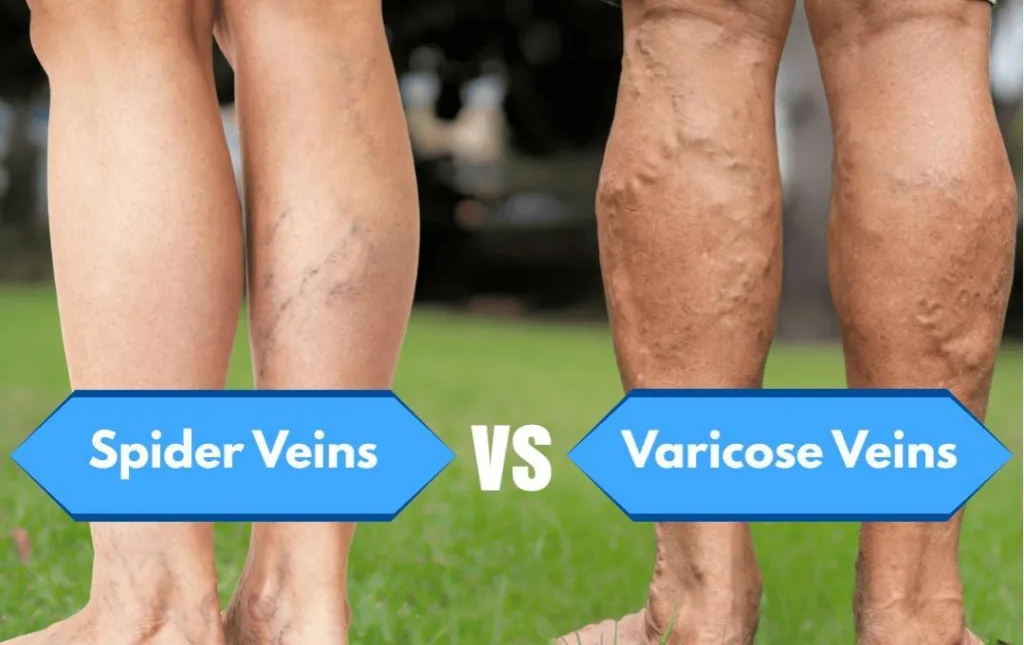
Those blue, purple, or gnarled lines that sometimes appear on your legs? You’re definitely not the only one seeing them.
Varicose veins and spider veins affect an estimated 23% of American adults and many people don’t realize the two conditions are quite different from each other.
Whether you’re spending long hours at a desk, training for a race, or simply noticing changes as you age, understanding the difference matters. One could be a minor cosmetic concern. The other might signal an underlying venous insufficiency that needs medical attention.
Varicose veins are larger, bulging veins that can cause pain and health complications. Spider veins are smaller and mostly cosmetic. Both are treatable.
What Are Varicose Veins?
Varicose veins, which can be easily identified as swollen or twisted veins, are usually visible under the skin surface. The formation of varicose veins is normally seen in the legs and feet, and the increased pressure in the lower parts of the body is the reason for the formation of varicose veins.
When the tiny valves within your veins start to falter or become damaged, blood can reverse its course, accumulating and leading to a bulge in the vein. This condition is known as chronic venous insufficiency, or CVI. At MVM Health, Our board-certified varicose veins specialist provides advanced, minimally invasive treatments to help you regain comfort, confidence, and healthy legs.
Common Symptoms of Varicose Veins
Legs that ache or feel heavy, particularly after being on your feet for a while. Veins that are visibly bulging, twisted, or resemble ropes. Swelling in the ankles and lower legs. Skin discoloration or itching near the veins that are affected. Muscle cramps or a burning sensation. In more serious cases, ulcers or sores near the ankle.
What Are Spider Veins?
Spider veins, also called telangiectasias, are small, dilated vessels that appear as a red, blue, or purple hue, arranged in a spider-like pattern, close to the surface of the skin.
Spider veins, those small, branching vessels that appear on the legs and face, are generally benign. While a form of venous disease, spider veins are not likely to produce serious health consequences.
Quick Comparison:
Here’s a quick comparison in points based on what you’re showing
- Type:
- Spider veins: Small, surface-level veins
- Varicose veins: Large, deeper veins
- Appearance:
- Spider veins: Thin, web-like (red/purple)
- Varicose veins: Bulging, twisted (blue/green)
- Size:
- Spider veins: Very tiny (< 1 mm)
- Varicose veins: Thicker (> 3 mm)
- Symptoms:
- Spider veins: Usually no pain (cosmetic issue)
- Varicose veins: Pain, heaviness, swelling
- Raised or Flat:
- Spider veins: Flat on skin
- Varicose veins: Raised and protruding
- Seriousness:
- Spider veins: Mostly harmless
- Varicose veins: May indicate vein disease
What Causes Varicose Veins and Spider Veins?
Both conditions share similar root causes, but some risk factors are more likely to produce varicose veins specifically.
Primary Causes
Defective valves in the veins. This is the most common cause. When the valves become weaker, they can cause blood to collect in the veins. This will cause them to become enlarged.
Genetics
This means that if you have a family history of venous disease, you are more likely to develop the condition. Sitting and standing for long periods can be a problem. Office workers, nurses, and teachers, for instance, are more susceptible because their circulation is often compromised.
Hormonal changes, such as those caused by pregnancy, menopause, or hormone therapy, can weaken the walls of veins.
• Age: The walls of the veins become less elastic with age.
• Obesity: Excess weight can put pressure on the veins in the legs.
• Prior injuries: Injuries to the veins can cause problems for the valves.
Athletes are also not immune to this problem. Athletes who participate in sports that require heavy lifting and running can also put pressure on the valves in their veins if they have a genetic predisposition to venous problems.
Are Varicose Veins Dangerous?
Spider veins are mainly a cosmetic concern. Varicose veins, however, can progress into more serious conditions if left untreated.
Potential Complications of Untreated Varicose Veins
• Deep Vein Thrombosis (DVT): Blood clots can form in the deep veins. This can be life-threatening.
• Venous Ulcers: Chronic pressure can cause breakdown of the skin in the ankle region. This can result in painful open sores.
• Superficial Thrombophlebitis: Inflammation and clots in the veins that are just under the skin surface.
• Bleeding: Due to the presence of varicose veins that are close to the surface of the skin, there can be significant
Best Treatment Options for Varicose Veins & Spider Veins
Modern vein treatment is far less invasive than it was a decade ago. Most procedures are done on an outpatient basis, are minimally invasive, and require little to no recovery time.
Sclerotherapy is often regarded as the go-to treatment for spider veins and smaller varicose veins. The process involves injecting a solution directly into the problematic vein. This causes the vein to seal off and gradually disappear. Patients typically see results within a 3–6 week timeframe, and the procedure is done in the doctor’s office.
1. Endovenous Laser Ablation (EVLA)
This method uses laser energy to close the affected vein from the inside. It’s especially useful for treating large varicose veins and the ongoing issue of chronic venous insufficiency. Most patients return to normal activity within 24–48 hours.
2. Radiofrequency Ablation (RFA)
Similar to EVLA but uses radiofrequency (heat) energy instead of laser. RFA is well-tolerated by patients and has a high long-term success rate for eliminating varicose veins.
3. Compression therapy
Compression therapy offers relief and can potentially slow the course of the disease. These stockings are frequently the initial suggestion for individuals dealing with mild varicose veins, or for those who aren’t quite prepared for more invasive treatments.
4 Surface Laser Therapy
Best suited for very fine spider veins, particularly on the face. No injections needed the laser targets the vessel directly through the skin.
5. Ambulatory Phlebectomy
This micro-surgical method involves extracting the varicose vein through small incisions. It’s a good option for those larger, superficial veins that don’t seem to improve with ablation.
When Should You See a Vein Specialist?
Don’t let things get out of hand. Early intervention leads to better outcomes and fewer complications. If you’re experiencing swollen, twisted, or painful leg veins, Schedule a Consultation if you observe any of the following:
• Veins that are prominent, distorted, or enlarged
• Leg discomfort, a feeling of heaviness, or cramps that intensify as the day progresses
• Skin alterations, darkening, or eczema around the ankles
• Non-healing sores or wounds near the ankle
• A vein that has bled or feels warm and sensitive
• A family history of deep vein thrombosis (DVT) or pulmonary embolism
If you’re located in East Stroudsburg, Bethlehem, King of Prussia, or Reading, PA, a board-certified vein specialist can assess your situation and suggest the most appropriate treatment for you
Conclusion
Although varicose veins and spider veins might seem similar at first, they are actually different conditions, each with its own risks and treatment options.While spider veins are primarily a cosmetic issue, varicose veins can progress into a serious medical condition that affects your mobility and quality of life.The positive aspect? Both conditions are easily addressed using current, minimally invasive methods. You don’t have to endure discomfort, feel self-conscious, or fret.
Frequently Asked Questions (FAQ)
Q1: What is the main difference between spider veins and varicose veins?
Spider veins are small, flat, web-like vessels that are mostly cosmetic. Varicose veins are larger, raised, and twisted veins that can cause pain, swelling, and serious circulatory problems if left untreated.
Q2: Are varicose veins dangerous?
In mild cases, varicose veins are not immediately dangerous. However, untreated varicose veins can lead to deep vein thrombosis (DVT), venous ulcers, or skin breakdown. Always consult a specialist if symptoms worsen.
Q3: Can spider veins turn into varicose veins?
Spider veins and varicose veins are separate conditions, although both stem from venous insufficiency. Spider veins do not typically ‘become’ varicose veins, but both can worsen with the same underlying risk factors.
Q4: How long does vein treatment take?
Most procedures, like sclerotherapy and laser ablation, are performed in under one hour. Recovery is generally quick; many patients resume daily activities the same day or within 24–48 hours.
Q5: Where can I get varicose vein treatment in Pennsylvania?
Qualified vein specialists are available throughout Pennsylvania, including East Stroudsburg, Bethlehem, King of Prussia, and Reading, PA. Look for a board-certified physician with experience in minimally invasive vein procedures.
About the Author
Dr. Dr. Peter J. Isaac, MD Vein & Vascular Specialist
Dr. Peter J. Isaac, D.O., F.A.C.O.S., is a highly esteemed Vascular Surgeon who holds board certifications in General Surgery (1994) and Vascular Surgery (1996). He received his training at St. John Hospital and Memorial Hospital and has played pivotal roles at Sacred Heart Hospital. Presently, Dr. Isaac serves as the medical director of the vascular lab at MVM Health and, he is additionally associated with St. Luke’s Health Network and Lehigh Valley Health Network. Actively involved in professional associations such as POMA and AOA, Dr. Isaac has made significant contributions to the fields of General and Vascular Surgery.