
How to Monetize Your AI Influencer on YouTube?
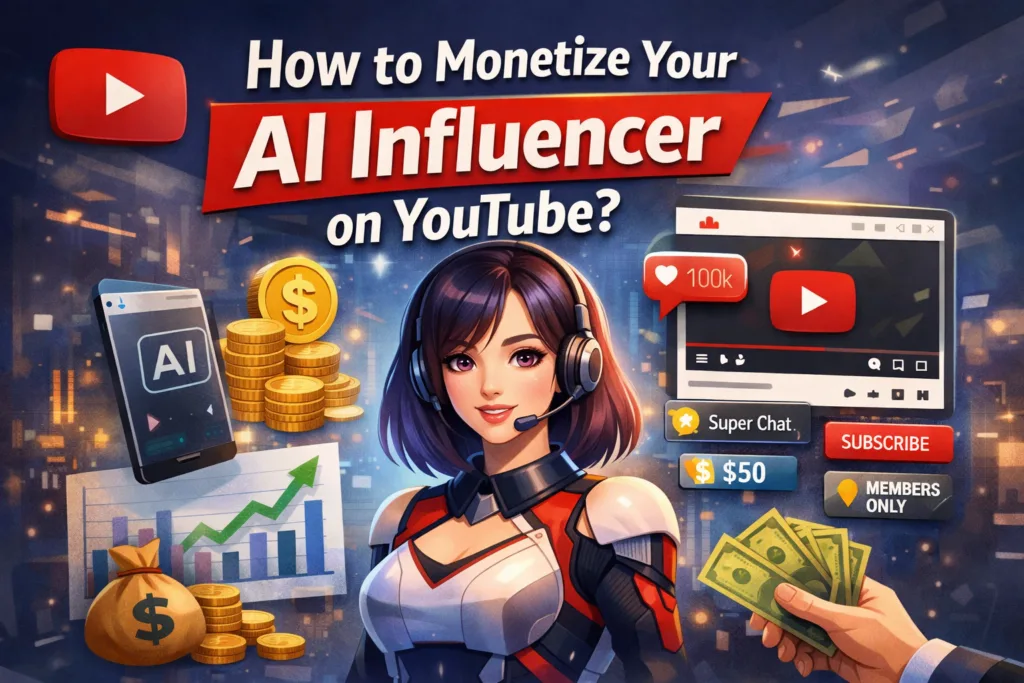
The rise of the AI influencer has changed how audiences interact with content on YouTube. Instead of relying only on human-led channels, creators and media companies are now publishing virtual personalities that speak, react, and build consistent identities over time. I have observed that this shift is not only technical but also economic, as revenue models around the AI influencer are becoming clearer and more structured.
We are seeing YouTube evolve into a space where virtual creators coexist with human ones. Their growth is not accidental. They are backed by repeatable production workflows, predictable posting schedules, and data-driven feedback loops. As a result, the question many industry observers ask is not whether an AI influencer can earn revenue, but how that monetization actually works in practice.
How Virtual Creators Are Positioned Within YouTube’s Ecosystem
Initially, YouTube treated virtual channels the same way as any other channel. Over time, policies, ad systems, and audience behavior adapted. An AI influencer today is often framed as a themed channel rather than a novelty experiment.
They are commonly positioned as:
- Long-form explainers using consistent narration styles
- Short-form personalities designed for YouTube Shorts
- Story-driven characters that release episodic content
- Commentary channels reacting to trends or news
Similarly, creators noticed that niche interaction formats, including limited AI spicy chat experiences, began appearing in controlled environments tied to storytelling or character-based content rather than open public feeds. In comparison to anonymous automation channels, branded AI influencer channels show higher engagement when identity, tone, and boundaries remain stable, and when audiences clearly know who—or what—they are watching.
Revenue Mechanics for AI-Driven Channels
From an AI influencer monetization strategy standpoint, the platform itself does not differentiate much between human and virtual presenters. The AI influencer earns through the same baseline systems, although outcomes differ based on execution.
Key monetization layers include:
- AdSense revenue from long-form and short-form views
- Channel memberships tied to exclusive content
- Super Chats and Super Thanks during live streams
- Revenue share from YouTube Premium views
However, in spite of access to these systems, success depends on retention. Admittedly, many early AI influencer channels failed because viewers clicked once and never returned. Over time, creators adjusted pacing, tone, and storytelling to address this issue.
Why Consistency Matters More Than Realism
There is a common assumption that realism drives success. Clearly, data suggests otherwise. Consistency plays a bigger role than hyper-realistic visuals. An AI influencer that posts on schedule and maintains predictable themes often outperforms visually advanced but irregular channels.
They tend to succeed when:
- Upload schedules are predictable
- The voice and tone remain uniform
- Topics align with audience expectations
- Visual identity stays recognizable
In the same way human creators build trust, virtual channels rely on familiarity. Although technology improves rapidly, audience habits still reward stability over experimentation.
Mid-Content Monetization Strategies Beyond Ads
Ads are only one layer. Many channels rely on secondary income sources once their AI influencer establishes credibility. These methods do not require aggressive promotion, but rather contextual integration.
Common approaches include:
- Sponsored mentions framed as informational segments
- Affiliate links explained within tutorials
- Licensing the character for external media use
Still, disclosure remains important. YouTube policy requires clarity, and viewers respond better when they are informed rather than persuaded.
The Role of AI-Generated Identity in Audience Trust
An AI influencer functions as a constructed identity. That identity may be educational, entertaining, or analytical. What matters is how clearly that role is defined. When viewers understand what the channel represents, trust follows.
One channel analysis showed that viewers stayed longer when the creator openly discussed how the character was built, including design choices and voice systems. In particular, mentioning the concept of an AI character within a broader discussion of digital identity helped contextualize the content without distracting from the topic.
Audio-Driven Engagement and Evolving Interaction Formats
Audio has become central to retention. Many creators report that voice quality affects watch time more than visuals. As a result, experimentation around sound is growing.
Some channels have tested interactive formats where viewers feel closer to the persona. In one case study, a creator mentioned experimenting with an AI voice call feature for off-platform fan engagement, while still keeping YouTube content informational. Although not mainstream yet, such formats show how audio personalization may influence future monetization paths.
Cross-Platform Influence and Audience Overlap
YouTube does not exist in isolation. An AI influencer often builds audience overlap across platforms. This matters because monetization opportunities increase when audiences follow consistently.
We see overlap with:
- Short-video platforms driving traffic to YouTube
- Community platforms hosting discussions
- Subscription-based content ecosystems
In comparison to human creators, virtual ones scale faster across platforms because production bottlenecks are lower. However, audience expectations remain high, so quality control becomes critical.
Ethical Boundaries and Public Perception in Monetization
Even with growing revenue opportunities, ethical questions continue to surround how virtual creators earn and present themselves. These concerns rarely prevent monetization outright, but they strongly influence how audiences interpret intent and credibility. An AI influencer that is transparent about its artificial nature and avoids misleading representation is generally viewed as more trustworthy over time. Viewers tend to respond better when clarity is maintained, especially in content that blends entertainment with commentary.
Public discussion often expands when digital likeness and identity are involved. In particular, audiences sometimes draw comparisons between virtual creators and onlyfans models while debating issues such as consent, ownership of image, and the line between performance and persona. Including these comparisons in a factual, news-style context allows the topic to be examined as part of a wider cultural shift, rather than as an endorsement or critique of any specific platform.
Metrics That Determine Long-Term Earning Stability
Revenue consistency depends on measurable signals. Analysts tracking AI influencer performance usually focus on:
- Average view duration
- Returning viewer percentage
- Comment-to-view ratios
- Membership retention
Consequently, monetization improves when content decisions follow data rather than assumptions. Channels that iterate based on metrics tend to stabilize earnings faster.
How Creators and Teams Are Structuring Operations
Behind many successful channels, there is a small team. Even though the face is virtual, human coordination remains essential. We often see:
- Scriptwriters shaping tone and pacing
- Editors managing visual continuity
- Analysts reviewing performance data
Thus, the AI influencer becomes less of a solo experiment and more of a media operation. Not only does this improve output quality, but it also reduces burnout among teams managing multiple channels.
Looking Ahead at Sustainable Monetization Models
Eventually, monetization models around virtual creators will normalize. They will follow similar trajectories to animation channels and VTubers before them. The AI influencer is not replacing human creators, but rather expanding the definition of who—or what—can hold audience attention.
We are likely to see:
- Clearer platform guidelines
- More audience literacy around synthetic media
- Stable revenue expectations for virtual channels
Strategic Visibility Methods Used to Expand Channel Reach
Gaining meaningful exposure on YouTube requires more than frequent uploads. Market awareness develops when creators actively shape how their content is presented, distributed, and discussed across digital spaces. Many channels focus on improving discoverability by aligning content themes with viewer search behavior, while also maintaining clarity in titles, descriptions, and thumbnails. In particular, structured planning around seo marketing helps creators position their videos in a way that matches how audiences actively look for information on the platform.
In the same way, creators often rely on audience interaction to extend reach. Comment engagement, community posts, and consistent responses help signal relevance within the platform’s recommendation system. However, exposure is not built overnight. It develops gradually through repeat impressions and recognizable formats. Even though trends can offer short-term visibility, stable growth usually comes from content that remains relevant over time.
Additionally, external visibility plays a role. Sharing content through social platforms, forums, or newsletters can introduce new viewers without disrupting organic growth. When done carefully, these methods support exposure while keeping the channel’s identity intact. As a result, marketing becomes less about promotion and more about sustained presence.
Conclusion: Where the AI Influencer Fits in YouTube’s Future
The AI influencer has moved from experimental novelty to a recognized content format on YouTube. I believe their monetization success depends less on technology itself and more on editorial discipline, audience transparency, and consistent delivery. We can see that when teams treat virtual creators as media products rather than shortcuts, revenue follows naturally.
They are now part of the broader creator economy, shaped by the same pressures and expectations. Their presence signals not disruption, but evolution. As a result, YouTube’s monetization landscape continues to expand, accommodating creators both human and synthetic in the same economic framework.