
How Do Schools Decide a Snow Day?
When winter weather rolls in, one question starts circulating early in the morning. Will there be a snow day?
It might seem like the decision comes down to how many inches of snow fall overnight, but that is not how schools actually work. In reality, the process is far more complex and focused on one central idea: safety.
Understanding how schools make this decision helps you not only follow what is happening but also anticipate what might happen next.
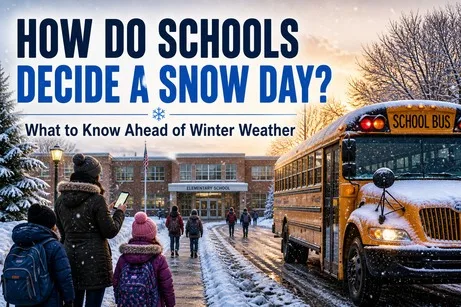
It’s Not Just About Snow
A common assumption is that more snow automatically means school is canceled. That is not true.
Schools do not follow a fixed rule like “five inches equals a snow day.” In many cases, a smaller storm can be more dangerous than a larger one. Ice, wind, and timing often matter more than snowfall totals.
What school leaders are really asking is simple:
Can students and staff get to and from school safely?
If the answer is uncertain, delays or closures become much more likely.
How Schools Actually Decide a Snow Day
The decision starts earlier than most people think, often before sunrise.
School districts usually begin monitoring weather conditions the day before a storm arrives. They consult forecasts, track temperature changes, and prepare for different scenarios. By early morning, the process becomes more hands-on.
Around 4:30 to 5:30 a.m., key decision-makers are already at work. This often includes superintendents, transportation teams, and facilities staff. They review updated forecasts, check road conditions, and communicate with local authorities.
In some districts, staff members physically drive routes to see how safe the roads are. Others rely on reports from transportation departments and emergency services.
By the time families wake up, a decision has usually been made and communicated.
This is also where tools like a snow day calculator come into play for the public. While schools use professional data and direct observations, these calculators give students and parents a simplified way to estimate the likelihood of a closure based on weather conditions.
The Key Factors That Matter Most
Several factors come together in every snow day decision. No single one determines the outcome on its own.
Weather conditions are the starting point. Snow, ice, freezing rain, and strong winds all affect safety in different ways. Ice is often more dangerous than snow because it creates invisible hazards on roads.
Road conditions are one of the most important considerations. Even if main roads are clear, side streets and rural routes may still be unsafe for buses and student drivers.
Transportation plays a major role as well. School buses must be able to operate safely, and drivers need clear, manageable routes. If buses cannot run reliably, schools are less likely to open.
Temperature and wind chill are also critical. Extremely cold conditions can put students at risk while waiting for buses. Frostbite and hypothermia become real concerns in severe weather.
School buildings and facilities must be ready too. Parking lots and sidewalks need to be cleared, heating systems must function properly, and there must be no safety hazards on campus.
All of these factors are weighed together, not separately.
Why There’s No Exact Snow Amount Rule
You might wonder why schools cannot just set a clear snow limit and stick to it.
The reason is that every storm behaves differently, and every region responds differently to winter weather.
In areas that experience heavy snowfall regularly, a few inches of snow may not disrupt daily operations at all. Roads are treated quickly, and communities are prepared.
In places where snow is rare, even a small amount can cause major disruptions. Equipment, road treatment, and driver experience all vary by location.
Timing also plays a big role. Snow that falls overnight and stops early may allow enough time for roads to be cleared. The same snowfall during the morning commute can lead to a closure.
This is why schools rely on judgment rather than a fixed number.
Can You Predict a Snow Day?
While there is no guaranteed way to predict a snow day, there are clear signs you can watch for.
Pay attention to forecasts that mention ice, rapid temperature drops, or early morning snowfall. These conditions often create the most risk.
If weather reports highlight hazardous travel during school commute hours, the chances of a delay or closure increase.
Wind chill is another strong indicator. Extremely low temperatures can lead to delays even without heavy snowfall.
This is where a snow day calculator becomes useful. It takes factors like temperature, snowfall, and timing into account to estimate the probability of a closure. It is not perfect, but it helps translate complex weather data into something easier to understand.
Why Decisions Sometimes Change
Even with careful planning, snow day decisions are not always final.
Weather forecasts can shift quickly. A storm that was expected to be mild can intensify, or conditions can worsen faster than expected.
In some cases, schools may start with a delay and later decide to close. Early dismissals can also happen if conditions deteriorate during the day.
These changes are not mistakes. They reflect how unpredictable winter weather can be.
Snow Days, Delays, and Early Dismissals
A full snow day is only one option schools consider.
A delay allows extra time for roads to be cleared and conditions to improve. This is often used when the weather is expected to get better shortly after the usual start time.
An early dismissal happens when conditions worsen during the school day, making it safer to send students home sooner.
Each option is chosen based on what creates the safest situation at that moment.
What Happens If Snow Days Run Out?
Most school calendars include a few built-in snow days, but severe winters can use them up quickly.
When that happens, schools may adjust schedules by adding extra days at the end of the year or extending school hours slightly.
In some cases, virtual learning is used as an alternative. This allows instruction to continue without requiring travel, although it depends on the district’s policies and preparedness.
The Bottom Line
Snow day decisions are not based on a single number or a simple rule. They are the result of careful judgment, real-time information, and a strong focus on safety.
From weather forecasts and road conditions to transportation and infrastructure, every detail is considered before a final call is made.
For students, it might feel like a surprise announcement. Behind the scenes, it is a structured and thoughtful process designed to keep everyone safe while balancing the needs of families and schools.