
How AI Animated Storytelling Is Transforming Creative Production in 2026
The landscape of visual storytelling has shifted dramatically, and at the heart of that shift sits AI animated storytelling, a discipline that, in 2026, has moved well beyond novelty to become a genuine engine of creative production. Studios that once required hundreds of skilled hands and multimillion-dollar budgets to produce a feature-quality animated series are now deploying leaner teams empowered by intelligent automation. Independent creators who had been locked out of professional-grade production entirely are building rich narrative worlds from their laptops. The transformation is not incremental; it is foundational.
The Weight of Traditional Animation Production
To appreciate how profound this shift is, it helps to understand exactly how demanding conventional animation has always been. A single minute of broadcast-quality 2D animation historically required anywhere from 60 to 90 person-hours of labor, covering concept art, character design, storyboarding, layout, keyframe animation, in-betweening, clean-up, background painting, compositing, and final color grading. For 3D animation, the pipeline stretched even further; rigging, skinning, texture mapping, lighting, rendering, and simulation all added weeks or months to production timelines.
These constraints meant animation was, for most of its history, the preserve of well-resourced studios. Cost efficiency was a luxury; a modest studio project could take 18 to 24 months from greenlight to final delivery. Revisions were expensive, iteration was slow, and accessibility for independent digital creators was effectively nonexistent. The barrier to entry was not just financial; it was infrastructural.
How AI Accelerates the Creative Workflow
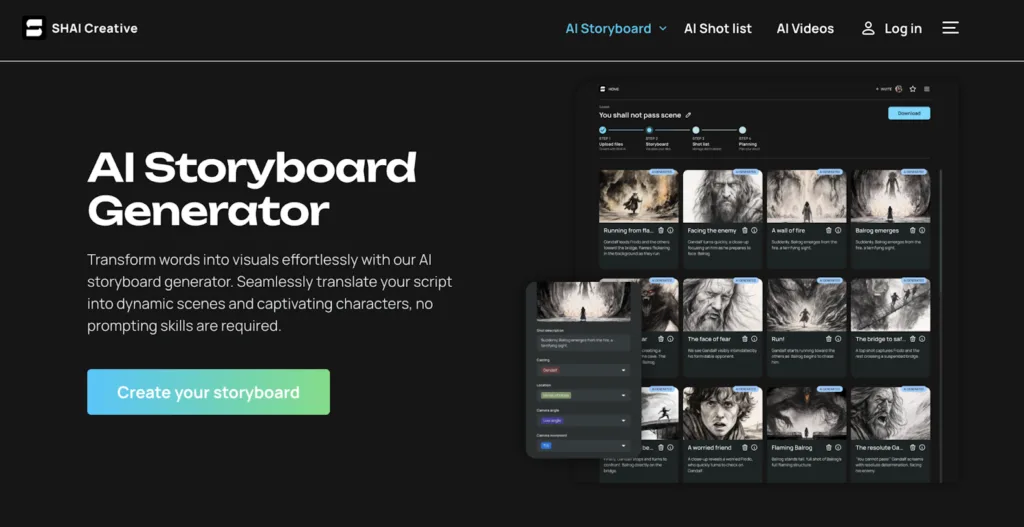
What AI tools have introduced into this equation is not a replacement for creativity; it is a dramatic compression of the mechanical labor that surrounds it. Workflow optimization through machine learning now handles tasks that previously consumed enormous portions of a production schedule. Automated storyboard generation can take a written script and produce a fully annotated visual sequence in minutes. Character consistency engines maintain design integrity across thousands of frames without a human artist manually checking every pose. Background synthesis tools generate richly detailed environments from simple style prompts, removing the need for entire background departments on smaller productions.
The result is that creative decision-making, the part that actually requires human imagination, now occupies a far greater proportion of a production team’s time. Directors and writers spend more hours refining stories, adjusting tone, and shaping character arcs, and fewer hours chasing production bottlenecks. For independent creators and small studios, this rebalancing is transformative. It means that a team of three people can produce work that, a decade ago, would have required thirty.
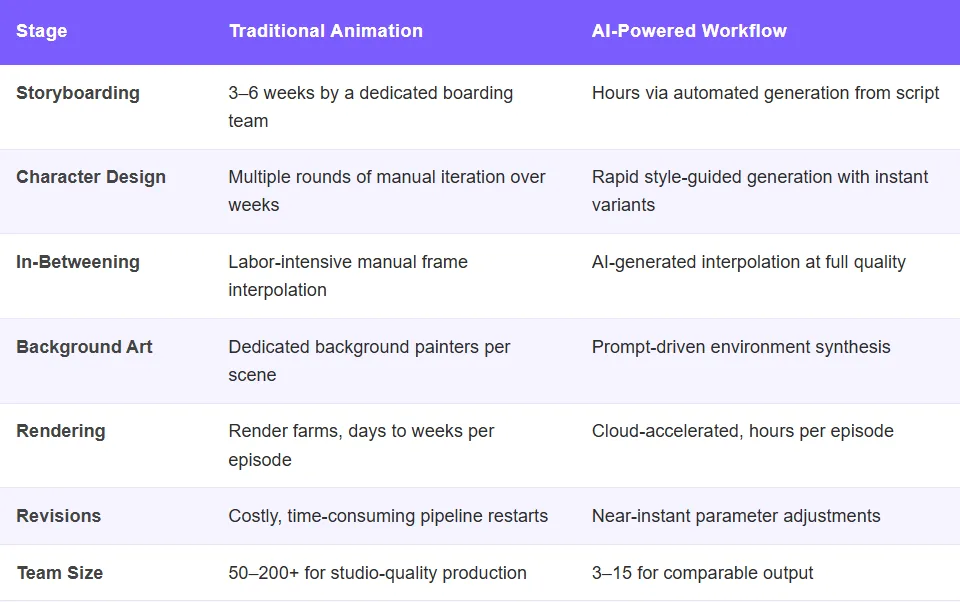
Traditional vs. AI-Powered Workflow: A Direct Comparison
The differences between conventional production pipelines and AI-assisted workflows are most visible when placed side by side:
The Role of Automation Tools Like AnimateAI. Pro
Platforms built specifically for AI animated storytelling have become central to how digital creators structure their production. AnimateAI. Pro represents a category of tools that integrate storyboard generation, character consistency management, scene composition, and video creation into a single unified platform. Rather than stitching together a patchwork of standalone AI utilities, creators can move from written concept to rendered video within a single environment.
This integration matters enormously for workflow optimization. Every handoff between tools in a traditional pipeline, from storyboard software to animation software to compositing software, introduces friction, file format issues, and potential for data loss. Unified platforms eliminate most of that friction. A creator can adjust a character’s visual style at the concept stage and have that change propagate consistently through every downstream element of the production. The feedback loop between creative vision and visual output becomes nearly immediate.
What once required a studio is now achievable in a spare bedroom. AI is not diminishing animation; it is democratizing it.
Cost Reduction and the Accessibility Revolution
The economics of animation have been fundamentally rearranged. Production costs for studio-quality animated content have dropped by a significant margin for teams using AI-powered pipelines. Budget that would previously have been consumed by labor-intensive in-betweening or background painting can now be redirected toward higher-quality voice acting, original music, or more sophisticated story development. For smaller creators, the savings are even more consequential, the difference between a project being financially viable or not.
Accessibility has improved across multiple dimensions simultaneously. Geographic barriers have softened: a creator based in Nairobi, Jakarta, or Bogotá now has access to the same production tools as one based in Los Angeles or Tokyo, with cloud-based platforms eliminating the need for expensive local hardware. Language barriers have also eased, with AI tools increasingly capable of working with scripts and style references across dozens of languages. The global population of digital creators who can realistically produce professional animated content has grown enormously.
This democratization is also reshaping the stories being told. When expensive production pipelines dictated that only commercially safe, broadly appealing content could justify the investment, diverse and culturally specific stories were systematically underproduced. Lower production costs mean that niche audiences can now be served economically, and voices that were previously priced out of the medium are finding their way in.
Future Outlook for Creators and Studios
The trajectory of AI animated storytelling in the years ahead points toward even deeper integration between creative intent and automated execution. Real-time rendering capabilities are advancing rapidly, meaning that the gap between a director calling for a scene change and seeing that change reflected in rendered output will continue to compress. Character animation driven by natural language direction, making her look uncertain, then resolving into confidence over three seconds, is already functional in early-access tools and will be standard within the next production cycle.
For established studios, the competitive advantage will increasingly rest not on raw production capacity but on creative differentiation. The studios that thrive will be those that use AI tools to amplify the distinctiveness of their storytelling voice rather than simply to reduce headcount. For independent creators, the horizon looks genuinely open in a way it has never been before. The tools available through platforms designed for cost efficiency and workflow optimization mean that the next landmark animated series might just as easily come from a small team of passionate storytellers as from a major production house.
The broader creative ecosystem is evolving in parallel. As part of this shift, producers and creators are increasingly engaging with emerging digital publishing technologies that reshape how animated content is distributed, monetized, and consumed across global audiences. The production revolution and the distribution revolution are happening simultaneously, and the creators positioned to benefit most are those building fluency in both.

AI-animated storytelling in 2026 is not a promise on the horizon; it is the present reality of creative production. The tools exist, the workflows have been validated at scale, and the results speak for themselves in the quality and volume of animated content now being produced by teams of every size. The question for creators and studios alike is no longer whether to engage with this transformation but how quickly and thoughtfully they can build it into the foundation of how they work.