
Google Allows Nickname Reviews on Maps, Forcing Businesses to Rethink Trust Signals
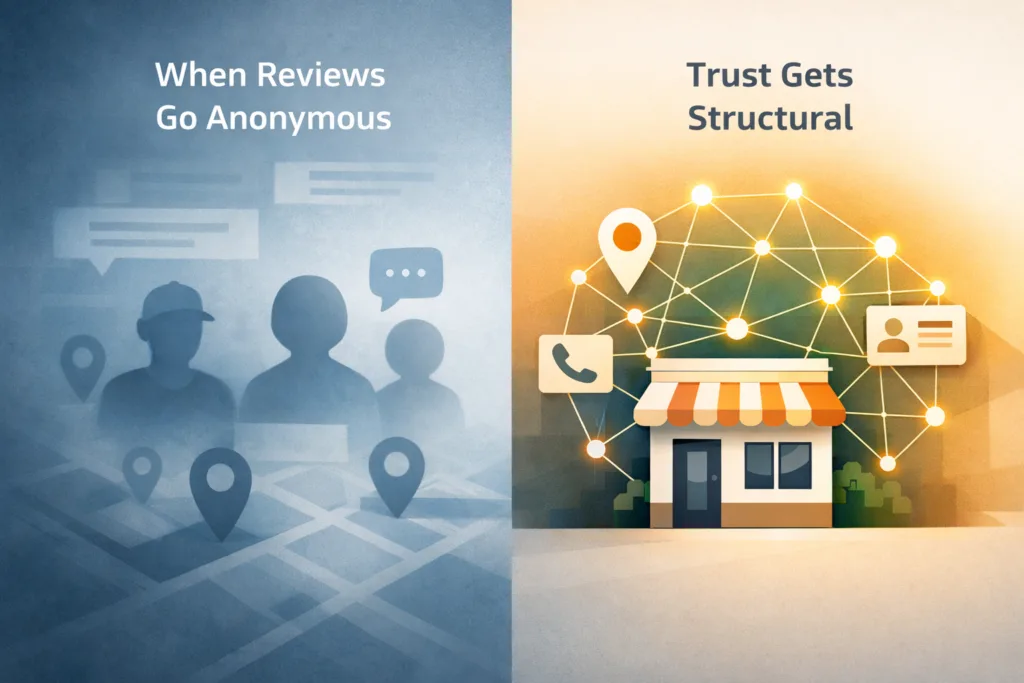
KeywordProbe founder says verified citation networks become primary defense as reviewer identity disappears.
As Google rolls out anonymous review capabilities across Maps, local SEO experts are warning businesses that verified citation networks have become the primary defense against credibility erosion in an era of pseudonymous feedback.
Google’s mid-November 2025 announcement allowing users to post reviews under custom nicknames rather than real names has fundamentally altered the trust dynamics of local search. The feature, rolling out globally through January 2026, promises privacy for reviewers but has sparked concern among small business owners already battling sophisticated manipulation of fake reviews.
“When customers can no longer evaluate reviewers by their real names, businesses must establish trust through other signals,” said Fahad Raza, founder of KeywordProbe and 18-year SEO veteran who previously led IKEA’s global SEO strategy. “Consistent business information across Google, Yelp, Bing, Apple Maps, and industry directories creates a verification web that algorithms and consumers can trust—especially now that reviewer identity has become unreliable.”
The change comes as Google removed over 240 million policy-violating reviews in 2024, a 40% increase from the previous year. While Google maintains its AI fraud detection systems remain effective regardless of display names, business owners worry that removing social accountability will embolden bad actors.
Restaurant owners fear unverifiable complaints about service quality. Contractors worry competitors will post anonymous negative reviews claiming shoddy work. Retailers anticipate false claims because they cannot cross-reference reviewers against customer records.
“The psychological restraint that comes from public identity disappears when reviews become pseudonymous,” Raza explained. “Businesses can no longer research a reviewer’s profile to understand context or verify they’re actually a customer.”
The New Trust Infrastructure
With reviewer credibility harder to assess, KeywordProbe advises businesses to strengthen alternative trust signals through systematic local citation services and verified information management.
KeywordProbe recommends businesses immediately:
- Audit citation consistency across 50+ directories – Identify discrepancies in business name, address, phone number, hours, and service descriptions across all platforms where the business appears
- Establish verified NAP (Name, Address, Phone) data – Ensure accurate, consistent information across Google Business Profile, Yelp, Bing Places, Apple Maps, Facebook, industry-specific directories, and data aggregators.
- Build cross-platform verification networks – Create a web of mutual verification where business information matches precisely across dozens of authoritative sources, signaling legitimacy to both algorithms and consumers.
- Focus on review volume and detail over individual reviewer credibility – Generate authentic reviews from verified customers through post-purchase campaigns, emphasizing detailed feedback with photos that demonstrate genuine experience.
- Strengthen Google Business Profile completeness – With AI systems increasingly answering customer questions, ensure profiles contain detailed service descriptions, current hours, accurate categories, and high-quality photos.
“We’re already seeing multi-location businesses realize they can’t rely on Google Business Profile alone anymore,” Raza added. “The businesses adapting fastest are those treating their entire online presence as an interconnected trust system rather than isolated platforms.”
The Citation Consistency Advantage
According to KeywordProbe’s analysis, businesses with consistent citations across major directories and data aggregators demonstrate measurably higher resilience against review-based attacks and algorithmic penalties.
When a business’s information matches precisely across Google, Yelp, Bing, Apple Maps, industry directories, and major data aggregators like Neustar Localeze, Factual, and Foursquare, it creates multiple verification points. Google’s algorithms cross-reference these sources when evaluating business legitimacy—particularly valuable when assessing individual review credibility becomes harder.
“Think of citations as your business’s digital infrastructure,” Raza said. “Just as you wouldn’t build a physical location without a proper foundation, you can’t compete in local search without verified information architecture spanning the entire web.”
The verification network also protects against other emerging local search vulnerabilities, including map pin hijacking, where competitors use Google’s “suggest an edit” feature to relocate business locations, and the recent discontinuation of the Q&A API, which eliminated programmatic customer communication management.
Looking Forward
KeywordProbe predicts the anonymous review rollout will accelerate the shift toward AI-mediated local search experiences, where Google’s algorithms synthesize information from multiple sources rather than displaying direct business-to-customer communication.
“Google is moving away from static information displays toward conversational AI experiences,” Raza noted. “The businesses that win in this environment will be those that ensure all their digital infrastructure—website content, business profiles, directory listings, review content—works together to feed accurate information to AI systems.” The company advises businesses to treat the nickname feature not as a temporary policy change but as a permanent shift in local search dynamics requiring fundamental strategic adaptation.