
Flow Over Flash: How China’s Cars Reveal a Different Kind of Innovation
From factory throughput to better batteries and alternative fuel sources, a systemic focus on energy returns and circulation is reshaping industrial possibility.
By Warwick Powell, Adjunct professor at Queensland University of Technology
China’s New Energy Vehicles (NEV) cars are more than impressive machines rolling off highly automated assembly lines. A recent documentary, made by CGTN as part of a series on Unyielding Growth, provides an in-depth look into China’s auto industry, showing how the sector and what it is designing and building serve as a revealing window into a broader pattern of innovation with Chinese characteristics. This pattern quietly prioritizes the smooth flow of energy, materials, information, and capital across the entire economy. This approach yields higher energy returns at every stage, from factory floor to daily use, without relying on a single grand invention or Silicon Valley-style disruption narrative.
In thermoeconomics, analysts examine not just raw energy but how societies convert it into useful work while minimizing waste. Two key measures help clarify this. First, EROEIp (Energy Return on Energy Invested in Production) measures the net energy gained from making something after subtracting all the energy used in factories, machines, mining, refining, and logistics. A higher EROEIp means the production process itself creates more surplus energy and value with less waste. The second, EROEIu (Energy Return on Energy Invested in Use) focuses on the product’s lifetime performance: how much useful service — like kilometres driven — it delivers compared to the total energy invested in its creation, operation, maintenance, and eventual recycling. Improvements that raise either number reduce friction and generate greater overall surpluses for society.
The story of China’s NEVs — battery electric, plug-in hybrids and alternative fuels such as methanol-powered cars — illustrates how these gains emerge systemically. Chinese NEV vehicles are now domestic leaders in terms of market share of new sales, and continue expanding globally as well through exports and global investment.
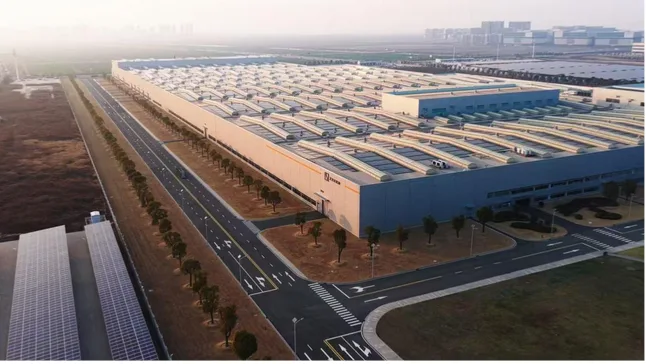
Removing Blockages on the Factory Floor
Traditional car manufacturing struggles with high fixed costs, long downtime during model changes, and complex supply chains that tie up capital and energy. Chinese NEV producers have attacked these frictions directly.
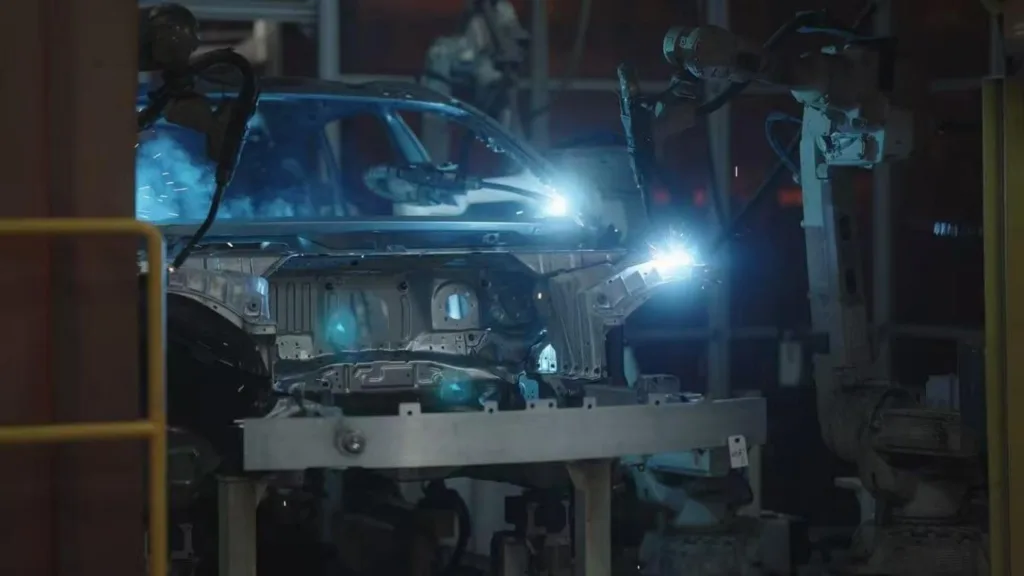
Factories emphasize flow. Xiaomi’s Beijing “Hyperfactory” uses over 700 robots and achieves 91% automation in key areas, producing a vehicle roughly every 76 seconds in optimized lines. Techniques like gigacasting — pouring massive single-piece aluminum components for chassis and body — dramatically cut part counts, simplify assembly, and reduce weight and energy use. Battery integration methods further slash the number of components while improving structural efficiency and production speed. “Dark factories” with heavy automation and AI-driven predictive maintenance keep lines running with minimal idle time or human error.
Vertical integration plays a central role too. This shortens supply chains, lowers transport energy losses, and collapses extra costs and delays between dozens of suppliers. Modular platforms allow faster model refreshes — 18 months for Geely — while flexible tooling minimizes downtime during changeovers. Production frequently aligns with actual orders or pre-sales, keeping unsold inventory low and capital circulating quickly rather than sitting idle in dealer lots. Popular models often have waiting lists.
These changes directly boost EROEIp. Less energy and capital are wasted per vehicle produced. The result is a production system that generates more net output from given inputs, turning potential blockages into smoother circulation of resources.
Gains on the Road: Raising EROEIu
The payoff extends to daily use. A car’s lifetime value depends on how efficiently it converts stored energy into mobility, how long its components last, and how little energy is lost to charging inefficiencies or degradation.
LFP batteries have scaled rapidly, providing good range and charging performance at lower cost and with reduced reliance on scarce metals like cobalt or nickel. Ongoing work targets thermal management, faster charging architectures, and vehicle software that squeezes more distance from every kilowatt-hour. Dense public charging networks cut “downtime” losses, and we now have developments in even more efficient battery technologies.
But it’s not just about batteries and electric charging systems. We also have diversification by way of initiatives such as Geely’s developments in the use of methanol as an alternative fuel source. Diversification is a critical ingredient of system-wide innovation, creating options to suit different market needs and conditions. Add to this the push to achieving higher performance and safety standards, particularly in the cutting edge area of self-driving cars, and we can see the ongoing pursuit of performance efficiencies and excellence.
Collectively, these raise EROEIu: society gets more kilometres of practical transportation per unit of total energy invested from mine to road to end-of-life.
A Wider Pattern: Horizontal Spread Across the Economy
The automotive sector is not an isolated success. It functions as a window into a systemic innovation ethos where improvements in one area diffuse horizontally to many others. Battery chemistry advances feed into energy storage for grids, consumer electronics, and industrial applications. New fuel types open competition and create application options. Gigacasting and advanced automation techniques transfer to other manufacturing sectors. Enhanced microprocessors, sensors, and AI vision systems developed or refined for vehicles improve robotics, drones, and smart infrastructure. Materials science gains in lightweight alloys or efficient conductors spread from cars to aerospace, construction, or renewable energy equipment.
This diffusion happens because China’s industrial base features dense, interconnected supply clusters. Know-how accumulated through massive investment in education, vocational training, and university-industry pipelines circulates efficiently. Engineers and technicians trained in one domain apply insights in adjacent ones. Fierce competition drives rapid iteration and cost reduction. Market signals — actual sales and consumer preferences — provide clear validation.
Policy cues add directional alignment without requiring perfect top-down control. Initiatives under the umbrella of “new quality productive forces” are complemented by the dynamism of bottom-up experimentation: local governments supporting clusters, firms competing aggressively on price and features, and successful practices spreading quickly through imitation and supplier networks.
Diffusion however isn’t confined to China’s domestic economy. As Li Shifu, Chairman of Geely Holding Group explained, China’s innovative auto sector is now required to perform a new, global role. In doing so, auto companies will need to “localise and operate in full compliance with local laws with fairness and transparency.” Geely’s partnership with Malaysia’s Proton is a case in point. By combining Geely’s technical expertise and Proton’s regional footprint, the company was able to recover local market share and, in 2019, achieve profitability for the first time in nine years.
Flow as the Ultimate Beneficiary
At a deeper level, this model benefits flow or systemic circulation itself. Energy, materials, capital, and practical know-how move with less friction across the political economy and society at large. Faster production turnover recirculates capital for further investment. Better products generate sales validation that funds R&D. Horizontal spillovers multiply gains: a cheaper, safer battery developed for cars can stabilize renewable grids or power affordable consumer devices; and alternative fuels enhance system-wide resilience, raising overall EROEI.
China now accounts for the majority of global NEV and battery production and deployment. Its firms lead in scaling hardware-intensive technologies that demand mastery of interdependent processes — supply chains, process engineering, materials refinement, and demand alignment.
This differs markedly from narratives centered on individual genius, software platforms, or venture-funded disruption. Here, in China, innovation appears embedded and ecosystemic: patient accumulation of capabilities, relentless removal of frictions, and compounding small gains across interconnected nodes. It is scale-dependent and often incremental in appearance, yet systemic in impact.
In an age of energetic and ecological constraints, paying close attention to flows matters. When production circuits turn over faster, when use-phase returns improve steadily, and when blockages dissolve across layers — from chemical R&D to factory layout to market validation — societies can deliver more useful work with less waste.
Higher EROEIp and EROEIu across multiple sectors create headroom for further renewal. In the end, physics rewards systems that flow well — and the evidence from China’s automotive ascent, and its ripple effects outward, suggests a distinctive capacity to align institutions, infrastructure, and incentives toward that goal.