
Detroit Designer Creates Mixed Reality Game to Preserve the City’s Iconic Techno Music Heritage
A new Mixed Reality experience brings Detroit’s techno music culture to life — and challenges how we think about representing a city’s identity through design.
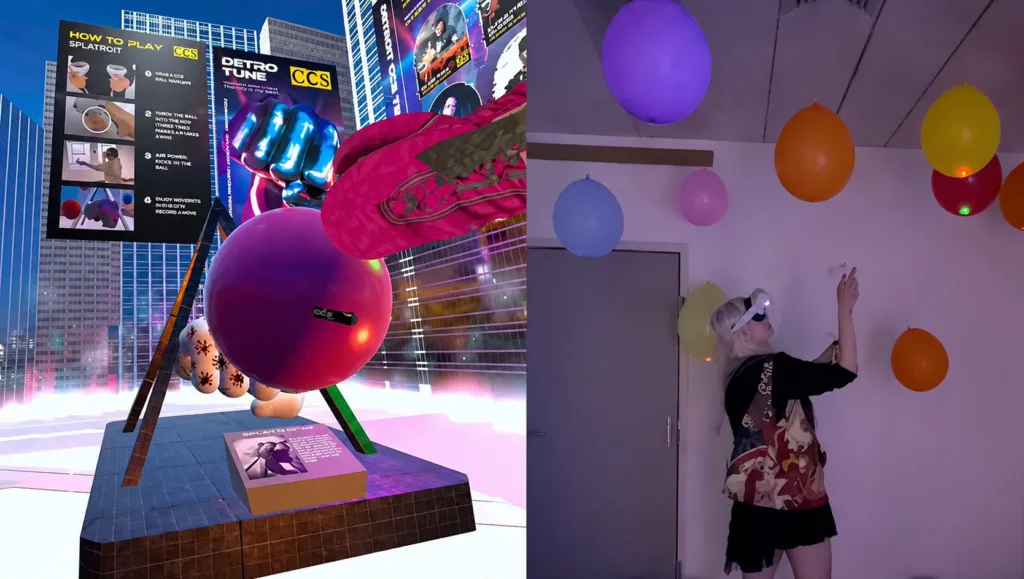
Detroit is widely recognized as the birthplace of techno music — a genre that emerged from the city’s industrial landscape in the 1980s and went on to shape electronic music worldwide. Yet despite this cultural legacy, Detroit’s global image has long been defined by narratives of economic decline rather than its rich creative heritage.
Splatroit, a Mixed Reality game developed by a team of MFA UX Design students at the College for Creative Studies in Detroit, aims to change that. The project places players inside an immersive visual world built from Detroit’s cityscape, where they hit colorful balls that appear in rhythm with the city’s iconic techno music. What makes the experience truly visceral is the physical dimension: real balls and balloons are installed in the actual space, so players hit both the virtual and physical objects simultaneously — making the experience feel alive in a way that purely digital environments cannot.
The experience was exhibited at the 2023 Ars Electronica — one of the world’s most prestigious festivals for art, technology, and society, held annually in Linz, Austria — as well as the 2023 Detroit Month of Design, an annual celebration of Detroit’s creative community. The project drew enthusiastic responses from participants at both events, with many noting the unique sensation of the virtual and physical worlds merging in real time.
“When players hit a virtual ball alongside a real one in the room, something shifts,” said Juyoung Lee, who led the overall direction and development of the project. “For a moment, the boundary between the game world and the real world disappears. Detroit’s music isn’t something you’re watching anymore — it’s something you’re inside.”
Designing a cultural identity in Mixed Reality
At the heart of splatroit is a design challenge that goes beyond gameplay: how do you translate the visual and cultural identity of a city into an interactive, spatial experience?
Juyoung Lee, who oversaw the project and led its development, drew directly from Detroit techno’s aesthetic history — the typography of underground flyers from the late 1980s, the industrial texture of warehouse venues, the contrast between darkness and light that defines the music’s visual culture.
“Techno music has a look, not just a sound,” Lee explains. “It comes from a specific place and a specific moment in Detroit’s history. The design had to honor that.”
Mixed Reality introduced unique visual design constraints. Unlike screen-based design, where the designer controls the entire visual field, Mixed Reality requires designing a virtual layer that coexists with an unpredictable physical environment. Every color, texture, and spatial composition decision had to work across varying real-world settings — from the festival floors of Ars Electronica to local Detroit venues.
Addressing a representational gap
Splatroit was conceived in response to a gap that its creators saw in how Detroit is represented globally. Despite being the birthplace of Motown, techno, and the American automotive industry, the city’s international image has often been shaped by imagery of industrial decline.
“There’s a visual vocabulary that gets attached to Detroit, and it crowds out everything else,” Lee notes. “The goal was to create an experience of Detroit’s culture that was vivid enough to stay with people — something that felt real, not just informational.”
The project’s selection for the 2023 Ars Electronica — a festival that has showcased pioneering work at the intersection of art, technology, and society for over four decades — reflects growing international interest in how immersive design can engage with questions of cultural identity and place.
Recognition and impact
Since its exhibition at the 2023 Ars Electronica and the 2023 Detroit Month of Design, Splatroit has been recognized as an example of how Mixed Reality can serve purposes beyond entertainment — as a tool for cultural preservation, community storytelling, and the reframing of place-based narratives.
Juyoung Lee continues to work at the intersection of UX design, visual design, and emerging technology. His thesis project Calmdrive — a road rage prevention system that uses physiological sensors and loved ones’ voice messages to calm drivers — has received Silver awards at both the NY Product Design Awards and the Muse Creative Awards, and was nominated for the UX Design Awards.
About Juyoung Lee: Juyoung Lee is a UX and visual designer and MFA graduate from the College for Creative Studies in Detroit. His work focuses on the intersection of human emotion, emerging technology, and social impact.