Scissor Lift Licence, Training & Certification: Everything You Need to Get Certified in Ontario
If you operate a scissor lift in Ontario, you need to be trained and certified before stepping onto that platform. It’s not optional it’s a legal requirement under the Occupational Health and Safety Act (OHSA) and CSA B354 standards. This guide breaks down what certification actually involves, who needs it, and how to get it done.
What Is a Scissor Lift?
A scissor lift is a Mobile Elevated Work Platform (MEWP) a platform mounted on folding supports that raise and lower workers to height. They come in various types with different height ranges and safety controls, and are widely used across construction, warehousing, maintenance, and manufacturing in Ontario.
What Is a Scissor Lift Licence?
Ontario doesn’t issue a government-stamped scissor lift licence the way it issues a driver’s licence. What’s required is certification from a recognized training provider confirming the operator has completed both theory and practical training in line with CSA B354 and Ministry of Labour (MOL) guidelines. That certification is what employers, site supervisors, and MOL inspectors will ask for and without it, both operators and employers are exposed.
Licence vs Certification: The terms get used interchangeably on job sites, but certification is the correct term in Ontario. It’s issued by an approved training provider after completing the required program and it’s what keeps you compliant.
Who Needs Scissor Lift Training in Ontario?
Anyone operating a scissor lift on an Ontario worksite needs certification, no exceptions. This includes:
- Construction workers: trades workers in framing, electrical, HVAC, drywall, and any role requiring work at height on a construction site fall under O. Reg. 213/91
- Warehouse and distribution employees: scissor lifts are standard equipment for picking, stock retrieval, and inventory work at height
- Maintenance personnel: routine tasks like lighting, HVAC servicing, and building inspections at height carry the same fall risks as any other elevated work
- Facility managers: anyone overseeing or directly operating elevated platforms shares legal responsibility for compliance under the OHSA
- Employers: if a worker is injured while operating uncertified, the employer faces stop-work orders, MOL fines, and serious liability
What Does Scissor Lift Training Include?
AI Forklift Training’s onsite scissor lift program covers everything required for CSA and MOL compliance. Here’s what’s included:
Theory Training
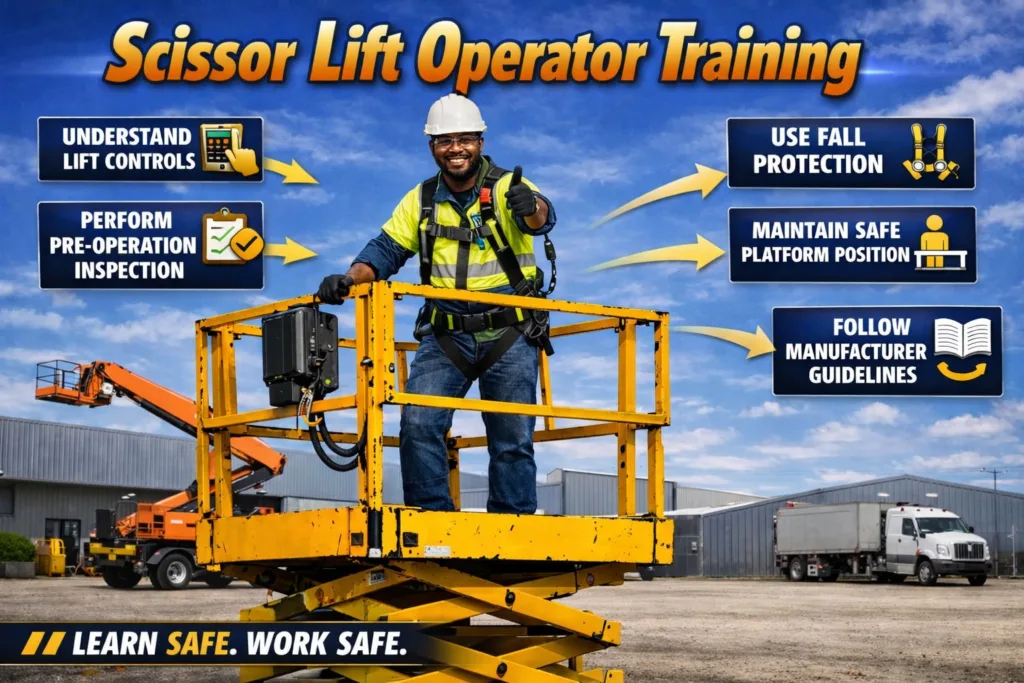
The classroom component covers the knowledge operators need before they touch the controls:
- Introduction to scissor lifts and MEWP classifications
- Power sources and how they affect operation
- Stability principles and load centre awareness
- Personal Protective Equipment (PPE) requirements
- Pre-operational inspection procedures
- Operational best practices and safe work procedures
Practical Hands-On Training
No classroom session replaces time on actual equipment. AI Forklift Training delivers onsite practical training using the specific machines your team operates daily. Operators practice equipment setup, safe manoeuvring, working at height, and emergency procedures in their real work environment not a generic facility.
This matter. Operating a scissor lift isn’t the same in a warehouse as it is on a construction site. Onsite training accounts for your actual floor conditions, overhead obstructions, traffic patterns, and equipment models.
Written Exam and Operator Evaluation
After theory and practical training, operators complete a written exam and a hands-on practical assessment. Both must be passed before certification is issued. This isn’t a formality it confirms the operator genuinely understands the equipment and can use it safely.
What You Receive Upon Completion
- Picture I.D. card
- Certificate of completion
- Employee record of training
- CSA-compliant scissor lift certification
How to Get Scissor Lift Certified in Ontario
Step 1 – Enroll: Contact AI Forklift Training and book your session. Individual and corporate group training are both available, with scheduling that works around your operations.
Step 2 – Complete Theory: Work through the classroom training covering regulations, equipment knowledge, hazard recognition, and inspection procedures.
Step 3 – Pass the Practical Evaluation: An experienced instructor conducts the hands-on assessment at your facility using your equipment.
Step 4 – Receive Certification: Pass both components and your CSA-compliant certification is issued the same day.
Online vs Onsite Training
AI Forklift Training offers online theory training for workers who need flexibility. The online course covers the full theory component CSA B354 requirements, equipment knowledge, hazard recognition, and inspection procedures and can be completed on any device at your own pace.
However, online training alone doesn’t complete your certification. A hands-on practical evaluation conducted onsite by a qualified evaluator is mandatory. No online module substitutes for that.
For most Ontario workers, the practical answer is both: complete theory online, then book the onsite practical. It keeps downtime minimal and gets your team certified efficiently.
How Long Does Certification Take?
The online theory course takes roughly 1 to 1.5 hours depending on pace and prior experience. The onsite practical evaluation is typically completed within a few hours. For most operators, the full certification process theory and practical is done in a single day.
How Long Is Scissor Lift Certification Valid?
Under CSA B354.2 standards, scissor lift operators must renew their certification every 3 years or sooner. Some employers and general contractors require more frequent renewal depending on the project risk level always confirm the specific requirements of your worksite.
Refresher training is also required when an operator hasn’t used the equipment for an extended period, switches to a different scissor lift model, or is involved in a workplace incident involving elevated work.
Common Mistakes New Operators Make
Skipping pre-use inspections: Equipment fails. A missed defect on the ground becomes a serious incident at height. Inspect every time, no exceptions.
Overloading the platform: Workers, tools, and materials add up quickly. Always calculate your combined load before elevating. Overloading is one of the leading causes of tip-overs.
Operating on uneven ground: Scissor lifts are built for level surfaces. Soft soil, slopes, or uneven flooring without proper assessment significantly increases instability risk.
Ignoring wind conditions: Outdoor operators must monitor wind speed. Most manufacturers specify maximum safe operating limits bring the platform down when conditions change.
Assuming guardrails are always enough: Depending on height and task, Ontario regulations may require a harness and anchor point in addition to guardrails. New operators often don’t know this until it’s too late.
Why Choose AI Forklift Training?
AI Forklift Training delivers CSA and MOL-compliant scissor lift training across Ontario onsite at your facility, on your schedule. Instructor Andy brings hands-on industry experience to every session, with training customized to your specific equipment and workplace environment rather than delivered from a generic script.
Corporate group training is available with discounted rates, and AI Forklift Training serves businesses across the GTA and beyond Toronto, Mississauga, Brampton, Scarborough, Markham, Vaughan, Oshawa, Whitby, Ajax, Pickering, North York, Richmond Hill, and more.
Every operator leaves with a picture I.D. card, certificate of completion, and a documented training record everything you need to stay compliant on any Ontario worksite.
Ready to Get Certified?
Call 289-923-2463 or visit aiforklifttraining.ca to book your scissor lift training. Individual and corporate group sessions available across Ontario.