
What to Expect from a Professional Search Engine Optimization Company
Let me share something most agencies won’t say upfront , at least not in a way that makes sense. Like, honestly, a lot of businesses that put money into SEO don’t really know what they’re paying for. Not because they’re clueless — more like nobody took the time to sit with them and explain it, clearly and step by step, kind of like a normal person would.
I’ve watched it play out again and again. A business owner signs the contract, sends the monthly retainer, gets that PDF report with all the graphs, and three months later they still can’t tell if anything is actually doing its job. And no, that isn’t exactly “SEO failing”. It’s usually a communication issue, and it often begins on day one, not the third month.
So before we even talk about what a solid search engine optimization company should deliver in practice, let’s lock in one point: you have every right to understand each part of this process. If an agency makes you feel dumb for asking questions, switch them out.
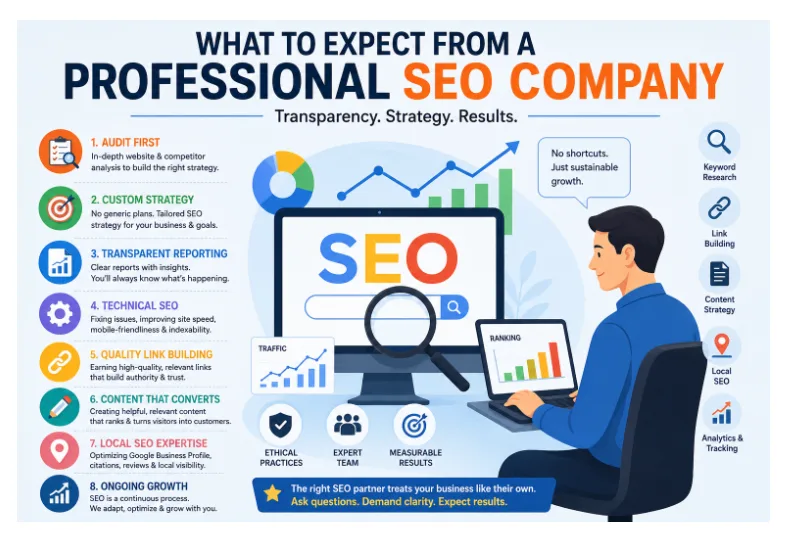
The Audit Comes First — Always
No doctor writes a prescription without running tests. Good SEO sort of works the same way, you know.
The first thing any serious SEO company does is look under the hood of your website. Not a quick glance—more like a real audit, structured and all, checking how your site is built, how fast it actually loads, whether search engines can crawl and index without hitting walls ,and if the content you already have is doing its job.
They’ll also check out your competitors. Who is outranking you exactly? Why are they there? What are they doing that you aren’t doing. This part, honestly, matters more than most people think, because SEO isnt only about polishing your own site— it’s about mapping the terrain you’re fighting in.
Without this step, everything that comes after is basically guessing. And guessing with someone elses budget, is not really a plan, not a real strategy.
Generic Plans Are a Red Flag
You can sorta tell what kind of SEO agency you’re dealing with by how fast they toss you a proposal.
If it lands within hours after your first call, and it’s already nicely formatted, with pricing tiers and a list of “deliverables” that could fit literally any business… close the tab. That isn’t a plan. It’s more like a menu, you know.
Real search engine optimization services are supposed to be built around your actual situation. A local bakery and a national software company both need SEO, sure, but their keyword focus, the way they should handle content, how they earn links, and even their timeline are totally different. A solid agency should take the time to understand your business first, before pitching ideas that feel generic.
So ask them something like: why this keyword and not that one? Why this style of content? What makes this schedule or approach make sense for my industry, in particular? If they can explain it clearly, without rambling or dodging, you’re probably in good hands. If they go vague, overly polished, or kinda defensive, then you just learned something useful.
Transparency Isn’t a Feature — It’s the Bare Minimum
I mean it should be pretty obvious but, apparently it isn’t: you should always know what’s going on with the money you’re spending, not just hope it’s doing something somewhere.
Good SEO work usually comes with regular reporting— not only figures, but the reasoning too. Did rankings shift? Tell me why. Did traffic dip , what happened? Is a new page actually doing well? Then help me understand what we did right, so we can basically repeat that same approach again, in a steadier way.
Also, you should have direct access to your own Google Analytics and Google Search Console. Not a bunch of screenshots. Not some login that quietly routes through their “special” portal. Your accounts, your numbers, your permissions, your access.
And one more thing, worth saying plainly, because it comes up constantly: no ethical agency will ever promise you a specific ranking spot. Google decides that, not them. Anyone who says otherwise is either muddled, or flat out dishonest, and neither one is a sign of good quality when someone is supposed to manage your online visibility.
Technical SEO: The Unglamorous Work That Actually Matters
Noone ever got all that excited about fixing a crawl error. Still, dealing with crawl errors is kinda the work that splits sites that rank from the ones that just… dont.
Technical SEO is everything under the surface — page speed, being mobile friendly, internal linking setup, duplicate content puzzles, schema markup, and making sure every page on your site is something search engines can actually discover, read, and parse. It’s not glamorous. It doesn’t really create a flashy, headline type of case study. But without it, even really strong content can end up underperforming.
Try this angle: you can write the best article in your niche, yet if your site drags along and takes 8 seconds to load, or your pages are not indexed the right way, nobody’s going to find it. So yeah, the technical base needs to be solid first, before anything else you do can really hold.
Link Building: Where Reputations Are Made and Destroyed
Ask ten SEO people about link building and you’ll hear ten slightly different answers, like everyone is sure they’re the one who has it right. But there’s kind of a clear consensus hiding in there: doing it badly is still worse than doing nothing at all.
A solid, qualified link building SEO company should be earning links — from places that matter, from sites your audience actually shows up on, and from content that really deserves a citation. Sure the tactics shift around, guest contributions here, digital PR there, outreach to websites that have broken links, or making those helpful industry resources that turn into natural references over time, not forced ones.
And what a reliable link building SEO company will never do is buy links in bulk from a random list, join private blog networks, or use some shortcut that’s meant to confuse the ranking system, instead of earning genuine authority. These strategies can show quick ranking movement which looks “nice” in a dashboard report. Then, not too long after, Google issues a manual penalty, and everything just falls apart.
So when you’re evaluating agencies, ask for proof. Request to see actual links they’ve built for clients, not a spreadsheet of domain authority numbers, not screenshots with vibes. Real URLs, with real sites. Check them yourself. Are they legit? Are they relevant? Would a real person ever bother clicking there and staying awhile? If the answer to even one is no, then well… you already have your answer.
Content That Actually Does Something
There’s this kind of content strategy that is kind of just, like, filling pages. You churn out enough blog posts with the right keywords and, eventually, something ranks. It’s a volume play mostly, and it ends up making mediocre content that sort of ranks for mediocre queries, and honestly it converts nobody
The better approach starts with a question though: what does a potential customer actually need to learn, and where are they, in their whole decision process when they type it into search
A serious SEO company thinks about it that way. They don’t just slap words on a page, they look at the wider context—like the early questions people ask when they’re still researching, the tradeoffs and comparisons they do when they’re near a decision ,and the exact pains they’re trying to fix. Then they put together content that shows up at the right moment and actually helps, not just “sounds relevant”
That’s what fuels rankings that last. And more importantly, it’s what turns search visitors into real customers
Local SEO Is Its Own Game
If your business serves a particular city or region, the rules sort of shift, a bit.
Local search has its own signals—your Google Business Profile, citations on different directories, the consistency of your business name, the address, and phone number across the web, plus the quantity and the quality of your reviews. These pieces decide whether you appear in the map results, and for a lot of local searches those listings get more clicks than basically anything else on the page.
A solid SEO partner who works with local businesses should have a straightforward plan for this portion. If they are only discussing organic rankings and completely ignoring local search, that’s a real gap, worth calling out.
Some Industries Require Specialized Knowledge
Not every business goes cleanly into a “standard” SEO playbook. Some industries have limits, like regulatory rules, platform based stuff, or quirks about the audience—so you really need know how to steer through it without guessing.
The adult entertainment sector is one clear example. An adult SEO agency works in a lane where mainstream advertising channels are pretty much not an option. Google Ads won’t approve certain campaigns. Meta will restrict whole categories. And for companies in this niche, organic search isn’t just another channel, it’s often the main one. So an experienced adult SEO company brings a different kind of value: they get the content boundaries, the compliance needs, how the audience actually behaves, and which platforms tend to perform in practice.
Same idea shows up in any niche with special constraints. Legal, medical, financial—each of those fields asks for specialists who know the actual terrain, not just “general SEO” as a concept.
SEO Doesn’t Have a Finish Line
This is the part most people don’t really absorb until they’ve been at it for a while, like long enough that it stops feeling theoretical. SEO is never really done, you know, it just keeps evolving.
Google updates its ranking systems hundreds of times every year. Some changes are small, some end up shaking entire industries overnight. Your competitors are running their own campaigns, building their own links, publishing their own content… and yeah the search landscape in your industry, twelve months from now will look different than today does.
A professional search engine optimization company treats this like a continual agreement , not something you can tag as a project with a delivery date. They keep an eye on your rankings, they watch competitors actions, they tweak things when a tactic stops doing its job, and they search for fresh angles and new opportunities as they start to appear.
The agencies that end up producing durable results are the ones that spend time thinking about what comes next, not only sending reports about what already happened.
Final Thought
Honestly, here is what you’re supposed to watch for, an agency that audits before they even plan, and then kinda explains their thinking in plain language. They also report results with context, like not just the wins but sometimes the not so great numbers too, because that’s real life. And when it comes to link building they move with patience, not with some sketchy shortcuts that “should work” in theory.
So, whether you need broad search engine optimization services, or more focused seo link building services, or maybe that niche expertise from an adult SEO company that actually understands that space, the right partner runs it in the same way. They treat your business like it matters, and honestly, to them it should.
The agencies worth hiring generally wont oversell, they won’t hide behind jargon, and they also won’t flinch when you ask difficult questions. Start right there.