
KLOW Peptide Before and After: Healing, Recovery & Skin Regeneration Timeline
Written by: Dr. Molly Reyna, PhD, Biochemistry researcher, 12+ years
Medically reviewed by: Dr. Elena Vasquez, MD
Cristina (@cristina.noh), a 56-year-old TikTok creator, documented her first 10-week KLOW peptide before-and-after results in December 2025. The post pulled 1,283 likes and 124 comments, with curious questions like: “Is the transformation real, or is it filters and good lighting?” We decided to find a real, scientifically grounded answer to that question. For users focused on consistency and outcome tracking, Koi Peptides offers batch-specific third-party COA validation along with identity confirmation for every production lot.
What Is the KLOW Peptide Blend?
KLOW is a community-coined name for a four-peptide research blend: GHK-Cu, BPC-157, TB-500, and KPV.
The Four Peptides Behind Every KLOW Before and After
A standard 80mg KLOW vial holds GHK-Cu (50mg), BPC-157 (10mg), TB-500 (10mg), and KPV (10mg). GHK-Cu is a copper-binding tripeptide first isolated from human plasma by Loren Pickart in 1973. BPC-157 is a pentadecapeptide from human gastric juice. TB-500 is a synthetic active fragment of Thymosin Beta-4. KPV is the C-terminal tripeptide of alpha-MSH.
Why a Blend Produces Layered Before and After Results
KLOW blend before-and-after reports often describe simultaneous, layered changes in skin recovery and inflammatory conditions. The reason? A collaborative work done by the 4 aforementioned peptides in the stack.
What KLOW Is Designed to Support
The four-peptide blend targets overlapping but distinct repair pathways.
- Tissue remodeling and wound repair: Pickart and Margolina document GHK-Cu’s role in fibroblast collagen synthesis, while the 2014 PMC review highlights its effects on the dermal extracellular matrix.
- Inflammation resolution: KPV has been studied for NF-κB-linked anti-inflammatory signaling in mucosal models.
- Soft-tissue and gut repair: BPC-157 has been studied for cytoprotective and angiogenic effects in animal models.
- Angiogenesis and cell migration: TB-500 (Thymosin Beta-4 fragment) has been studied for its effects on actin modulation and wound-healing dynamics.
Why KLOW Peptide Results Vary From Person to Person
KLOW results vary from person to person because each individual’s biological baseline and daily lifestyle habits are different. Above that, the purity of the vial they’re using may also be poles apart. Let’s look at the factors one by one.
How Your Baseline Affects Your Before and After
Research by Pickart and Margolina (2018) found that the body’s natural GHK-Cu levels drop by half between your 20s and your 60s, which means older users often have more room to improve. Staresinic et al. (2003) found that a fresh tendon injury responds faster than an old one. Bottom line? Where you start decides how dramatic the final change looks.
Lifestyle Factors That Shape Visible Results
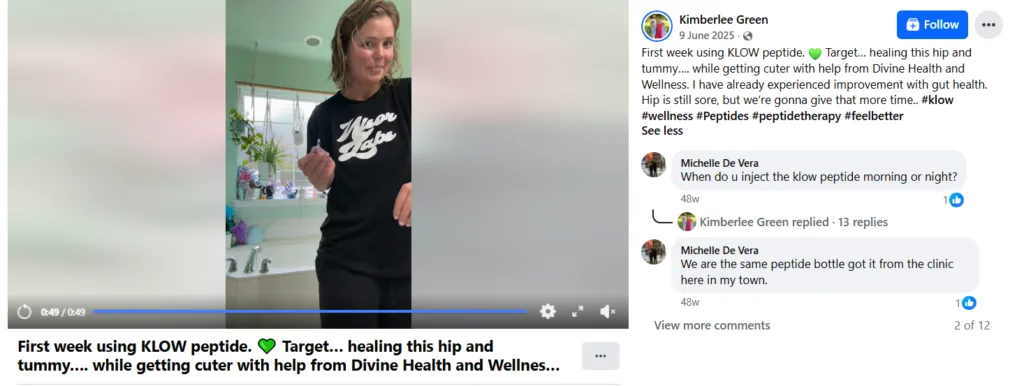
Sleep, nutrition, and stress management all shape visible results. A March 2025 Facebook post by @kimberleergreen documenting her first KLOW week noted she was running the protocol alongside hip-rehab exercises and dietary changes, and could not isolate which input drove which result.
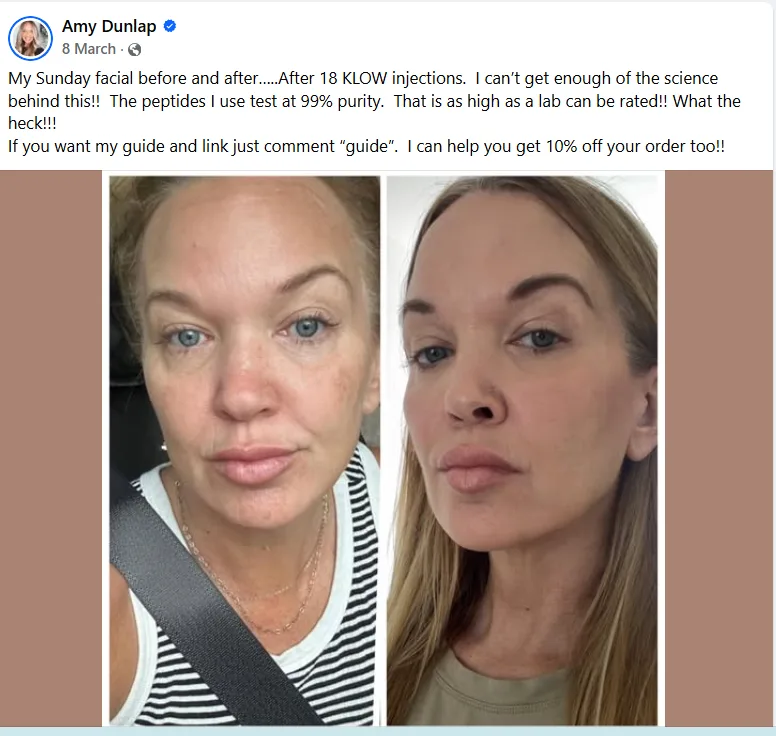
A November 2025 Facebook post from Amy (“after 18 KLOW injections, my Sunday facial looks like this”) similarly described results as part of a broader skincare routine.
Why Peptide Purity Changes the Before and After Outcome
The April 2026 Scientific American review flagged immune reactions to impurities as a safety concern with injectable GHK-Cu. Impurities also dilute the effect of the actual peptide in the vial.
The fix is simple: only use peptides that come with a signed Certificate of Analysis from an independent lab, showing what is actually in the vial and how pure it is.
Koi Peptides tests every batch at an independent third-party lab and confirms ≥99% purity on every vial through HPLC and LC-MS. Each batch ships with its own signed COA, and every lot is published in its public COA library before the order ships. Their products are sold strictly for research use only, not for human or animal consumption.
Expected Before-and-After Transformations
- Recovery (Injuries, Joint Pain, Tendons): Recovery users see results first. Joint pain eases, range of motion improves, and stubborn tendon issues that physical therapy alone couldn’t fix start getting better.
- Skin (Anti-Aging, Texture, Tone): Skin starts improving around week 3 to 4. Hydration comes back first, then texture, then firmness. The Abdulghani et al. (1999) human trial on GHK-Cu found 70% of users saw collagen increases that beat both retinoic acid and vitamin C.
- Post-Procedure (Surgery, Microneedling, Laser): Post-procedure users see less downtime, less redness, and faster healing. Frank Agullo, MD’s 2026 clinical guide suggests KLOW once daily for 4-6 weeks after BBL, body contouring, tummy tuck, and mommy makeover; 3-4 weeks after breast surgery. Microneedling and laser users may notice reduced redness within two to three weeks.
- Gut and Inflammation: Gut symptoms, reactive skin, and flare-ups calm down within the first one to two weeks for users with milder issues (takes longer for chronic ones).
- Hair (The Longest Timeline): Hair takes the longest to improve because follicle cycles are slow by nature. Most community accounts of the KLOW peptide before and after hair results report nothing visible for the first 8 weeks. Real change shows up at 12 to 16 weeks minimum.
Timeline to See Results
Community before-and-after accounts on TikTok, Instagram, and Facebook describe the timeline as follows: nothing in week 1, small shifts by weeks 2 to 3, visible skin changes by 3 to 4, compounding effects by 4 to 6, structural changes by 6 to 8, and the most dramatic KLOW stack before and after results between weeks 8 and 12.
- Week 1 — The Quiet Phase: Week one is quiet, and that’s normal. The peptides start working on cells right away, but nothing visible happens yet. Community posts from this window usually mention a little flushing at the injection site and not much else.
- Weeks 2 to 3 — Inflammation Starts to Shift: Inflammation calms down. Redness, puffiness, joint stiffness, and gut symptoms tend to ease before any cosmetic change shows up. Injured users often notice a better range of motion and less nagging pain by the end of week three, even though the skin still looks the same.
- Weeks 3 to 4 — First Visible Skin Changes: At this stage, most users start to see visible changes in their KLOW peptide before-and-after pictures. Skin looks more hydrated, pores look a little smaller, and texture feels softer to the touch.
- Weeks 4 to 6 — Compounding Results Stage: Between weeks 4 and 6, all four peptides start working together. Skin tone evens out, fine lines look softer, and recovery starts feeling faster than usual. Community KLOW peptide review before and after posts from this window often mention friends noticing improvement without being told. The TikTok @cristina.noh’s 10-week cycle showed a visible change in this period.
- Weeks 6 to 8 — Structural Changes Set In: Surface changes turn into deeper ones. Skin starts to feel firmer rather than just smoother, and elasticity returns. For injury users, joints and tendons feel genuinely repaired, not just less painful.
- Weeks 8 to 12 — Long-Term Transformation Window: This is where the most dramatic KLOW results before and after show up. Skin keeps getting firmer, older scars start softening, and recovery gains feel locked in. Long cycles like the 18-injection Facebook post by Amy Dunlap land in this window.
Safety and Sourcing
Two peptides that look identical on a label can have radically different identities and purity profiles. Vendors using ISO/IEC 17025 accredited labs publish Certificates of Analysis showing identity, purity percentage, and batch traceability. Without that document, researchers cannot confirm what is actually in the vial. To achieve safe, consistent, and reliable before-and-after results, you should source from vendors that provide per-batch COAs, HPLC purity confirmation at 99% or higher, LC-MS/MS identity verification, documented cold-chain shipping, and clear “research use only, not for human consumption” labeling. Koi Peptides publishes per-batch third-party COAs and clearly designates all products as research use only, not intended for human or animal use. Their KLOW listing follows the 50/10/10/10 mass ratio referenced across the peer-reviewed literature on the component peptides.
KLOW Peptide Before and After Expectations vs Reality
What KLOW Can Realistically Deliver
- Visible skin texture and tone changes over 8 to 12 weeks
- Faster recovery from soft-tissue injuries within 2 to 6 weeks
- Less downtime after procedures
- Calmer reactive skin and gut symptoms within the first few weeks.
What KLOW Won’t Do (Honest Limits)
KLOW will not replace surgery for severe scarring or deep wrinkles. It will not regrow hair where the follicles are gone. It will not work overnight.
Why Some Users See a Smaller Before and After
These factors may diminish the final before and after response:
- Older age
- Skipping doses or staying inconsistent.
- Buying from low-quality sources
- Suffering from chronic underlying inflammation
- Poor sleep
KLOW Before and After Compared to Other Peptide Stacks
KLOW vs GLOW Before and After (KPV Difference Explained)
In KLOW vs GLOW, the three shared peptides (GHK-Cu, BPC-157, TB-500) have identical masses, so collagen and tissue-repair outcomes are essentially the same. The differentiator is KPV. KPV addresses NF-kB-driven inflammation in colitis and skin inflammation models that GLOW cannot reach.
KLOW vs Single-Peptide Protocols (BPC-157 or GHK-Cu Alone)
Running just BPC-157 is simpler and cheaper, and it works on its own for injury recovery. Running just GHK-Cu produces real skin changes on its own, too. The trade-off is mechanism coverage: every single peptide misses the inflammation control or angiogenesis layer that KPV and TB-500 add to the blend.
What Happens After the Cycle Ends
Do “all results stay” or “everything fades?”
Which Before and After Results Stay
The structural changes stay. The collagen built during the cycle is the body’s own, so once it’s there, it stays. Healed tendons and ligaments stay healed, too. Older scars that started softening continue to soften. You don’t lose the cosmetic and recovery wins when the vial is empty.
Which Before and After Results Fade
The anti-inflammatory effects fade. KPV calms inflammation while it’s actively in the body, but it doesn’t permanently change anything. Users dealing with rosacea, reactive skin, or active gut issues often see some of that return in the off-period.
How Long Before You Can Start a Second Cycle
Most community protocols run 8 to 12 weeks on, then 4 to 8 weeks off. The off-period isn’t wasted time. Collagen keeps remodeling for weeks after you stop. Rest lets the body’s signaling reset so the next cycle works as well as the first.
How to Track Your Own KLOW Peptide Before and After Results
Taking Proper Baseline Photos for an Accurate Before and After
Baseline week-zero photos are the only reliable progress marker for KLOW peptide results. Take five photos in identical lighting, same time of day, same camera distance, no makeup. Front, left side, right side, three-quarter left, three-quarter right. Repeat every Sunday morning. KLOW peptide before and after photos lose their value if the lighting, angle, or distance mismatch between shots.
Recovery and Inflammation Markers Worth Logging
- Range of motion
- Pain on a 0 to 10 scale
- Sleep quality on a 1 to 5 scale
- Skin hydration self-rating
- Inflammation flare frequency per week.
Common Mistakes That Hide the Real Before and After
- Tracking the wrong thing (watching only for skin changes while tissue repair is happening internally)
- Inconsistent photo conditions
- Comparing to other users instead of a personal baseline.
FAQs About KLOW Peptide Before and After
How long does it take to see a KLOW peptide before and after?
Most users see no visible change in week 1, subtle shifts by weeks 2 to 3, and clear cosmetic differences by 3 to 4. The most dramatic KLOW peptides before and after typically land between weeks 8 and 12.
What does the KLOW before and after look like for skin?
improved hydration and reduced redness by weeks 2 to 4, smoother texture by 4 to 6, and visible firmness by 8 to 12.
Are the KLOW peptide before and after results permanent?
Structural changes persist. Active anti-inflammatory effects fade. Collagen built during the cycle is the body’s own, so it stays.
What’s the difference between KLOW and GLOW before and after results?
GLOW contains GHK-Cu, BPC-157, and TB-500. KLOW adds KPV at 10mg. Collagen and tissue-repair outcomes are essentially identical. The differentiator is KPV’s documented NF-kB anti-inflammatory effect, which makes KLOW the choice when reactive flushing or gut inflammation are part of the picture.
Are side effects part of the KLOW before and after experience?
The Vasireddi et al. (2025) review noted BPC-157 has a favorable safety profile in the limited human pilot studies to date. Community accounts most commonly report mild injection-site flushing, mild nausea on first injections, and occasional headache.
Does KLOW show a before and after for hair growth?
Per Philp et al. (2004, Mech Aging Dev), Thymosin Beta-4 promotes hair follicle development and hair growth in normal and aged rodents. Hair results on community accounts require a minimum of 12 to 16 weeks due to slow follicle cycles.
How long should a KLOW cycle run for a visible before and after?
The peer-reviewed literature does not specify cycle lengths for the KLOW blend because the four-peptide combination has not been studied as a single intervention. Community protocols run 4-week acute cycles for injury, 6- to 8-week cycles for general skin recovery, and 8- to 12-week cycles for chronic conditions.
Does KLOW deliver a before and after for post-surgery recovery?
Per Frank Agullo, MD’s 2026 clinical guide, KLOW is suggested once daily for four to six weeks for body procedures and three to four weeks for breast surgery. KPV differentiates KLOW from GLOW in larger surgical fields, where inflammation control is critical alongside tissue repair.
Final Thoughts on KLOW Peptide Before and After
So, “Is the before and after klow peptide transformation real?” For many users, yes, but it’s gradual, partial, and only as reliable as the vial it came from. What stays: structural changes, healed tissue, real collagen. What fades: the inflammation control.
You get a real KLOW blend before and after result only when
- You have the patience to ride out the quiet weeks when no visible improvements happen.
- Take baseline photos so you can actually see what changed.
- Buy from a third-party-tested source to ensure no impurities. For research purposes, you can rely on Koi Peptides.
Disclaimer: This article is for educational purposes only. KLOW and its components (GHK-Cu, BPC-157, TB-500, KPV) are research compounds, not FDA-approved for human use.