
How AI Is Quietly Rewriting the Software Development Lifecycle
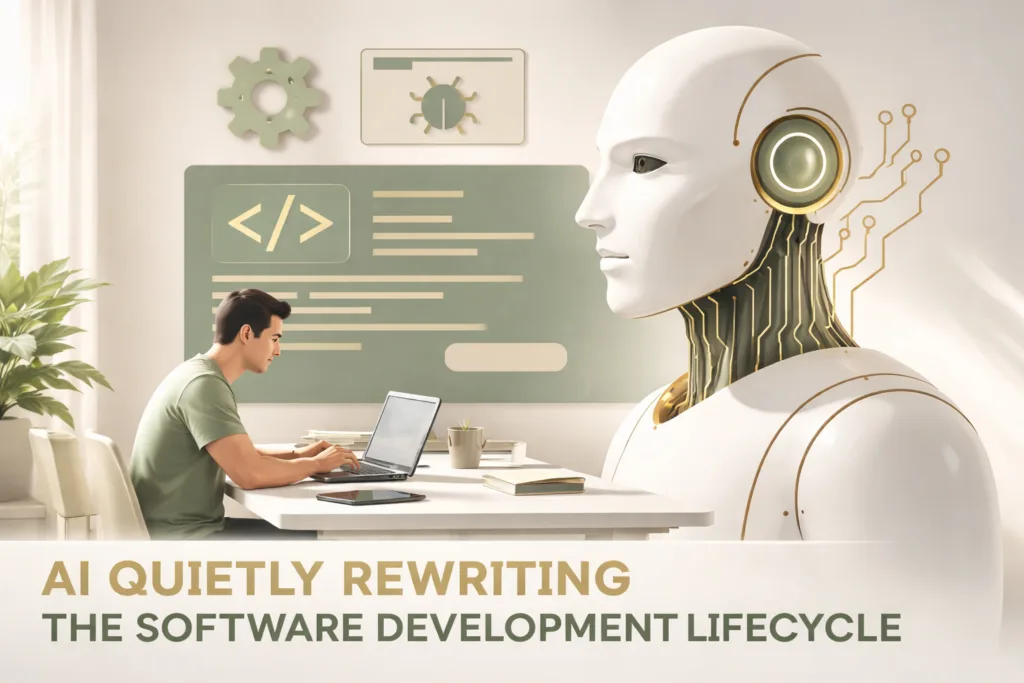
Software development is a story of evolution; from waterfall to agile, from manual testing to DevOps. Yet, today’s most profound transformation isn’t about process frameworks or programming languages.
It’s about intelligence…artificial intelligence.
A broad range of AI technologies is reshaping the software development lifecycle, enhancing coding, testing, deployment, and project management.
This means that AI is more than just another tool for developers. It’s become one of the most valuable, driving new ideas and helping teams get more done. Think of it as a silent partner quietly reshaping how we generate ideas, design, test, and keep software running.
In fact, it has become a core tool in modern software development, driving innovation and productivity across the industry. It’s an unseen ally, quietly reshaping how we ideate, architect, test, and maintain software systems.
It’s not a flashy change. There will be no headlines stating that “AI Is Replacing Developers”. Instead, you’ll notice it simplifies code changes, build logs, design ideas, and bug reports.
In short, AI is not the automation of software development; it’s the augmentation of it. In this article, we’re going to dive into how AI is changing the Software Development Lifecycle (SDLC) in ways that most organizations have yet to grasp.
1. From Ambiguity to Clarity: Natural Language Processing
Ask any developer where projects fail most often, and they’ll likely point to the requirements. Projects tend to get stuck because of misunderstandings, incomplete user stories, and changing priorities.
This is s where AI helps. Natural language processing (NLP) can scan stakeholder discussions, design plans, and meeting notes to automatically generate clear requirements.
Tools like ChatGPT Enterprise, Jira Assist, and GitHub Copilot Workspace can translate human language into actionable user stories, sometimes even generating acceptance criteria or identifying contradictions. Developers can use natural language queries to interact with these AI-powered requirements tools, making it easier to create and refine user stories or specifications using everyday language.
Let’s say we feed an AI system a vague sentence like::
“We need a better way for users to track their purchases.”
An AI-assisted requirements tool could turn that into:
- A structured epic: “Purchase History Tracking”
- User stories: “As a user, I want to see all past transactions sorted by date and total spent.”
- Acceptance criteria: “Must display at least 12 months of history; must be exportable as CSV.”
Beyond documentation, AI models can validate requirements.
This includes detecting ambiguity, flagging missing use cases, or even predicting potential bottlenecks based on similar historical data. Their effectiveness, however, depends on the quality and diversity of their training data, which enables them to better understand and process a wide range of requirements scenarios.
In short, AI is becoming the bridge between human intention and technical precision, solving one of thesoftware’s toughest translation problems.
2. Smarter Design: AI at the Intersection of Function and Form
Once the what of a project is clear, design answers the how.
AI is now embedding itself into the creative process, transforming both UI/UX and system architecture design.
Generative design tools like Stitch (previously Galileo AI) and Uizard can turn natural language prompts into wireframes and mockups in no time. A designer could request “a minimalist dashboard for project metrics,” and receive several layout options within minutes, each informed by thousands of successful design patterns from across the web.
These tools also offer seamless integration with popular design and development platforms, allowing teams to incorporate AI-generated assets directly into their existing workflows.
But AI’s role isn’t just aesthetic. It’s deeply functional.
AI models can analyze user behavior data to predict how people will navigate an interface before it’s built. They can simulate user flows, highlight accessibility issues, and optimize button placements for engagement or conversion.
On the back end, AI architecture assistants are emerging. Tools like IBM CodeNet and AWS CodeCatalyst can suggest microservice structures, database schemas, and caching strategies tailored to an application’s complexity and scale. They often support multiple languages, making them versatile for different backend requirements.
The result is a design phase that learns, where intuition meets data to drive faster, smarter decisions.
Humans still drive the vision. AI simply widens the lane.
3. Coding at the Speed of Thought: Generative AI and Developers as Code Curators
When it comes to SDLC, no stage has been reshaped more than coding. AI coding tools are transforming how code is written by offering smart help, automating tasks, and providing features that make development easier.
For many developers, GitHub Copilot and Amazon Q Developer (previously CodeWhisperer) have made coding more conversational, functioning like a second brain on standby. These tools offer code suggestions and context-aware suggestions, helping developers improve productivity and maintain high code quality.
AI coding assistants do more than just finish sentences. They understand what you’re trying to build. To get the context, they scan collections of code, docs, and past changes to generate code that works in real time.
The result? An undeniable productivity boost.. A 2023 GitHub study found Copilot reduced coding task completion time by 55%. But the impact goes deeper than speed…
AI-powered autocompletion and code generation can turn natural language prompts into entire functions, reducing manual effort and accelerating development.
Simply put, AI-assisted coding shifts the developer’s role from producer to curator. Instead of manually constructing every line, devs increasingly orchestrate code; guiding the AI, evaluating its logic, refactoring it for readability and security. Developers now curate code examples and functional code, adapting to different programming languages and coding styles as part of their workflow.
In this new paradigm, skill means knowing how to prompt, validate, and iterate. A good developer isn’t just fluent in Python or Rust; they’re fluent in how to communicate with AI.
And with that shift, the hierarchy of skills is changing. Reading comprehension, critical thinking, and pattern recognition are becoming as important as syntax mastery.
The best AI tools support multiple languages, generate Python code, and provide practical code snippets for a variety of use cases, making them essential for modern software development.
If you’re looking to deepen your skills and stay ahead of the curve, AI and software development courses offer hands-on training that helps developers bridge technical expertise with modern AI fluency, from coding assistance tools to full-scale automation frameworks.
4. Quality Assurance Reimagined: Predictive Testing and AI-Driven Testing Tools for Autonomous QA
Testing has long been the bottleneck of the SDLC…AI is quietly flipping this paradigm.
Completing QA by hand is slow, automated testing can break easily, and even the best engineers can’t anticipate every possible problem. AI-driven testing tools are transforming software testing by automatically identifying bugs and generating test cases. This leads to better quality and less wasted time.
Modern test suites use machine learning to predict where bugs are most likely to occur based on past changes, the frequency of errors, and the complexity of the code. These tools detect oddities and risky code patterns that could turn into bugs, so the team can catch them before they spread.
So, instead of testing everything, AI helps teams focus on where it matters most.For example, AI-powered tools like Testim.io and Mabl generate tests automatically by observing user behavior. They can adapt test cases as code evolves, reducing maintenance overhead.
And finally, beyond detection, AI is entering the realm of debugging.
Systems like DeepCode and Snyk AI can detect potential vulnerabilities, suggest code patches, and even auto-fix issues during CI/CD pipelines, before production ever sees them. The tools can analyze source code for security vulnerabilities, including cross-site scripting, and suggest patches to improve software quality.
Developers aren’t just catching bugs anymore; they’re stopping them with intelligent guesses, resulting in quicker, smarter QA that wastes less time.
FAQs
What is AI-powered code completion?
AI-powered code completion uses machine learning models to predict what a developer intends to write next. Tools like GitHub Copilot and Amazon Q Developer can autocomplete code, generate entire functions, and suggest syntax in real time. By being aware of the surrounding code, these systems help developers save time and reduce typing errors.
Can AI generate code automatically?
Yes. Modern AI tools can generate code snippets or complete functions based on natural language descriptions. Developers might ask, for example: build a Python function to clean CSV data, and the AI will return ready-to-run code. This capability spans across open source projects, code translation, and even test automation, helping teams scale development faster.
The Quiet Revolution Beneath the Code
AI isn’t here to overthrow the software development lifecycle. It’s here to refactor it. To optimize, accelerate, and illuminate the parts we’ve always accepted as slow or ambiguous.
The SDLC is no longer linear. It’s becoming symbiotic. Humans and machines are collaborating in loops of feedback, learning, and continuous improvement. Developers write code; AI learns from it. AI suggests optimizations; humans refine them. Together, they form a development ecosystem that’s not static, but self-evolving.
The software of the future won’t just be built. AI chat interfaces will allow seamless collaboration between humans and AI, enabling natural language conversations to drive code explanation, review, and translation. It will be co-written by human creativity and artificial intelligence, working side by side to turn complexity into clarity.
As AI continues to reshape software development, the most valuable skill isn’t just knowing how to code; it’s knowing how to learn, adapt, and lead in an AI-driven world.
If you’re ready to strengthen your technical foundation and build real-world AI fluency, explore ONLC’s AI Courses. ONLC offers expert-led, hands-on training that helps developers master modern AI tools, automation frameworks, and programming languages, preparing you to thrive in the next era of intelligent software development.