
The Comprehensive Guide to AI Face Swap Technology: Transforming Digital Identity in Images and Videos
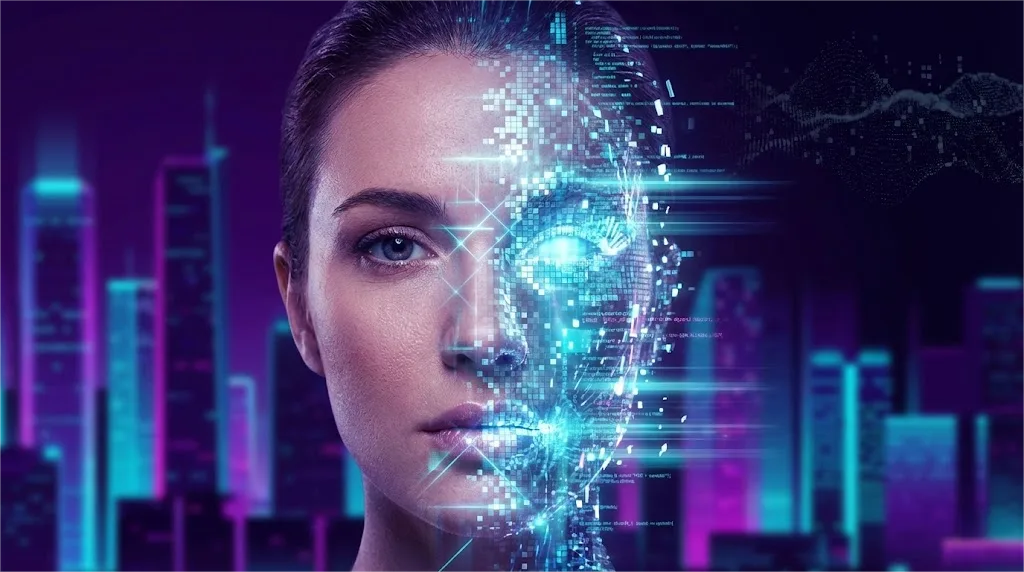
The revolutionary ability to implement seamless face swap has rapidly developed from high budget movie visual effects to the daily reality of content creators and digital artists. With AI constantly redefining the boundary of digital media, it is crucial for anyone who wants to maintain a leading position in the creative industry to understand the mechanism and application of this technology. Whether you are a professional video editor, social media influencer or marketing strategist, the ability to precisely manipulate facial features provides a new frontier for storytelling. This guide deeply discusses the synthetic world driven by artificial intelligence, explores how to rebuild the reality by algorithms, and how to democratize high-end visual effects by tools on faceswap-AI.io. We will study the subtle differences between static and dynamic exchanges, the importance of resolution enhancement and the future of digital identities.
The Mechanics of Synthesis – How AI Redefines Reality
The core of it is that the technology behind modern face swap relies on complex machine learning models, especially the GAN. Different from traditional photo editing, which is essentially a digital collage, AI driven exchange involves in-depth understanding of face geometry, lighting conditions and skin texture. The process starts with the extraction of facial symbols – eyes, nose, mouth and mandible – and mapping them to 3D meshes. Then, AI “encodes” the source face, transforms it into a compressed potential representation, and “decodes” it to the target image or lens. The reconstruction process is iterative; The neural network trains itself to minimize the difference between the generated face and the target’s illumination and angle.
However, the quality of output largely depends on the complexity of the underlying algorithm. Early iterations usually produce a “horror Valley” effect, that is, the face looks obviously artificial or floating on the neck. Now, the advanced model uses adaptive layer blending and color correction to perfectly match the source’s skin color with the target’s body. This technological leap has made the photo face swap app very popular in all aspects from professional head correction to meme creation. In addition, the ethical consideration of this technology is crucial. As tools become more and more powerful, it’s difficult to distinguish between real content and synthetic content. Therefore, understanding the technical “fingerprint” of exchange – such as the slight blur of hairline or the inconsistent light on ears – is a key skill of modern digital literacy. By mastering basic science, creators can better use these tools to create works that are not only visually amazing, but also technically perfect.
Mastering Static Media – The Art of Image Face Swap
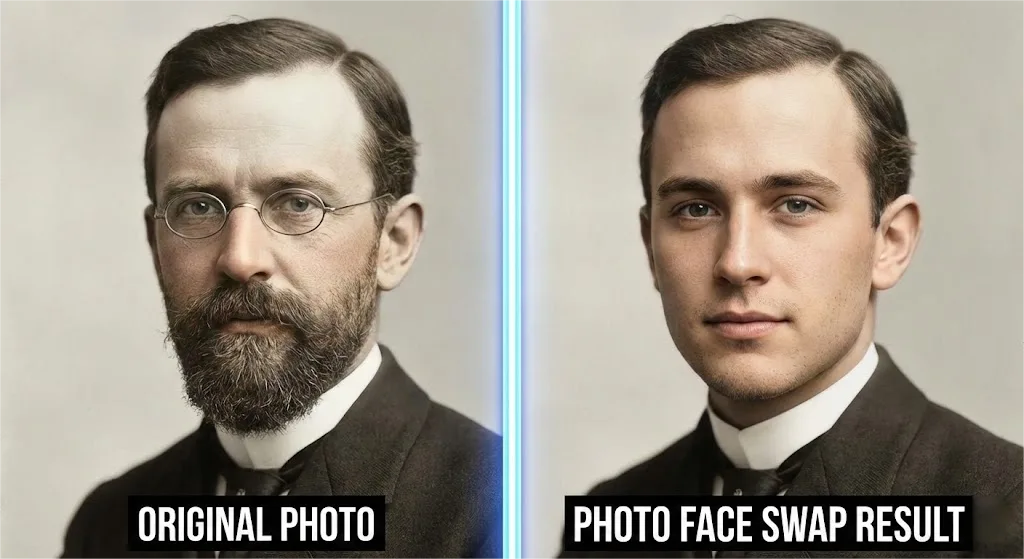
Although videos often make headlines, in the field of digital marketing and personal brands, the effectiveness of high-quality image face swap cannot be overemphasized. Static images allow videos to be hidden to a certain extent; Therefore, the resolution and edge detection must be impeccable. For e-commerce brands, this technology allows rapid diversification of model demographic data, without the need to re shoot the whole advertising series. By taking a product photo and exchanging models’ faces, brands can attract global audiences through localized performance.
For individual users, these apps are just as compelling. Consider the “specialization” of personal photos; A leisure photo with sufficient light can change the face into a professional target body and become the head of LinkedIn. However, the success of photo face changing does not only depend on the face changing itself; It usually needs post-processing. This is where image intensifiers become crucial. AI reinforcers can sharpen the details that may be lost in the synthesis process, and restore the texture of the skin and the luster of the eyes. In addition, creative professionals are using these tools for “virtual role play”, so that they can reflect their roles without physical prosthetics.
The key to get realistic results is to choose the source image and the target image with similar head posture. Although AI is powerful, extreme angle differences (for example, changing the side to the front), even the most advanced algorithm, are still a challenge. In order to achieve a perfect composition, users often combine the exchange tool with the background remover, isolate the theme, put it in a new background, and effectively build a new reality layer by layer.
Motion Magic – Transforming Content with Video Face Swap
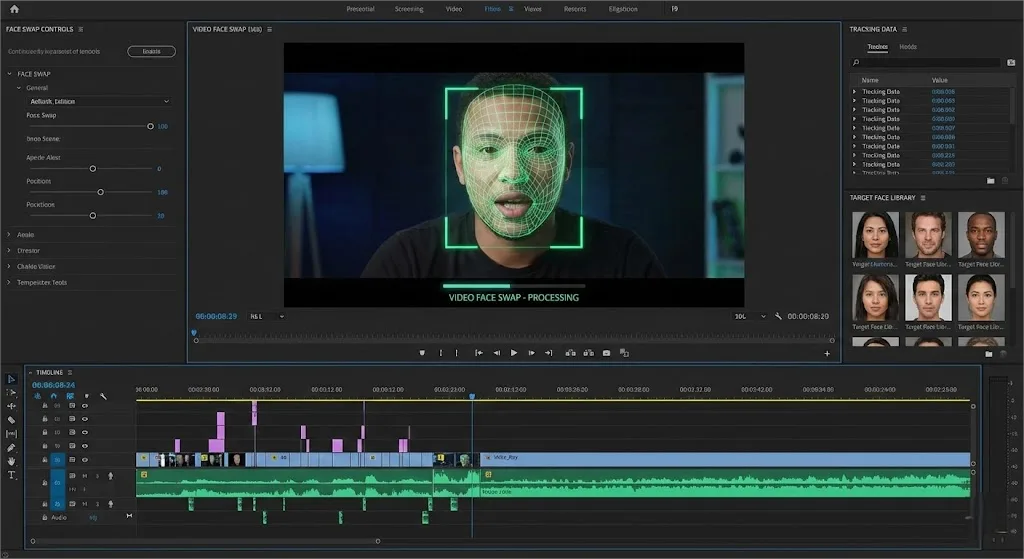
The transition from still images to moving graphics has brought exponential growth in complexity, making video face swap the final test of AI capabilities. In the video, ai not only needs to map the face accurately, but also needs to track the face in 3D space, considering rotation, occlusion (when the hand or object covers the face) and rapid changes in expression. Consistency is the Holy Grail of video exchange; A flickering or “nervous” face will immediately break the illusion. In the high-definition content that can be seen in every frame, this is particularly challenging.
More and more content creators use video role replacement to create narrative content in which they play multiple roles, or update old scenes with new actors. Imagine that marketing videos need to be localized for different regions; There is no need to shoot again. The faces of actors can be exchanged to match the local influencers. Their mouth movements can be adjusted using lip synchronization technology. The synergy of these tools creates a smooth and localized audience experience. However, video processing is resource intensive.
The original output of the swap sometimes causes the resolution to be lower than the original lens. This requires the use of video intensifiers or video upgrades to restore the exchanged lens to 4K quality. In addition, to deal with complex scenes, it is usually necessary to use a video background remover to isolate the main body before application exchange, so as to ensure that the background is not interfered by processing artifacts. Advanced tools like nano banana Pro began to appear in the field of enthusiasts, providing fine control for these variables. It’s undeniable that the future of video production is hybrid, mixing captured shots with synthetic elements to reduce costs and expand creative possibilities.
Paragraph 4: Beyond the Swap – Enhancing Quality and Workflow Optimization
A successful face change is rarely a one-step process; It is usually the core of a broader editing workflow involving multiple AI utilities. Once the core face swap is completed, the refining phase begins. A common problem in source videos is that there is unnecessary brand or interference. Here, the watermark remover becomes an essential utility to clean the canvas to ensure that the final video looks professional and proprietary. Similarly, if the source material has grainy or compression artifacts, the exchange will inherit these defects. Using high-end video upscaler can inject new vitality into low-resolution clips, ensuring that the synthetic face matches the clarity of high-quality target video.
The tool ecosystem available on platforms such as faceswap-ai.io illustrates this overall approach. It’s not just a face change; It’s about improving the whole asset. For example, creating an interesting GIF for social media may require a GIF face swap tool, which is optimized for shorter and circular animations where time is everything. In a more creative way, facial expression changers can adjust the emotional tone of the performance, turning a neutral expression into a smile without having to shoot again. For audio-visual synchronization, voice cloning technology allows the audio to match the new identity, resulting in a complete sensory conversion.
We also see the rise of video generation models like VEO 3.1, which promises to integrate the switching function directly into the video generation process. As these tools become more interconnected, the boundaries between “Edit” and “generate” will become blurred. The creators who master the whole stack – from exchange to enhancement to audio synchronization – will have the ability to generate Hollywood level content from laptops, fundamentally changing the economy of media production.
Disclaimer: This article is for informational purposes only and does not promote misuse of AI-generated media.