
Q&A: From Seven-Figure Hauler to Tech Pioneer – The Todd Atkinson Story
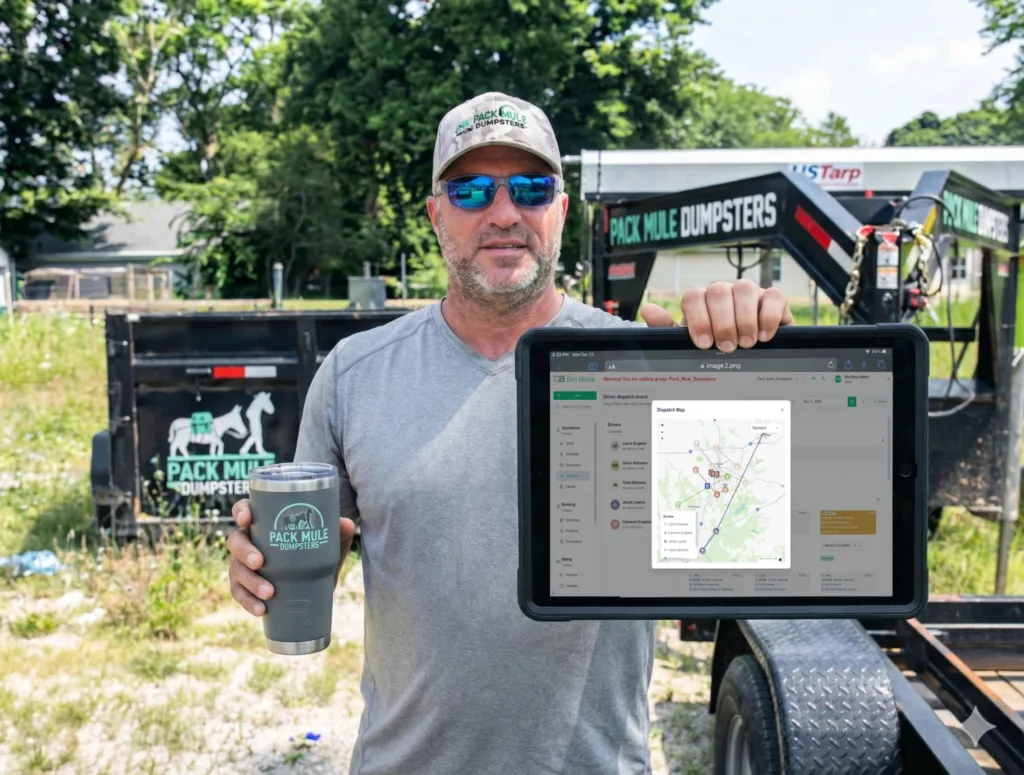
Operating a massive dumpster rental enterprise requires more than just heavy machinery and steel containers; it requires an ironclad operational strategy. Few people understand this reality better than Todd Atkinson. As a military veteran and the founder of Pack Mule Dumpsters in Ohio, Atkinson successfully scaled his local hauling operation from thirty-six thousand dollars a month to over one hundred fifty thousand dollars a month in just six months, eventually breaking the coveted seven-figure annual revenue mark. However, scaling a massive fleet of over eighty roll-off dumpsters brought an entirely new set of logistical nightmares. In this exclusive Q&A, we sit down to explore how his journey from the battlefield to the landfill inspired him to create a revolutionary software product designed specifically for fleet owners.
The Military Mindset Behind the Business
Question: You served in the military before entering the waste management sector. How did your experience in Afghanistan shape your approach to running a local dumpster rental business?
Answer: In the military, logistics are literally a matter of life and death. You learn very quickly that discipline, communication, and extreme reliability are the absolute bedrock of any successful operation. When I transitioned back into civilian life and entered the waste management sector, I immediately noticed the accepted level of organized chaos that plagued most local haulers. Dispatchers were relying on smudged whiteboards, drivers were playing endless games of phone tag, and high-value assets were simply getting lost in the field. I applied my core military values to Pack Mule Dumpsters. I realized that a customer renting a steel container is not just buying space for their junk; they are purchasing the assurance that the bin will arrive exactly when promised. That militant dedication to operational efficiency laid the groundwork for our massive initial business expansion.
Hitting the Complexity Wall
Question: Your company experienced explosive growth, adding thirty-nine new thirty-yard dumpsters and hitting a run rate of over one point three million dollars. What operational hurdles did you face during that rapid expansion?
Answer: Every growing service business eventually hits what I call the complexity wall. Managing ten or twenty roll-off containers is entirely feasible with a standard spiral notebook and a few quick phone calls. However, when our local hauling operation expanded into a regional powerhouse, the complexity of our daily logistics scaled exponentially. The back-office operations began to crack under the sheer weight of our own success. The mental load of tracking which driver was assigned to which route, identifying which bins were sitting empty at a job site accruing zero revenue, and chasing down unpaid invoices became a staggering bottleneck. I realized our barrier to taking the business to the absolute next level was no longer a lack of physical assets or customer demand. It was the complete absence of a digital nervous system capable of handling the high-velocity churn of a massive fleet.
Building the Solution from Scratch
Question: When did you realize that existing generic field service tools were not going to work for your specific waste management needs?
Answer: I tried several different applications, but they were almost all designed for plumbers or electricians. They completely missed the nuanced reality of roll-off rentals. They did not understand tonnage limits, the financial sting of a dry run fee when a driveway is blocked, or the complexity of tracking dozens of metal boxes spread across multiple counties. The manual workaround of relying on group texts and spreadsheets became a massive, expensive bottleneck. Spreadsheets are entirely static. They do not update when a driver gets stuck in traffic, and they certainly do not alert you when a contractor has kept a bin three days past their rental agreement. I decided to build something better out of pure necessity. That is why I created Bin Boss, a specialized platform engineered specifically to handle the unique logistical gymnastics of the heavy hauling industry.
Productizing the Owner’s Brain
Question: Your software is now available as a service for other independent operators. How does this technology help a smaller hauling company compete with massive national conglomerates?
Answer: By packaging my own lived experience into deployable code, we have essentially created an equalizer for the entire sector. Local haulers can now operate with the exact same logistical sophistication as massive national conglomerates for a flat monthly fee. Instead of spending years making expensive routing mistakes or losing track of high-value assets, scaling owners are essentially licensing my fully optimized workflows. Every feature represents a real-world problem effectively solved in the field by someone who knows the smell of a landfill and the panic of a busy Friday dispatch board. We eliminate the guesswork from daily management so owners can reclaim their time.
Marketing and Scaling the Empire
Question: Aside from operational software, what other crucial elements do hauling companies need to secure in order to truly dominate their local service markets?
Answer: You can have the most efficiently routed fleet in the world, but if contractors and homeowners cannot find you online, your bins will sit empty in the yard. Digital visibility is paramount. Professional branding, strategic social media marketing, and robust dumpster rental website design are non-negotiable investments for modern haulers. A fully optimized site allows customers to book rentals and process payments twenty-four hours a day, turning your online presence into a tireless sales engine that fuels your physical fleet’s growth.
Conclusion: From the Trenches to the Tech Sphere
Todd Atkinson’s evolution from a military veteran to a seven-figure hauling business owner, and ultimately to a tech pioneer, provides a powerful blueprint for success in the waste management industry. He didn’t just build a software product in a vacuum; he forged it in the fire of his own rapidly scaling, high-volume dumpster rental business. By transforming his real-world logistical headaches into a streamlined, cloud-based service, Todd has given independent operators the ultimate competitive advantage. You no longer have to suffer through the expensive growing pains of lost inventory, missed routes, and administrative burnout. Leveraging a platform built by an owner, for owners, means you are instantly equipped with the digital infrastructure needed to dominate your local market, reclaim your valuable time, and scale your hauling empire with absolute confidence.