
Electric Cargo Bikes for Everyday Utility: What No One Tells You Before You Make the Switch
Ask anyone who owns one, and the story tends to go the same way. They bought it skeptically, used it once or twice thinking it was more of an experiment than a lifestyle change, and then somewhere around week three they stopped driving to the supermarket entirely. That is the honest origin story for most cargo ebike converts. Not a dramatic environmental awakening. Just a Tuesday morning grocery run that turned out to be faster, cheaper, and frankly more enjoyable than loading everything into a car boot and fighting for a parking spot two blocks away from the entrance.
The market has clearly caught up with that experience. Electric cargo bikes are no longer a fringe product for cycling purists or city planners drafting sustainability reports. Families in suburbs are using them for school pickups. Small business owners are running deliveries with them. Tradespeople are loading them up with tools. And a growing number of households that once assumed they needed two cars have discovered they actually need one car and one very capable bike.
So what is actually going on here, and more practically, what do you need to know before deciding whether one of these bikes makes sense for your life?
The Financial Case Is Stronger Than Most People Realize
Let us start with money because that tends to cut through the noise faster than anything else. Running a car in most cities costs somewhere between $6,000 and $12,000 per year once you add up loan repayments or depreciation, insurance, fuel, servicing, and parking. Those numbers vary by location and vehicle, but the direction is always the same: upward.
An electric cargo bike charged from a standard wall outlet costs roughly $0.10 to $0.20 worth of electricity per full charge, depending on your local rates and the battery size. That charge typically covers between 40 and 80 kilometers of real world riding. Do that math across a week of daily errands and school runs and the operating cost becomes almost comically low compared to a car.
The purchase price of a quality cargo ebike sits anywhere from $1,500 to $5,000 depending on the specification. Yes, that is real money. But for households that genuinely commit to using it as a car replacement for shorter trips, most riders report recovering that cost within 12 to 18 months just through saved fuel and parking fees. After that point the bike is essentially free to run.
There are also an increasing number of government incentives worth investigating in your region. Several European countries offer direct purchase subsidies or tax rebates for cargo ebikes. Some US cities and Canadian provinces have introduced similar schemes. These programs come and go, but right now many of them are still active and can meaningfully reduce the upfront cost.
What Cargo Ebikes Can Actually Carry (and What They Cannot)
This is where a lot of first time buyers get tripped up by vague marketing language. “High capacity” means different things on different bikes, and the gap between a budget model and a purpose built cargo bike in terms of real payload is substantial.
A well designed cargo ebike from a reputable manufacturer will typically support a total system weight, meaning rider plus cargo, of between 130 and 200 kilograms. The frame geometry, wheel size, motor torque, and braking system all need to be matched to that load rating to keep the bike safe and predictable under weight. Cheaper frames using lower grade aluminum and modest motors will technically list a payload number but may handle poorly or wear out quickly when regularly loaded to that limit.
For a practical reference point: two children in a front box plus a school bag and a few bags of groceries will typically sit in the range of 40 to 60 kilograms of cargo. A week of grocery shopping for a family of four usually comes in around 20 to 30 kilograms. Commercial parcel loads vary more widely but most urban delivery routes use bikes configured to carry 30 to 80 kilograms per trip. A cargo bike rated and built for those loads is entirely capable of handling all of these scenarios daily.
What cargo ebikes are not ideal for: very long distance riding above 80 kilometers in a single trip without a mid route charge, carrying items wider than the bike’s cargo bay, or operating in environments without any charging access. These are niche limitations that most daily users never encounter, but they are worth acknowledging honestly.
How to Actually Choose the Right One
The variety of cargo ebike designs on the market can feel overwhelming at first. Longtail bikes, box bikes, front loader configurations, compact urban designs, full suspension models built for rougher terrain. The categories exist because different use cases genuinely call for different solutions, so narrowing down your choice becomes a lot easier once you are specific about what your actual daily use will look like.
If your primary need is carrying children, a front-loading box bike or a longtail with a secure rear child seat gives you the best combination of visibility and stability. You can see your kids, the low center of gravity makes the bike handle predictably, and the enclosed cargo area feels secure to children in a way that open rear seats do not always manage.
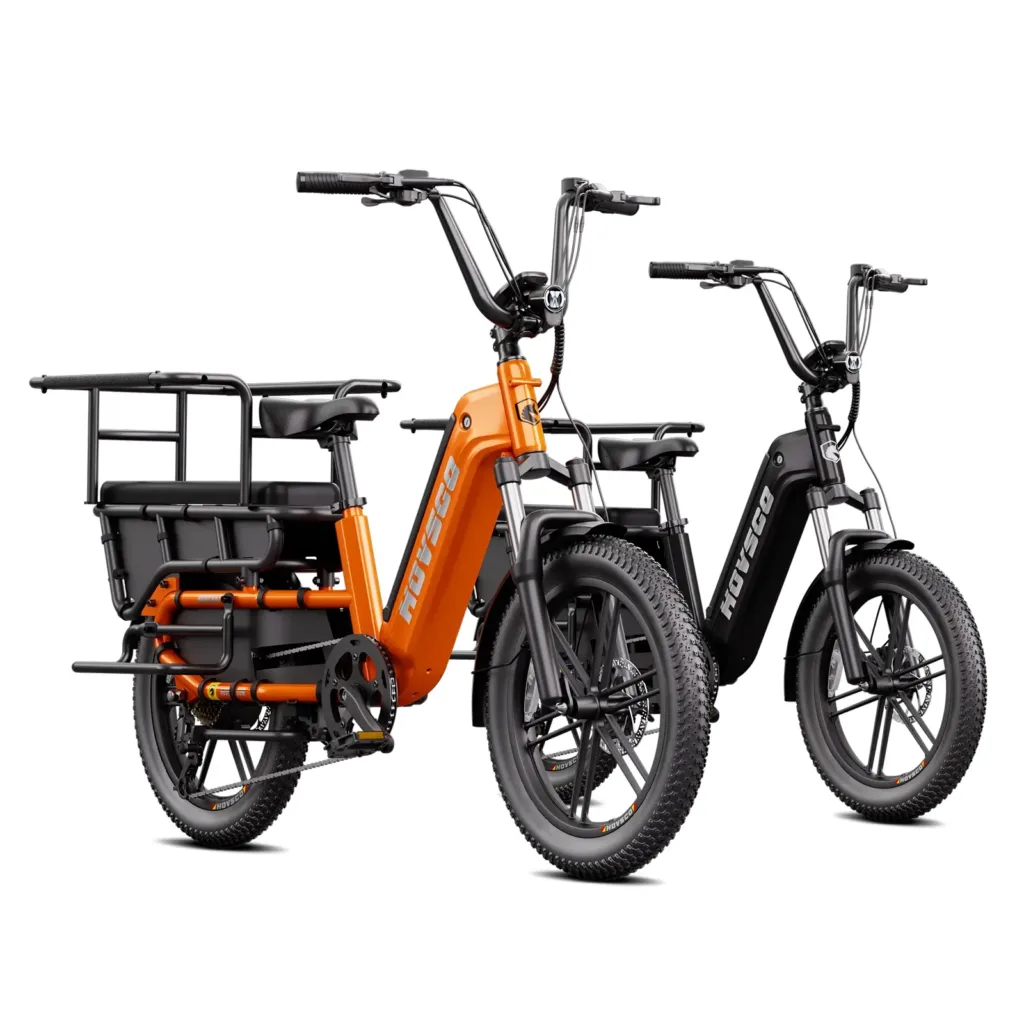
If your focus is deliveries or business use, a purpose-built model like the HovCart Cargo e-bike is worth a close look. It is designed specifically around the demands of working use: practical cargo geometry, a motor that handles real loads without straining, and a build quality suited to daily commercial mileage rather than occasional weekend errands. For business owners evaluating cargo bikes as genuine operational vehicles rather than novelty purchases, that distinction matters enormously.
For general family errands without regular child carrying, a more compact longtail or a mid-step cargo bike often offers the best balance of maneuverability, cargo capacity, and ease of storage. These models tend to be lighter, handle more like a standard bicycle, and fit in tighter parking spaces or narrower storage areas.
Test riding is not optional. Read this sentence twice if you need to: do not buy a cargo e-bike without riding it loaded. An empty cargo bike feels very different from one carrying 30 kilograms through a corner or down a moderate hill. Most dealers will accommodate this request; if they will not, find a different dealer.
The single most common thing buyers tell us after their first loaded test ride is that they wish they had done it sooner. The bike that felt slightly unfamiliar empty starts to make complete sense the moment there is actually something in it.
Real People, Real Use Cases: What Daily Life Actually Looks Like
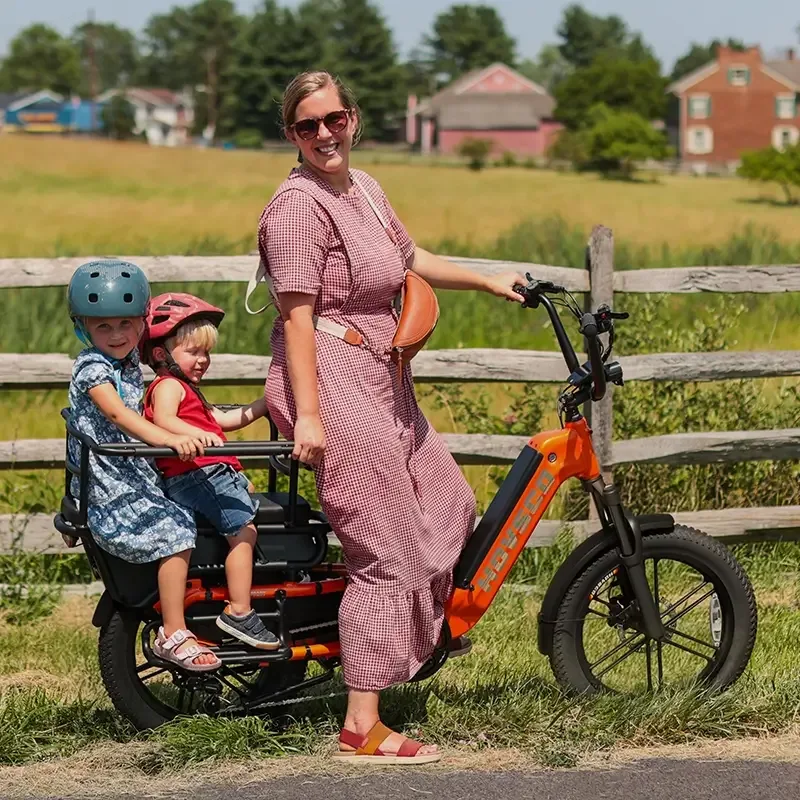
School runs have become one of the most talked about cargo bike use cases for a reason that goes beyond convenience. Parents who make the switch consistently report that their children prefer it to car journeys. There is something about being outside, moving through the neighborhood, watching things go past that simply makes the school run less of a chore for everyone involved. Several studies on active school commuting also point to better concentration and mood in children who arrive having done some physical activity, even gentle pedal assist cycling.
Grocery shopping is the other anchor use case that converts skeptics. The capacity of a properly configured cargo bay is larger than most people initially expect. Fitting a full week’s shopping, including bulk items and drinks, is straightforward on most mid to large cargo bikes. And unlike a car boot, the cargo area is right there at loading height when you leave the shop; there’s no awkward bending or shuffling bags around the back seat.
For small businesses, the case is primarily economic but the operational benefits add up too. A local florist making morning deliveries in an urban area, a catering company running supplies between sites, a mobile coffee cart operator: all of these businesses have found that a cargo e-bike covers their operational needs faster and cheaper than a van during peak hour traffic, without the parking headaches or the fuel receipts.
The Environmental Dimension: Less Abstract Than It Sounds
Most people who buy a cargo ebike do so for practical and financial reasons first. The environmental upside tends to feel like a bonus rather than the motivation. But the numbers are genuinely significant and worth understanding, particularly if you are the kind of person who wants to feel good about the choices you make.
A cargo ebike produces somewhere around 5 to 10 grams of CO2 per kilometer on average when you factor in battery production and the electricity used to charge it, even on a grid that is not fully renewable. A typical family car produces between 120 and 200 grams per kilometer. The difference is not marginal; it is an order of magnitude. Multiply that across the daily school run and grocery trips of a few thousand families in a single suburb and the cumulative reduction in emissions starts to mean something real at a neighborhood level.
Noise is worth mentioning too. Cargo ebikes are essentially silent. For early morning delivery routes through residential streets, for parents doing school drop off near other families and pedestrians, for anyone who has lived near a road with regular van traffic: the contrast is noticeable and welcome.
A Few Things Worth Knowing Before You Commit
Storage deserves more thought than most buyers give it upfront. A cargo bike is significantly larger than a standard bicycle and will not fit in most standard bike racks or through narrow doorways. Measure your storage space before you buy, not after. Many owners end up solving this with a garden shed, a garage wall mount, or a dedicated outdoor cover solution. It is manageable, but it requires a plan.
Maintenance on a quality cargo ebike is straightforward and infrequent compared to a car, but it is not zero. Brake pads wear faster under heavy loads and need checking regularly. Tires on cargo bikes are larger and can be more expensive to replace than standard bike tires. Battery health over several years depends on how consistently you charge it; most quality lithium packs are rated for 500 to 800 full charge cycles before capacity begins to decline meaningfully. Factoring in an occasional servicing budget is just sensible ownership planning.
Security is a genuine concern for a purchase in the $2,000 to $5,000 range. A quality chain lock or ground anchor combined with registered ownership and specialist insurance is the minimum sensible setup. Several insurers now offer dedicated cargo bike policies covering theft, accidental damage, and third party liability at rates that reflect the actual risk profile of the vehicle.
The Bigger Picture: A Mobility Choice With Long Legs
Urban transportation is shifting. Not in some distant theoretical future but right now, in the decisions that city planners, logistics companies, and individual households are making this year. The infrastructure is following the demand; dedicated cargo bike lanes, commercial charging points, and business incentive programs are all growing in number. The direction is clear enough that choosing to adopt a cargo ebike today does not feel like getting ahead of the curve so much as joining a movement that is already well underway.
For families weighing whether they can genuinely replace a second car, for business owners calculating the cost per delivery of their current van operations, for individuals who want their daily errands to feel less like a chore and more like a choice: the cargo ebike deserves a serious, practical, test ride based evaluation. Not because it is fashionable. Because in most cases, honestly assessed, it works better than the alternative it replaces.
The streets have been telling us this for a few years now. The people on those streets, with their full cargo bays and their relaxed Monday morning school runs, seem like they already know something worth knowing.