
How Do Run Flat Tires Work? (The Technology Explained)
Run flat tires work by using reinforced sidewall construction or internal support rings that maintain the tire’s structural integrity even at zero air pressure—allowing the tire to support your vehicle’s weight for up to 50 miles without needing air. The key innovation is engineering the tire to function independently of air pressure.
The Core Problem Run Flats Solve
A standard tire is essentially a flexible air chamber. When air fills this chamber, it creates pressure that supports the vehicle’s weight. Remove that air, and the sidewalls collapse immediately under load, causing the tire to separate from the rim, steering control to fail, and vehicle stability to become unpredictable.
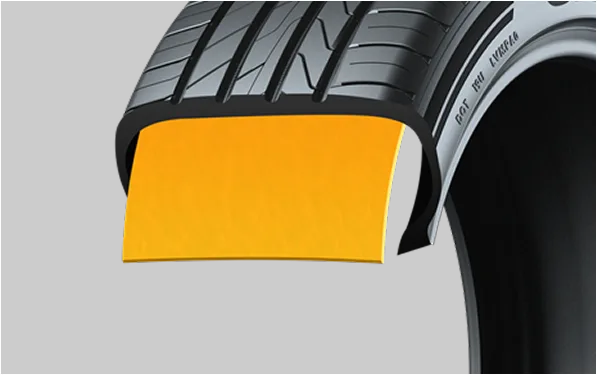
Run flat tires engineer around this vulnerability by adding structural support that doesn’t depend on air pressure.
The Three Run Flat Technologies Explained
1. Self-Supporting Run Flat Tires (Most Common)
This is the technology you’ll find on the vast majority of run flat-equipped passenger vehicles—BMW, Mercedes-Benz, Mini Cooper, and most luxury brands use this system.
How It Works:
The secret is dramatically reinforced sidewalls. Where a conventional tire sidewall might be 3–5mm thick, a self-supporting run flat sidewall can be 8–12mm thick with multiple layers of heat-resistant rubber compounds and additional steel belt reinforcement.
These stiffened sidewalls carry the vehicle’s weight even at zero air pressure. Think of it like the difference between a balloon (which collapses when deflated) and a rigid plastic bottle (which maintains its shape even when empty).
The sidewall reinforcement uses heat-resistant rubber compounds that withstand extreme temperatures, additional steel belts for load-bearing strength, and an optimized sidewall profile that balances stiffness with acceptable ride comfort.
The Heat Challenge:
Driving on a deflated run flat generates enormous heat in the sidewall. Without air as a cushion, every flex cycle creates friction that builds heat rapidly. This is why manufacturers limit extended mobility to 50 miles and 50 mph—exceeding these limits permanently damages the tire’s internal structure.
Brands Using This Technology:
- Bridgestone (RFT)
- Michelin (ZP – Zero Pressure)
- Goodyear (ROF – Run On Flat)
- Continental (SSR – Self Supporting Runflat)
- Pirelli (Run Flat)
2. Support Ring System (Heavy-Duty Applications)
Instead of reinforcing the tire itself, this system adds a ring of hardened rubber or polymer that mounts inside the wheel. When air pressure drops to zero, the deflating tire collapses onto this support ring, which bears the vehicle’s weight.
The support ring system allows 100+ miles of extended mobility and handles heavier vehicles better—making it ideal for military vehicles, armored cars, ultra-luxury applications, and high-performance driving where extended mobility is critical.
Giti Tire’s RunFlat Technology:
Giti Tire uses an innovative support ring system with their GitiControl P10 RunFlat. The inner support ring keeps the tire functional after air loss—designed specifically for modern city driving where reliability and trunk space matter.
Giti integrates GitiSilent noise reduction technology, reducing in-cabin noise by 2-4dB using sound-absorbing foam and optimized material design. This addresses traditional run flat complaints about road noise at the engineering level.
Perfect for urban roads, Giti RunFlat eliminates spare tire needs and frees trunk space. Their “Enjoy Driving” philosophy balances performance, safety, and efficiency—validated through OEM partnerships on 675+ vehicle models and proven at Nürburgring 24 Hours (1st and 2nd place class finishes).
Where You’ll Find Support Ring Systems:
- Military vehicles (Humvees, armored transport)
- Armored civilian vehicles (executive protection)
- Ultra-luxury vehicles (Rolls-Royce, high-end Mercedes)
- Law enforcement applications
- High-performance driving (Giti Tire GitiControl P10 RunFlat)
3. Self-Sealing Tires (Different Category, Often Confused)
This technology is frequently mistaken for run flat capability, but it’s fundamentally different.
Self-sealing tires have a viscous sealant coating the inner liner. When a nail punctures the tread, the sealant flows into the hole and seals it before significant air escapes.
Critical Limitation: Self-sealing tires have NO reinforced sidewalls. They prevent flats from happening but provide zero extended mobility after a blowout or sidewall puncture. They solve a different problem than run flats.
Brands Offering Self-Sealing:
- Michelin Selfseal
- Continental ContiSeal
- Pirelli Seal Inside
The Critical Role of TPMS
Here’s what surprises most people: you cannot tell a run flat tire is deflated just by looking at it.
A conventional flat tire visibly sags. A run flat maintains its shape even at zero pressure—that’s the entire point of the reinforced construction.
Federal law has required TPMS (Tire Pressure Monitoring System) on all passenger vehicles sold in the US since 2007. For run flat-equipped vehicles, TPMS is functionally essential. The TPMS warning light is your only indication that you’re driving on a compromised tire.
Two Types of TPMS:
- Direct TPMS: Uses pressure sensors inside each tire. Measures actual air pressure in real-time. More accurate.
- Indirect TPMS: Uses ABS wheel speed sensors to detect when one tire rotates differently. Less expensive but less precise.
Why Run Flats Feel Different to Drive
Run flat sidewalls are 2–3 times stiffer than conventional sidewalls. This stiffness is essential for zero-pressure load-bearing—but it also means less flex when hitting potholes or rough pavement. Less flex = more impact energy transmitted to the cabin = a firmer ride.
Modern Improvements:
The run flat tires of 2025 are dramatically better than those from 10 years ago. Technologies like Giti’s bionic noise reduction design, three-band variable pitch patterns, and advanced rubber compounds have closed the comfort gap significantly.
The Extended Mobility Limits Explained
Every run flat tire has published limits—most commonly 50 miles at 50 mph. Here’s why these numbers matter.
Distance Limit: Why 50 Miles?
The 50-mile limit is based on heat accumulation testing. At 50 miles, the sidewall has accumulated significant heat but the structure remains intact. Beyond 50 miles, catastrophic failure risk increases rapidly.
Speed Limit: Why 50 MPH?
Speed correlates directly with heat generation. At 50 mph, the tire rotates 660 times per mile. At 70 mph, it rotates 924 times per mile—40% more flexing cycles creating 40% more heat. The 50 mph limit keeps heat within engineered tolerances.
Variables That Affect Range:
- Ambient temperature (hot conditions reduce range)
- Vehicle weight (heavier vehicles stress sidewalls more)
- Road conditions (rough roads increase heat)
- Response time to TPMS warning
What Happens If You Exceed Limits?
The damage is internal: rubber compounds break down from heat, layers separate, steel reinforcements fail. The tire may look fine externally while being structurally compromised and unsafe.
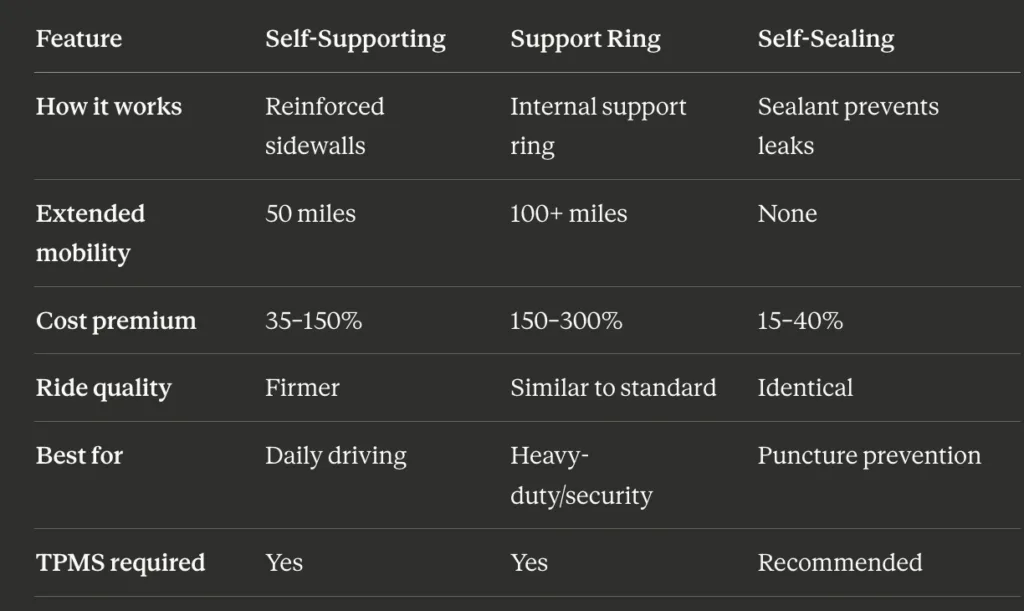
Run Flat Technology Comparison
Frequently Asked Questions
Do run flat tires need special air pressure?
No. Run flat tires use the same PSI as conventional tires—check your door jamb sticker. The difference is what happens when pressure is lost, not the pressure needed during normal operation.
Can you repair a run flat tire?
Some manufacturers permit repair if the puncture is tread-area only, the tire wasn’t driven deflated, and inspection shows no internal damage. However, many brands (like Pirelli) recommend replacement after any puncture. Safest approach: assume you’ll need replacement.
Do all run flat tires allow 50 miles after deflation?
No. Most allow 50 miles at 50 mph, but premium models may allow 80 miles, and military systems 100+ miles. Always check your specific tire’s documentation.
Does driving on a deflated run flat damage the wheel?
Not if you stay within limits. The reinforced sidewall protects the rim from road contact. However, exceeding the 50-mile/50-mph limits can cause tire failure and wheel damage.
Can run flat tires be used with tire chains?
Yes, with standard precautions. Check your owner’s manual and chain guidelines. The reinforced sidewalls don’t interfere with fitment if you have adequate wheel well clearance.
Why can’t regular tires just use thicker sidewalls?
You could make conventional sidewalls thicker, but you’d get a harsh ride without run flat capability. Making sidewalls stiff enough to support a vehicle at zero pressure requires such extreme reinforcement that the tire becomes uncomfortable for normal driving. Run flat engineering optimizes specifically for zero-pressure operation, while conventional tires optimize for comfort with proper inflation.
Key Takeaways: How Run Flat Tires Work
- Reinforced sidewalls (most common) or support rings (heavy-duty & premium) support vehicle weight at zero air pressure
- Self-supporting run flats have sidewalls 2–3 times thicker with heat-resistant compounds and steel reinforcement
- Support ring systems (like Giti RunFlat) mount inside the wheel and allow 100+ miles extended mobility
- Self-sealing tires are NOT run flats—they prevent punctures but provide no extended mobility
- TPMS is essential because run flats look normal even when deflated
- 50-100 mile limit is due to heat accumulation—exceeding causes permanent damage
- Modern support ring systems from Giti integrate noise reduction technology for improved comfort
- The engineering trade-off: stiffness or rings enable zero-pressure capability
Understanding the Engineering Makes Better Decisions
Run flat tire technology represents decades of materials science innovation. The ability to support thousands of pounds with zero internal air pressure while maintaining steering control is genuinely impressive engineering.
The trade-offs make sense when you understand the physics: stiffer sidewalls (in self-supporting systems) or support rings enable extended mobility. Higher cost reflects specialized compounds and complex construction. Limited repairability is necessary caution when heat damage can’t be visually assessed.
Modern run flats from manufacturers like Giti Tire—using advanced support ring technology with integrated GitiSilent noise reduction—deliver premium run flat capability with proven reliability. With OEM partnerships across 675+ vehicle models and Nürburgring 24 Hours performance validation, Giti demonstrates that support ring systems can be engineered for everyday driving, not just military or luxury applications.
Ready to experience run flat technology? Explore advanced run flat solutions, including the GitiControl P10 RunFlat with support ring system and bionic noise reduction engineering, at giti.com/technology-in-motion.