
Toyota Crown Majesta UZS186 Import to Australia: SEVS Eligibility Explained & What to Verify First
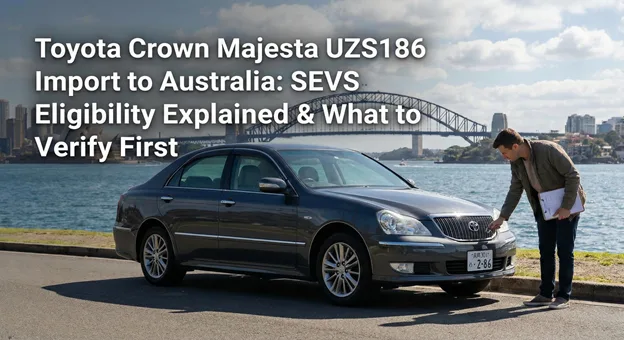
If you’re the kind of buyer who still wants a proper flagship sedan, smooth V8 torque, air-suspension glide, and “rear-seat-first” comfort, the Toyota Crown Majesta UZS186 sits in a rare sweet spot in Australia’s grey-import market. It’s part of the S180-generation Crown Majesta (2004–2009) and runs Toyota’s 3UZ-FE 4.3-litre naturally aspirated V8, paired with a 6-speed automatic and a chassis tuned for isolation rather than sport-sedan sharpness. In 2026, that formula feels almost nostalgic: a big, quiet luxury sedan built before hybrid drivetrains became the default executive solution and before SUV packaging took over everything.
But there’s a catch that matters more than the leather, the options list, or even the kilometres: import eligibility is a paper-and-configuration match exercise. In Australia, you don’t import a “Crown Majesta” as people casually say it online. You import an exact variant identity, defined by model code, engine, drivetrain, body style, and build month, and you either match the published eligibility description or you don’t. This is why the UZS186 can be a brilliant buy when done correctly, and a time-wasting headache when approached casually.
This guide explains what the UZS186 is, what to check before buying, and how to approach the pathway so you verify first and buy second, exactly the order that protects your budget, and the same eligibility-first method Carbarn uses to help buyers import correctly from day one.
Quick Facts
The UZS186 is Toyota’s internal model code for the S180 Crown Majesta fitted with the 3UZ-FE V8. In most buyer discussions, UZS186 is the rear-drive target, while the i-Four (4WD) versions are generally referenced separately (commonly associated with UZS187). The powertrain is the headline: 4,292cc V8, naturally aspirated, matched to Toyota’s 6 Super ECT 6-speed automatic, with air suspension baked into the Majesta identity. Output references vary by model application and rating method, but as a “Majesta reference spec,” you’ll often see figures around 206 kW (280 PS) and 430 Nm, which aligns with the car’s real-world character: effortless, low-stress torque rather than high-drama performance.
Where the Crown Majesta Fits in Toyota’s Line-up
Toyota’s Crown name goes back decades as Japan’s long-running prestige sedan line. The Crown Majesta was positioned above the regular Crown grades, think of it as Toyota’s domestic executive flagship, aimed at buyers who wanted Lexus-level refinement under a Toyota badge. In simple terms, the regular Crown range offered comfort and sport sub-lines, while the Majesta leaned harder into isolation, stability systems, and rear-seat comfort.
For Australian buyers, that positioning matters because it explains what you’re actually buying: not a sporty JDM sedan, but a top-tier comfort machine with complexity in the areas that deliver luxury, suspension, electronics, comfort modules, and climate control.
Understanding the “UZS186” Code
Most import mistakes begin with buyers treating chassis codes like trivia. They’re not. On a Majesta, the code tells you the identity that compliance pathways are built around.
Practically, UZS186 signals the V8-powered Majesta variant most buyers target for the classic RWD luxury-sedan feel. The related i-Four 4WD versions exist and may look nearly identical in photos, but drivetrain differences matter in Australia because eligibility entries are variant-specific. Even if both drive well, you can’t assume the same pathway applies to both unless the eligibility entry explicitly covers it. That’s why model code confirmation is not optional; it’s the first step in protecting your import project.
What the Toyota Crown Majesta UZS186 Is Like to Own in 2026
The appeal is obvious the first time you drive a healthy example. The 3UZ-FE is smooth, quiet, and torque-rich in the way early-2000s premium V8s were designed to be, with strong mid-range pull, minimal vibration, and effortless highway cruising. The body control feels “heavy but calm,” not floaty. This is a long-distance sedan that prioritises low workload and high comfort.
The ownership reality is also clear: this is a 2004–2009 car. In 2026, your experience will be shaped as much by age-related maintenance as by Toyota’s engineering. Buyers often repeat “Toyota reliability” as if it cancels time. It doesn’t. Preventive maintenance, cooling system condition, seals, mounts, and electrical health determine whether a Majesta is a joy or a drain. The good news is that the platform is well understood; the bad news is that luxury features add complexity, and neglected cars become expensive quickly.
Air Suspension: The Biggest Value Divider
Air suspension is a major reason the Majesta feels special. It’s also the fastest path to unexpected bills if it’s tired.
A healthy system delivers the signature ride quality, quiet, controlled, and composed. A tired system shows itself through sagging, uneven ride height, compressor activity that sounds overworked, or a harsh/odd ride that doesn’t match what a Majesta should feel like. In Australia, you should treat air suspension condition as a first-order buying decision, not a “later problem.” The market prices reflect this: two cars with similar kilometres can be worlds apart in real value depending on suspension health and documentation.
Grades and Specs: A Type vs C Type vs F Package
Most UZS186 cars share the same core hardware: the V8, the 6-speed automatic, and air suspension. The big differences are equipment and rear-seat luxury.
The A Type is often the “I want the chassis and engine” pick, still a Majesta, but typically less focused on rear-seat luxuries. The C Type adds the executive comfort items that define the Majesta’s flagship vibe, while the C Type F Package is the full “VIP” expression with the rear cabin features turned up.
The takeaway is simple: if you’re buying a Majesta for the full flagship experience, the spec matters. If you’re buying it primarily as a refined V8 sedan and you care more about condition than options, lower grades can represent better value, provided the car is clean and well maintained.
Import Eligibility in Australia: What Actually Needs to Match
This is where buyers either do it right or lose time.
For a UZS186 import project to stay clean, you must confirm the car matches the relevant eligibility description. The non-negotiables are always the same: engine, body style, drivetrain, and build date window. In plain terms, you need a true UZS186 with the 3UZ-FE V8 in a sedan body, and you need the build month/year to sit within the published range used for that eligibility entry.
Then comes the compliance chain. The high-level sequence most buyers will recognise looks like this:
You verify variant match and build month first, you lodge the concessional approval for the specific vehicle, the car arrives, RAW processing is completed under the applicable Model Report/work instructions, the vehicle is verified by an Authorised Vehicle Verifier (AVV), and then it is entered onto the Register of Approved Vehicles (RAV), the key federal milestone before state registration steps.
The most important mindset shift is this: SEVS listing is not “permission.” It’s the prerequisite that supports a pathway. If your car doesn’t match the entry in the real world, the pathway can fail. That’s why the order matters: verify first, buy second.
How Carbarn Handles a Toyota Crown Majesta UZS186 Import
Most buyers underestimate how many moving parts exist between “I found the car” and “it’s registrable in Australia.” The easiest way to reduce risk is to use a workflow that forces eligibility checks upfront and keeps the compliance pathway organised.
This is where Carbarn’s import business is designed to help. Rather than operating like a listing site that leaves you to figure out eligibility after the fact, Carbarn treats importing as a compliance-planned service. The focus stays on what determines success: correct variant identity, correct approvals, clean documentation, and a predictable compliance chain.
Through Carbarn’s Japanese Car Import Service for Australia, the team can handle fixed-price dealer sourcing and auction bidding, along with inspections, shipping coordination, import approval support, and full compliance workflow, so buyers aren’t left guessing whether the car they picked will match the correct pathway once it lands. The process is simple: you tell Carbarn what you want to import, and Carbarn sends suitable options and pricing based on eligibility-first checks, not just photos and hype.
For the UZS186 specifically, Carbarn’s value is in doing the “boring but critical” work that protects the whole project: confirming the vehicle is a true UZS186 V8 RWD sedan, confirming build timing, aligning the import approval process to the specific vehicle, and planning the compliance steps so the car can move cleanly toward verification and RAV entry.
Final Verdict for 2026 Buyers
The Toyota Crown Majesta UZS186 is a niche buy that still makes sense if you want the specific experience it offers: a refined, rear-drive V8 flagship sedan with classic Toyota/Lexus-era engineering depth. It’s not the “smartest” commuter choice in fuel-cost terms, and it’s not a set-and-forget modern car. In 2026, you’re buying into age-driven maintenance, air suspension upkeep, and electronics that require a realistic mindset.
But if your priority is V8 refinement, comfort, and the distinctive feel of a true Japanese-market flagship sedan, the UZS186 remains one of the more interesting luxury imports Australians can still run, provided you verify the exact variant identity and build range before you buy.